From pebbles to frames
Long before written arithmetic was convenient, people calculated with pebbles or counters on lines drawn in sand or on boards. The word calculation itself comes from the Latin calculus, a small stone. Greek and Roman merchants used counting boards, and the Romans developed small grooved hand abaci.
The bead frame
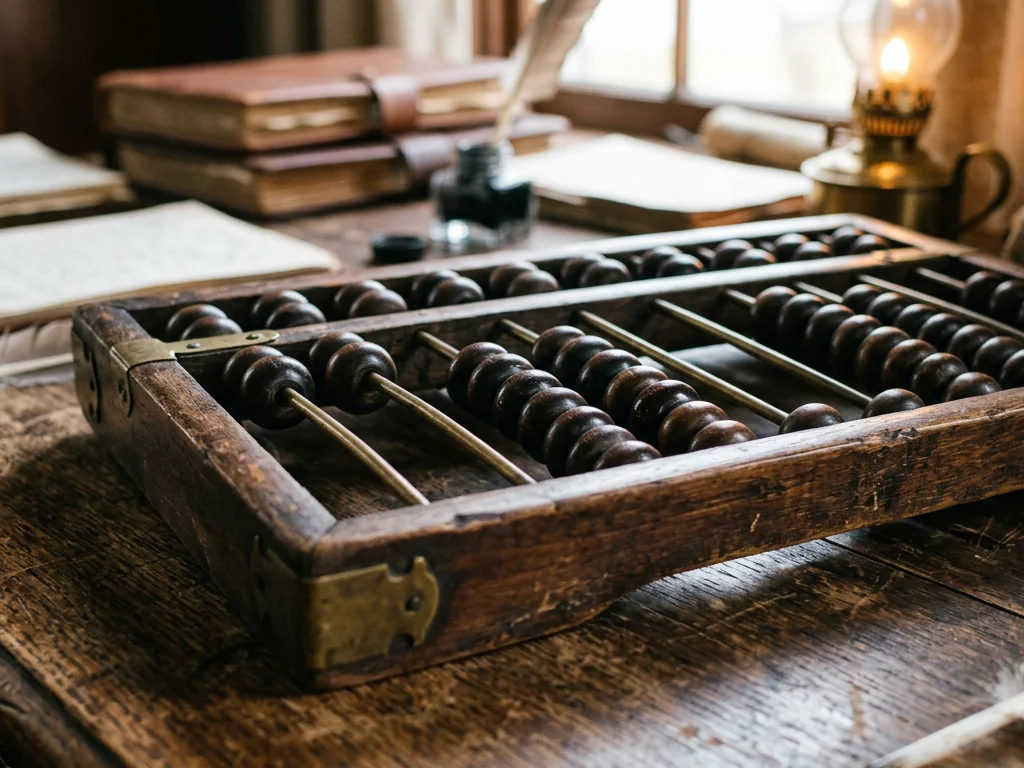
The familiar frame with beads on rods spread through China, where the suanpan was in wide use by the late medieval period, and later Japan, which refined it into the soroban. In the soroban, each rod has one upper bead worth five and four lower beads worth one, so any digit from zero to nine can be shown on a single rod.
Fast hands
Addition and subtraction become sequences of bead movements, with carries passed to the next rod. Skilled users can work astonishingly quickly; in 1946 a Japanese soroban operator beat a US Army clerk using an electric calculator in a public contest of arithmetic speed.
Still useful
Electronic calculators replaced the abacus in shops and offices, but many schools in East Asia still teach it. Practised users learn to visualise the frame and calculate mentally, a technique called anzan. Teachers also use simple bead frames to help young children understand place value and carrying.
Sources & further reading
Historical dates for early counting devices are approximate. Photograph: original AI-generated illustration (Adobe Firefly). Reference organisations do not endorse this website.