Many calendars at once
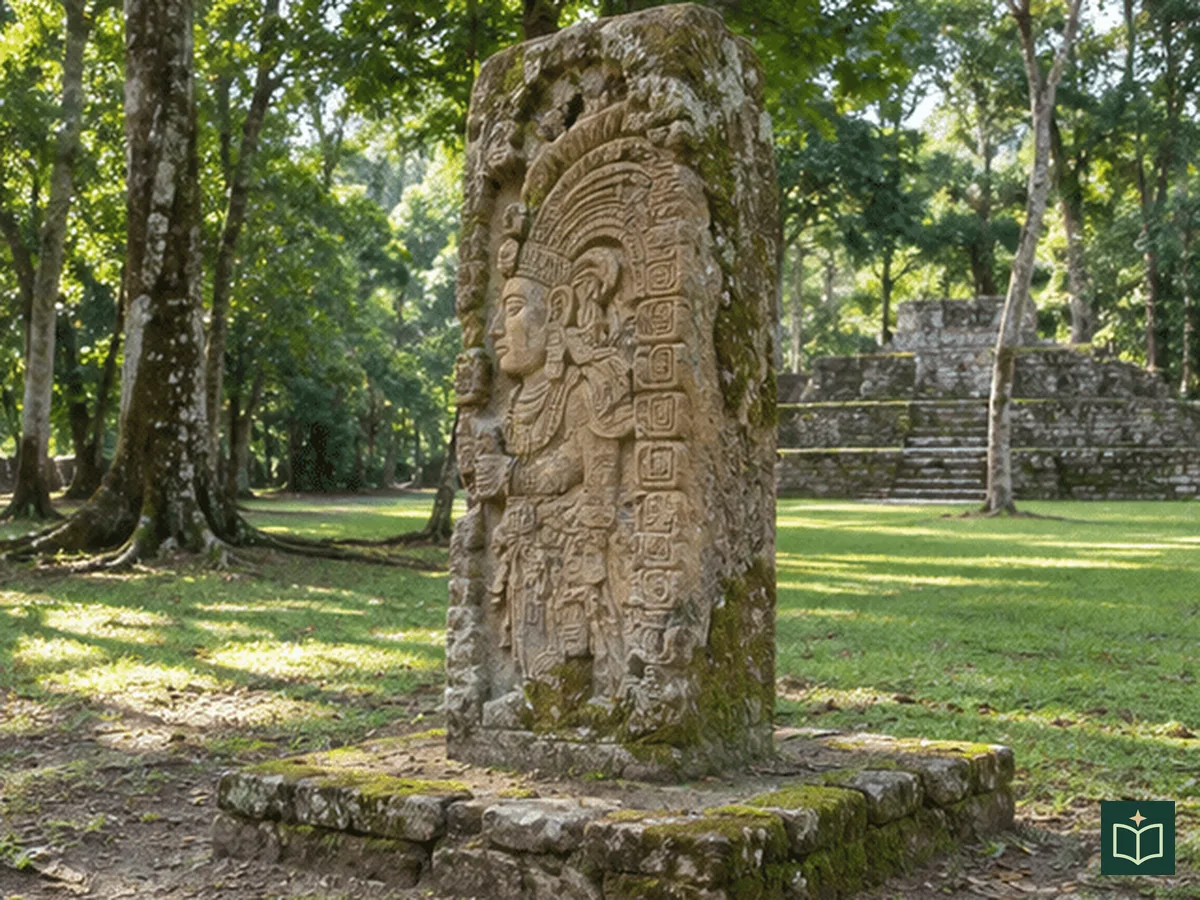
The ancient Maya of southern Mexico and Central America did not rely on a single calendar. They tracked time with several interlocking cycles, each with its own purpose. Two of the most important were shared across Mesoamerica: a 260-day ritual calendar and a 365-day year. A third, the Long Count, was used especially by the Maya during their Classic period, roughly AD 250 to 900, to date monuments precisely. Scribes recorded these dates in hieroglyphic texts carved on stone stelae, painted on pottery and written in bark-paper books called codices. Together the cycles let the Maya fix any day within a span of thousands of years.
The 260-day count
The 260-day calendar, known today as the Tzolk’in, combines two cycles running side by side: the numbers 1 to 13 and a sequence of 20 named days, such as Imix, Ik’ and Ajaw. Each day takes the next number and the next name, like two gears turning together. Because 13 and 20 share no common factor apart from one, every combination appears once before the pattern repeats after 260 days. Nobody knows for certain why this length was chosen; suggestions include the approximate length of human pregnancy and agricultural cycles. The count was used for naming people, scheduling ceremonies and divination, and some Maya communities in Guatemala still keep it today.
The 365-day year and the 52-year round
The second calendar, the Haab’, approximated the solar year. It had 18 months of 20 days each, making 360, plus a short period of 5 days called Wayeb’, considered an unlucky time. Each day therefore had two labels: one from the 260-day count and one from the 365-day year. A given combination, such as 4 Ajaw 8 Kumk’u, recurs only when both cycles return to the same starting point. Mathematically, that happens after 18,980 days, the lowest common multiple of 260 and 365, which is exactly 52 years of 365 days. This Calendar Round was important across Mesoamerica; the Aztecs marked its completion with a New Fire ceremony.
The Long Count
A 52-year cycle cannot tell one century from another, so the Maya also used the Long Count, a running tally of days. It works in units, mostly based on twenty: 1 day is a k’in; 20 days make a winal; 18 winals, 360 days, make a tun; 20 tuns, 7,200 days, make a k’atun; and 20 k’atuns, 144,000 days, make a b’ak’tun. A date such as 9.12.11.5.18 means 9 b’ak’tuns, 12 k’atuns, 11 tuns, 5 winals and 18 k’ins since the starting point. Most scholars correlate that starting date, written 13.0.0.0.0, with 11 August 3114 BC in our calendar, a mythical date of creation.
What happened in 2012
Thirteen b’ak’tuns, 1,872,000 days or about 5,125 years, after 3114 BC, the Long Count reached 13.0.0.0.0 again on 21 December 2012. For the Maya, the completion of 13 b’ak’tuns was significant because the previous world was thought to have ended after a similar cycle. But Maya inscriptions do not predict an end. Only a few ancient texts mention the 2012 date. The clearest, on Monument 6 from Tortuguero in Mexico, refers to a god descending, an event of ceremony rather than destruction. Other inscriptions, at Palenque for example, refer to dates thousands of years in the future, showing that the Maya expected time to continue.
How the myth spread
The idea of a 2012 apocalypse grew mainly in the late twentieth century, fed by popular books, websites and films that mixed Maya dates with unrelated ideas such as planetary alignments and a mystery planet. Scientists at NASA and elsewhere repeatedly explained that no astronomical threat existed. Maya scholars and many Maya people pointed out that the date was a turning point, more like a millennium than a doomsday. On 22 December 2012 the count simply moved on to 13.0.0.0.1. The episode is a lesson in how ancient calendars can be misread, and in how much sophisticated mathematics and astronomy the Maya built into their tracking of time.
Sources & further reading
Figures are rounded and widely published; check the linked organisations for the latest editions. These organisations do not endorse this website.