Drawings across a desert
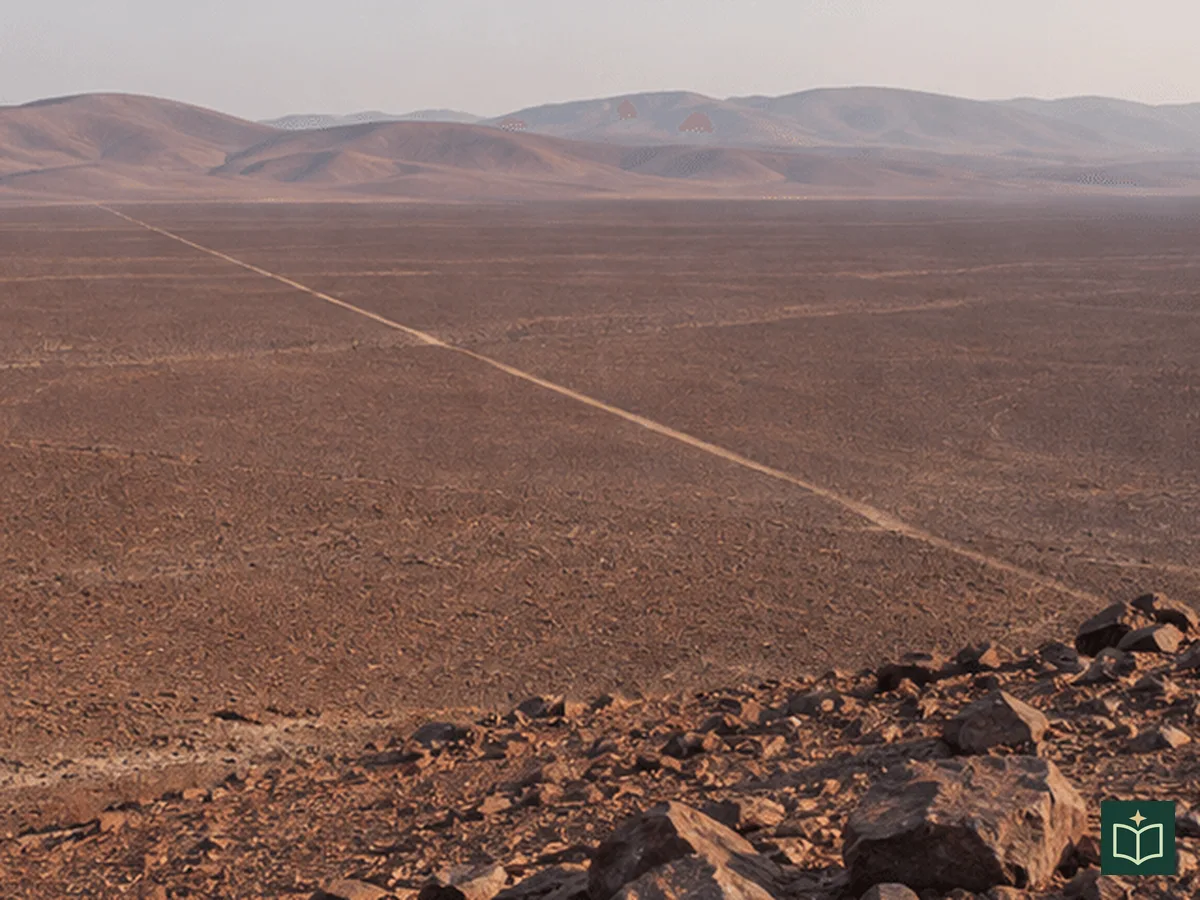
On the arid plains between the towns of Nazca and Palpa in southern Peru, the ground is marked with hundreds of straight lines, geometric shapes and animal figures. Some lines run for kilometres across the landscape, while the best-known figures include a hummingbird about 90 metres long, a monkey with a spiralling tail, a spider and a condor. Most were made by the Nazca culture, which flourished roughly between 100 BC and AD 700, though some older figures belong to the earlier Paracas culture. UNESCO lists the lines and geoglyphs of Nasca and Palpa as a World Heritage Site covering about 450 square kilometres.
How they were made
The technique was simple. The desert surface is covered with stones darkened by iron and manganese oxides over long exposure to the air. Beneath them lies paler, yellowish-grey soil. By raking or lifting away the top layer of dark stones and piling them along the edges, the Nazca created light-coloured lines a few tens of centimetres deep. To lay out large figures, they probably used wooden stakes and cords, perhaps scaling up from smaller drawings. Experiments have shown that a small team with simple tools can reproduce a large figure accurately in a few days. Wooden stakes found at the ends of some lines support this method.
Why they survived
Lines made by moving stones should be fragile, yet many have lasted around two thousand years. The reason is the climate. The Nazca desert is one of the driest places on Earth, with very little rain in most years. The ground also warms evenly, which tends to reduce strong winds at the surface. Without rain to wash the lines away or wind to cover them with sand, they have remained clear for centuries. That same fragility makes them vulnerable today. Vehicles driven off roads, mining, informal settlements and occasional heavy rains linked to El Niño events have damaged parts of the site, and protection remains a constant challenge.
Seen from the ground
A common claim is that the figures can be seen only from the air, which has led to fanciful theories, including visits by ancient astronauts. In fact, many lines and some figures can be seen from the surrounding foothills, and the people who made them did not need to view them from above to create them. Researchers have found broken pottery and other offerings along many lines, as well as signs that the lines were walked repeatedly. Several large figures are drawn as a single continuous line that never crosses itself, which may have been designed as a path for people to follow in procession.
Calendars, water and ritual
In the 1940s the American historian Paul Kosok and the German-born mathematician Maria Reiche studied the lines closely. Reiche, who spent decades protecting and mapping them, argued that many lines pointed to sunrises, sunsets and stars, forming an astronomical calendar. Later statistical studies found that most lines do not align with celestial events more often than chance would suggest. Many researchers now link the lines to water, the most precious resource in this desert. Some lines appear to point towards sources of water or follow underground flows, and the figures may have played a part in rituals asking for rain and fertility. Several explanations may each be partly right.
New figures still appearing
The lines are still being studied, and new figures keep turning up. Drones and high-resolution aerial imagery have revealed many smaller geoglyphs, often near footpaths, that are hard to see from the ground. In 2024 a Japanese-led team using artificial intelligence to scan aerial images reported hundreds of previously unknown figures, many depicting people and domestic animals. These smaller figures may have been meant to be viewed by people walking past, rather than being part of large ceremonies. Each discovery adds detail to the picture of a society that turned an entire desert into a place for ritual, movement and meaning.
Sources & further reading
Figures are rounded and widely published; check the linked organisations for the latest editions. These organisations do not endorse this website.