From reform to routine
Athens, a city-state in ancient Greece, developed the world’s best-documented early democracy. Its foundations are usually dated to the reforms of Cleisthenes in 508–507 BC, which reorganised citizens into ten new tribes, mixing people from the coast, the city and the countryside to weaken old aristocratic loyalties. Over the next century further changes shifted power from aristocratic councils to ordinary citizens. The system lasted, with interruptions, until 322 BC, when Macedonian rulers imposed restrictions. The word democracy comes from the Greek dēmos, the people, and kratos, power. In Athens, however, “the people” meant a particular group: adult male citizens, perhaps 30,000 or so in the fourth century BC.
The assembly on the hill
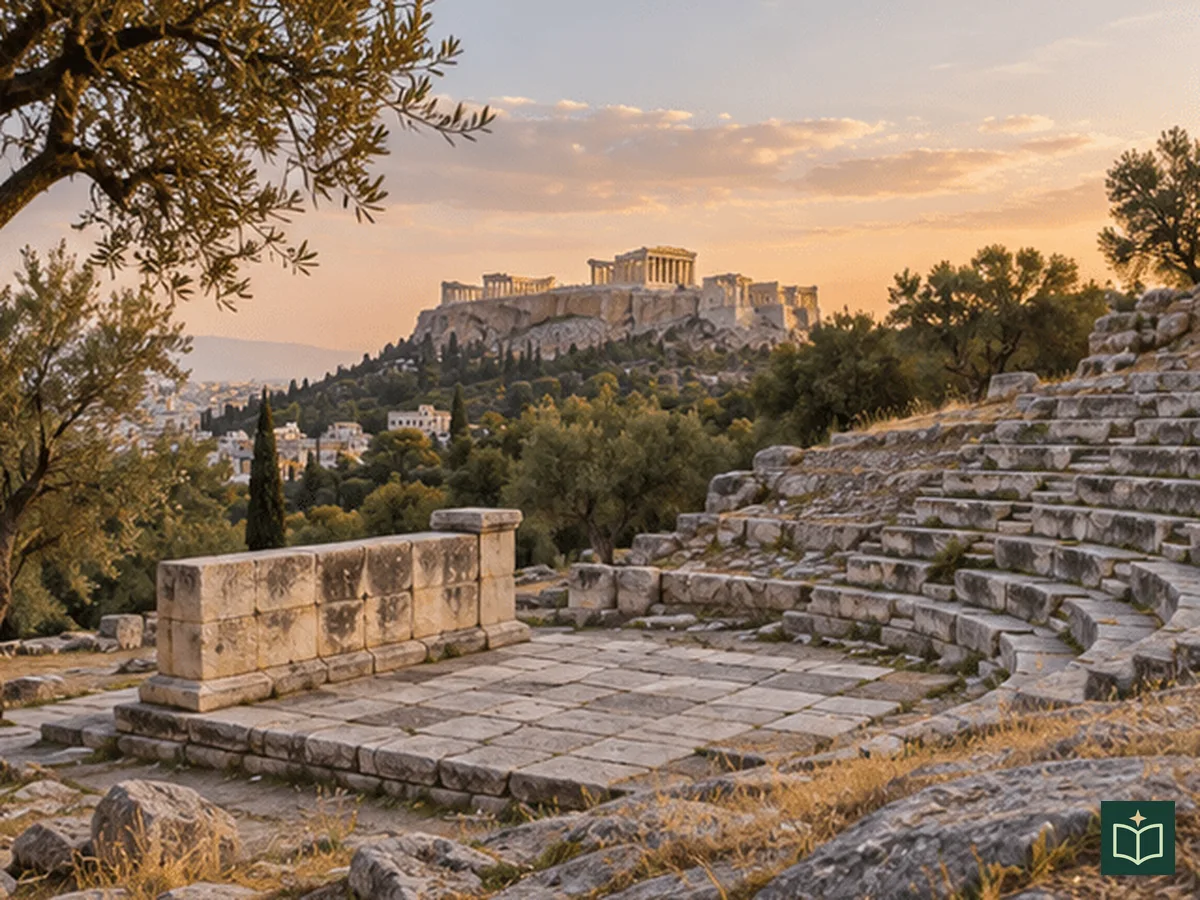
The heart of the system was the Ekklesia, the assembly. Any citizen over the age of 18 could attend, speak and vote. In the fourth century it met about 40 times a year on the Pnyx, a hillside near the Acropolis that could hold several thousand people. Votes were usually taken by show of hands. The assembly decided on war and peace, alliances, laws, taxes and public building, and it could hold officials to account. For some decisions, a quorum of 6,000 citizens was needed. To encourage poorer citizens to attend, Athens began paying them for attendance in the early fourth century BC, compensating for a day’s lost work.
A council chosen by lot
The assembly needed an agenda, and that was set by the Boule, a council of 500. Each of the ten tribes supplied 50 members, chosen by lot from citizens over 30 who put themselves forward. They served for one year and could serve only twice in a lifetime, so many citizens took a turn. Each tribe’s 50 councillors took charge as a standing committee for a tenth of the year, and their chairman, also picked by lot, held office for just one day. In that day he kept the city’s seal and the keys to its treasuries. A stone allotment machine, the kleroterion, used coloured balls to make selections fair.
Lotteries, juries and elected generals
Of roughly 700 public offices, about 600 were filled by lot, usually for one year. Athenians saw lotteries as truly democratic, because they gave every citizen an equal chance and prevented the rich and well-connected from dominating. Elections, by contrast, were thought to favour the famous. Courts worked the same way. Each year 6,000 citizens were enrolled as potential jurors, and juries of 201, 501 or more were drawn on the day to hear cases, making bribery difficult. There were no professional judges or lawyers. Some posts needed expertise, however. The ten generals, the strategoi, were elected, and could be re-elected; Pericles held the office many times.
Ostracism: exile by vote
Athens also had an unusual safeguard against anyone becoming too powerful. Once a year, the assembly voted on whether to hold an ostracism. If it agreed, citizens later scratched a name on a piece of broken pottery, an ostrakon. If at least 6,000 votes were cast, the man with the most was exiled for ten years. He kept his property and citizenship and could return afterwards, so it was not a criminal punishment. Thousands of these inscribed potsherds have been excavated, some bearing names of famous politicians such as Themistocles. Ostracism fell out of use after about 416 BC, when other legal procedures took over its role.
Who was left out
Athenian democracy was direct and participatory, but narrow. Women, however well-born, could not vote or hold office. Enslaved people, who may have numbered tens of thousands, had no political rights at all. Metics, free foreigners who lived and worked in Athens, paid taxes and served in the army yet could not vote; after 451 BC citizenship required both parents to be Athenian. Ancient critics, including Plato, argued that rule by the many was unstable and easily swayed by speakers. Even so, Athens showed that thousands of ordinary people could govern a state directly, and its use of lotteries still inspires citizens’ assemblies in some countries today.
Sources & further reading
Figures are rounded and widely published; check the linked organisations for the latest editions. These organisations do not endorse this website.