A stone that attracts iron
Lodestone is a naturally magnetised form of the iron mineral magnetite. Ancient Greek and Chinese writers both knew that it attracts iron. In China it was also noticed that a piece of lodestone, if allowed to turn freely, would settle along a north–south line. A text by Wang Chong from the first century AD mentions a 'south-pointer' that comes to rest pointing south. Many historians interpret it as a spoon carved from lodestone, spinning on a polished bronze plate, though the exact form is debated. Chinese tradition named it for the south, the direction of honour, though any compass needle points both ways.
Compasses for the earth before the sea
Early Chinese compasses were tools of geomancy, the practice now often called feng shui, which sought to place houses, cities and graves in harmony with the forces of the landscape. Diviners' boards marked with directions and cosmic symbols were used alongside them. This setting matters, because it explains why the device was refined for centuries on land before anyone took it to sea. Geomancers needed accurate directions, and their demand encouraged experiments with smaller and more sensitive pointers. Ornate geomantic compasses with many rings of characters remained in use in China into modern times, alongside the simpler instruments used by navigators.
From stone to needle
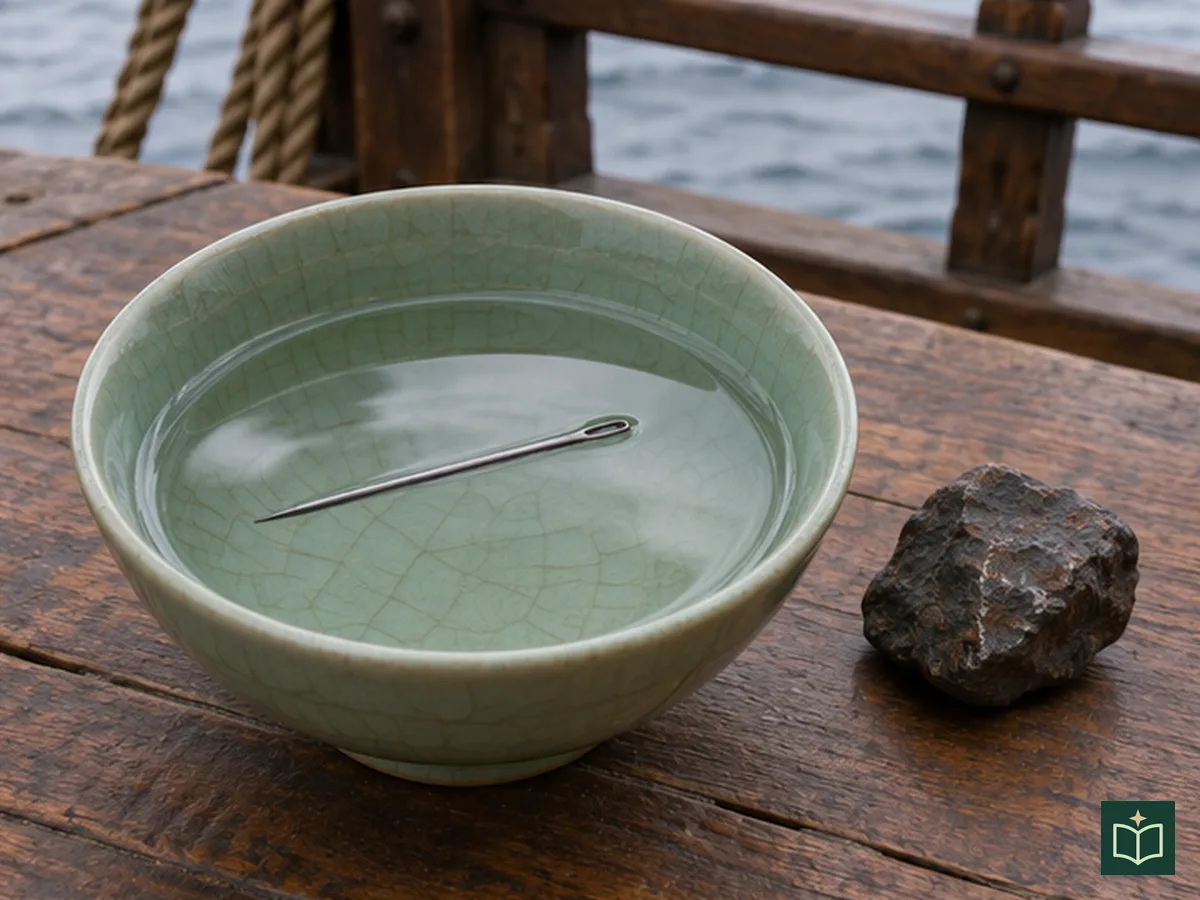
The big step was transferring magnetism from lodestone to iron. The military manual Wujing Zongyao, completed in 1044, describes a thin iron leaf shaped like a fish, heated and cooled in a north–south position so that it became magnetised, then floated on water. In 1088 the scholar Shen Kuo, in his Dream Pool Essays, described rubbing a needle on lodestone and hanging it from a single silk thread, or floating it, or balancing it on a fingernail or a bowl's rim. He also observed that the needle did not point exactly south but slightly east of it, the earliest known record of what is now called magnetic declination.
Taking it to sea
The first clear record of a compass used for navigation comes from Zhu Yu, writing in 1119 about the port of Guangzhou some years earlier. He noted that pilots knew their position by the stars at night and the Sun by day, and in cloudy weather looked at the south-pointing needle. Within about a century the compass appears in other parts of the world. The English scholar Alexander Neckam described a needle used by sailors around 1190. A Persian collection of stories by Muhammad al-Awfi, from about 1232, mentions a fish-shaped iron leaf rubbed with magnet, and in 1282 Baylak al-Qibjaqi described a floating needle used on a voyage from Syria to Alexandria.
Did it travel or reappear?
Whether the compass spread from China or was developed separately elsewhere is still debated. The Chinese evidence is older, and the Indian Ocean and Silk Road routes provided many chances for the idea to travel, but early European and Middle Eastern sources do not name China as the source. Whatever its path, the device was soon improved. Mediterranean sailors around 1300 mounted a needle on a pivot over a card marked with the winds, inside a box, creating the dry compass. Muslim scholars also wrote about using compasses to find the qibla, the direction of Mecca for prayer, which made it useful far from the sea.
Why it changed navigation
Before the compass, sailors relied on the Sun, stars, winds, swells and coastlines, and they knew them very well. The compass did not replace those skills, but it filled the gap when skies were overcast, making it safer to sail in winter and in open water. Combined with charts and later instruments for measuring latitude, it helped make the long ocean voyages of the fifteenth and sixteenth centuries possible. Navigators also learned that declination varies from place to place and changes over time, so charts of it had to be updated. Even in an age of satellite navigation, ships and aircraft still carry magnetic compasses as a backup.
Sources & further reading
Figures are rounded and widely published; check the linked organisations for the latest editions. These organisations do not endorse this website.