A librarian with a question
Eratosthenes was born around 276 BC in Cyrene, in today's Libya, and became chief librarian at the great Library of Alexandria in Ptolemaic Egypt. He worked in many fields, including geography, a word he helped popularise, mathematics, astronomy and poetry, and devised a well-known method for finding prime numbers. By his time educated Greeks already accepted that the Earth was a sphere. Aristotle had pointed to the curved shadow of the Earth on the Moon during eclipses, and to the way new stars come into view as travellers move south. The open question was not the planet's shape but its size.
The well at Syene
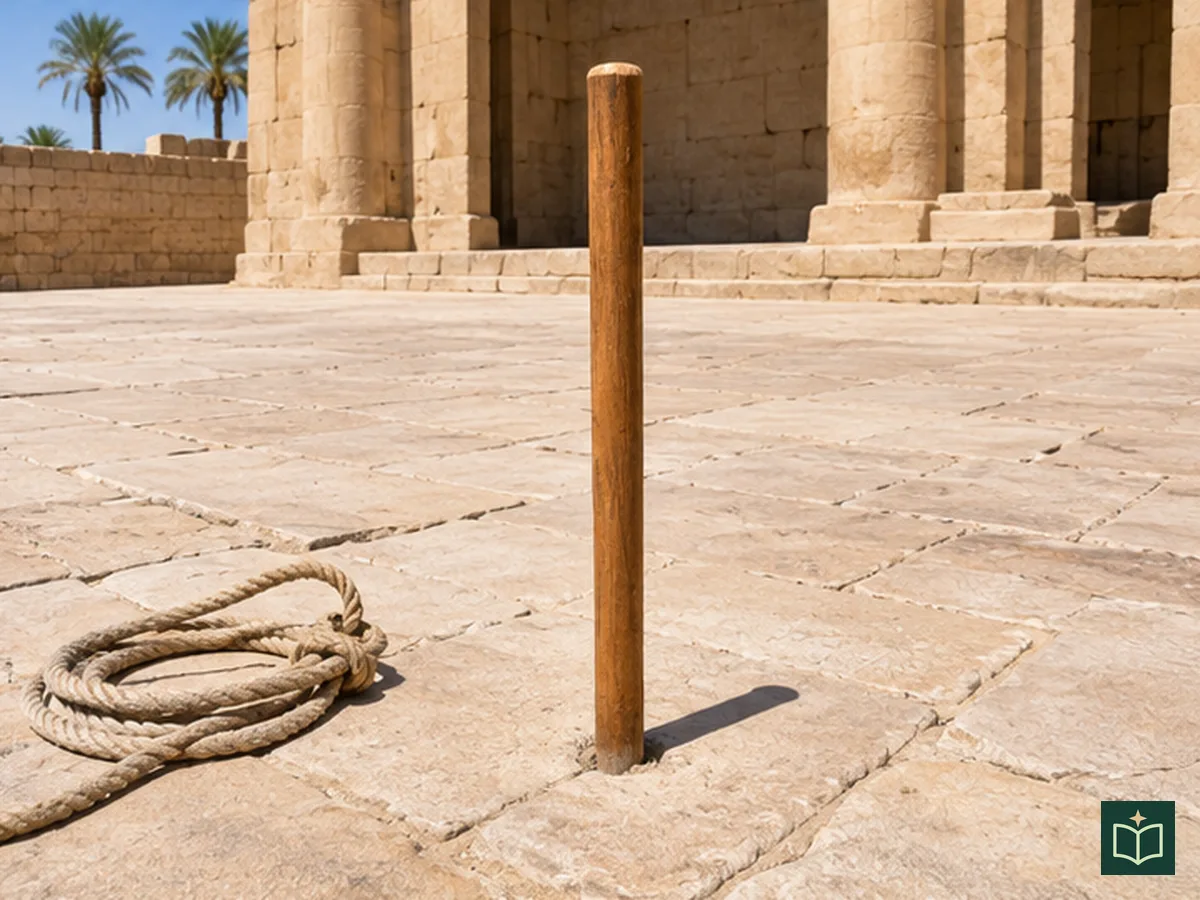
Eratosthenes heard that at Syene, today's Aswan, in southern Egypt, the Sun at noon on the summer solstice shone straight down to the bottom of a deep well, so that upright objects cast no shadow. That meant the Sun was directly overhead. Syene lies close to the Tropic of Cancer, the most northerly line where the Sun can be overhead. On the same day in Alexandria, far to the north, a vertical pointer did cast a short noon shadow. The difference was a clue. Because the Sun is so distant, its rays reach both cities effectively parallel, so any difference in angle must come from the curve of the Earth.
The geometry in one step
At Alexandria Eratosthenes measured the shadow angle as about one-fiftieth of a full circle, or 7.2 degrees. Basic geometry says that this is also the angle between the two cities measured from the centre of the Earth. In other words, the arc from Alexandria to Syene is one-fiftieth of the Earth's circumference. He took the distance between the cities to be about 5,000 stadia, a figure that may have come from royal surveyors who paced or measured routes in Egypt. Multiplying 5,000 by 50 gives 250,000 stadia for the whole circumference. Later sources report his figure as 252,000, perhaps rounded for convenience.
How close did he get?
The answer depends on the length of the stadion, a unit that varied between cities and periods. If he used a stadion of about 157.5 metres, as some scholars argue, then 250,000 stadia comes to 39,375 kilometres. The Earth's circumference measured through the poles is about 40,008 kilometres, so that would be within about 2 per cent. If he used the common Attic stadion of about 185 metres, the result is 46,250 kilometres, roughly 16 per cent too large. Either way the estimate was of the right size, a remarkable achievement given that it depended on a single angle and a distance estimated over hundreds of kilometres.
Errors that cancelled out
The method rested on simplifying assumptions. Syene is not exactly on the Tropic of Cancer, it is not due south of Alexandria but a few degrees to the east, and the distance between the two cities was only roughly known. Some of these errors partly cancelled each other out, which may explain why some modern calculations of his result look so impressively close. None of his own writings on the measurement survive; we know of it mainly through a summary by the later Greek astronomer Cleomedes. That is a common situation for ancient science, where many original books were lost and are known only from later references.
A lesson that lasts
The experiment is still repeated in classrooms around the world, sometimes by schools in different countries comparing noon shadows on the same day. It shows how much can be learned from careful observation and a clear model, without advanced equipment. It also corrects a popular myth: the idea that medieval Europeans believed in a flat Earth until Columbus proved otherwise. Scholars in the Greek, Islamic and medieval Christian worlds knew the Earth was round, and argued instead about its size. Columbus's mistake was to assume the planet was much smaller than Eratosthenes had suggested, an error that made Asia seem within easy reach.
Sources & further reading
Figures are rounded and widely published; check the linked organisations for the latest editions. These organisations do not endorse this website.