A king and a holy city
Lalibela lies in the highlands of northern Ethiopia, at about 2,500 metres above sea level. The town is named after King Lalibela of the Zagwe dynasty, who ruled in the late twelfth and early thirteenth centuries and is traditionally credited with creating its churches. Ethiopia had been Christian since the fourth century, when the kingdom of Aksum adopted the faith. Tradition holds that Lalibela intended the site as a new Jerusalem, at a time when pilgrimage to the Holy Land had become difficult. Local names reflect that idea: a stream channel running through the complex is called the Yordanos, after the river Jordan.
Eleven churches in three groups
The eleven churches are arranged in two main clusters, north and south of the Yordanos, linked by trenches, passageways and tunnels, with a single church, St George, standing apart from both. Some are fully monolithic, meaning they were carved as a single block, separated from the surrounding rock on all sides and attached only at the base. Others are semi-monolithic, still joined to the rock face on one or more sides, or are caves cut into cliffs. Bete Medhane Alem, the House of the Saviour of the World, is often described as the largest monolithic church in the world, with rows of carved pillars around its outside.
Carving from the top down
The builders worked in a soft red volcanic rock, a kind of tuff that is relatively easy to cut when freshly exposed but hardens with time. They began by marking out a rectangle or other shape on the surface, then dug deep trenches around it, leaving a block standing in the middle. Working downward, they shaped the roof, walls and windows, then cut doorways and hollowed the interior, carving columns, arches and vaults in place. Rubble was carried out through openings. Every measurement had to be right first time: a misplaced cut could not be repaired by adding new stone, only disguised.
The church of St George
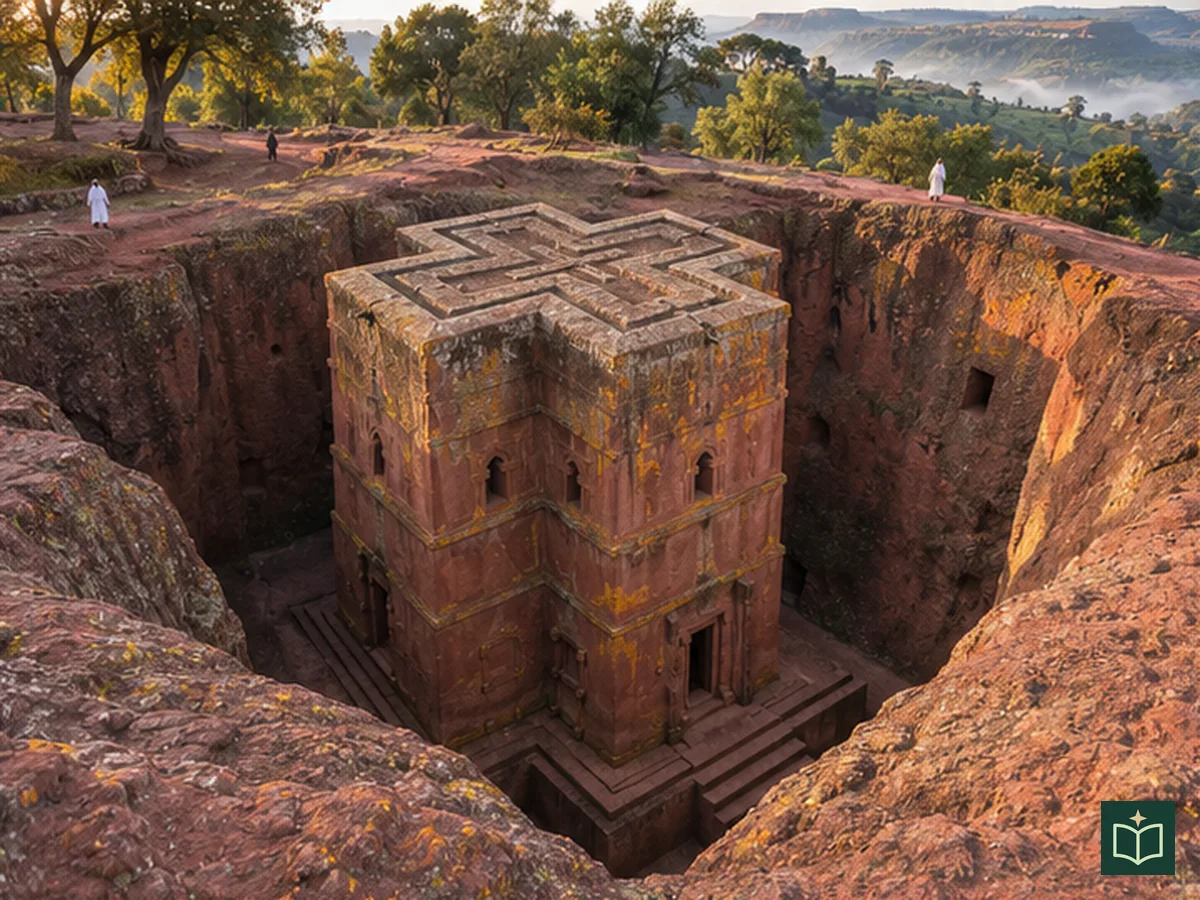
Bete Giyorgis, the Church of St George, stands alone and is the most photographed. Seen from above, it is a perfect cross, its flat roof carved with three nested crosses, sitting at the bottom of a square pit about 12 metres deep. Visitors reach it through a narrow trench and tunnel cut into the rock. Its walls taper slightly and are decorated with carved windows in the style of Aksumite architecture. The church stands on a stepped base that lifts it above the floor of the pit, helping rainwater drain away. Its simple, precise form makes the scale of the carving especially clear.
How long did it take?
Tradition says the churches were completed in a single reign, with some accounts claiming help from angels who worked at night. Many archaeologists think the reality is more complicated. Studies of the site suggest that some of the structures may have begun as other kinds of buildings or as defensive works, perhaps centuries earlier, and were later converted or enlarged into churches. Work probably continued over several generations. That does not diminish the achievement. It suggests a long, organised effort by skilled masons, labourers and planners, supported by royal power and church institutions, rather than a single burst of construction.
A living place of worship
Lalibela is not a ruin or a museum. Its churches are still used by the Ethiopian Orthodox Tewahedo Church, with priests, deacons and daily services, and the town draws large numbers of pilgrims, especially at Genna, Ethiopian Christmas, in early January. That continuing use is part of its value, but it also brings pressure. Rainwater, cracks and weathering threaten the soft rock, and in 2008 large protective shelters were erected over several churches, a measure meant to be temporary that some experts worry could create problems of its own. Conflict in northern Ethiopia in recent years has added concern for the site and the community around it.
Sources & further reading
Figures are rounded and widely published; check the linked organisations for the latest editions. These organisations do not endorse this website.