What the Hanse was
The word hanse meant a group or company, originally of merchants travelling together for protection. In the twelfth century, German traders began to push into the Baltic, helped by the founding of Lübeck as a port. Over the following century, merchant associations in different towns increasingly cooperated. By the mid-fourteenth century this had become a league of towns, generally dated from the first general diet, or Hansetag, held in Lübeck in 1356. At its height, close to two hundred towns had some connection to it, from the Netherlands to the Baltic states. It had no constitution, permanent army or single ruler.
What moved along its routes
The Hanse thrived by linking regions with very different goods. From Russia and the eastern Baltic came furs, wax, timber, flax and grain. Norway supplied dried cod, known as stockfish. Herring from the Øresund region was preserved with salt from Lüneburg. Flanders and England provided woollen cloth, while the Rhineland sent wine. Beer brewed in north German towns was exported widely. Cargo moved in the cog, a sturdy, deep-hulled sailing ship able to carry bulk goods, later joined by larger vessels called hulks. Lübeck and Hamburg, linked by a short overland route, became the hinge between Baltic and North Sea.
Offices abroad
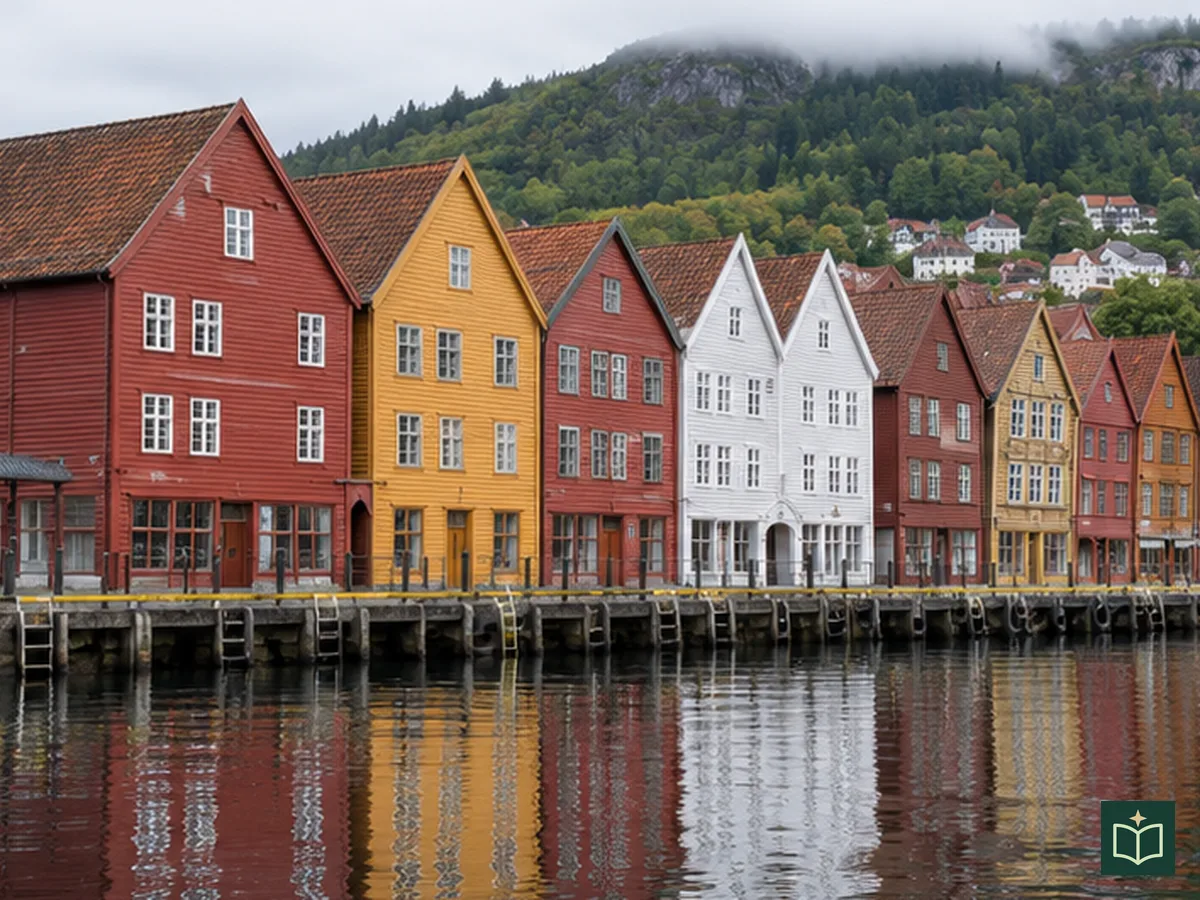
The league's strength lay partly in its kontore, permanent trading posts in foreign cities. The four most important were the Steelyard in London, the office in Bruges, the German Wharf, or Bryggen, in Bergen, and the Peterhof in Novgorod. These were walled or enclosed compounds where Hanseatic merchants lived under their own rules, with warehouses, offices and churches. Rulers granted them privileges such as reduced customs duties and legal autonomy, in exchange for the trade and revenue they brought. The wooden buildings of Bryggen, rebuilt many times after fires, still line Bergen's harbour and are now a UNESCO World Heritage Site.
Power without a state
The Hanse could act collectively when its interests were threatened. Its main tools were economic: towns could impose a blockade, cutting off trade with a ruler or city that broke agreements. When necessary they also fought. In the 1360s a coalition of towns went to war with King Valdemar IV of Denmark, who controlled the straits into the Baltic. The Peace of Stralsund in 1370 gave the towns extensive rights and temporary control of fortresses along the Danish coast. This marked the high point of Hanseatic power, when a network of merchants could dictate terms to a kingdom and expect them to be honoured.
Slow decline
From the fifteenth century the league weakened. Strong territorial states emerged in England, Sweden, Denmark, Russia and the Netherlands, and they favoured their own merchants. Dutch traders, with efficient ships and finance, outcompeted the Hanse in the Baltic. In 1494 Ivan III of Moscow closed the Novgorod office, and in 1598 Elizabeth I withdrew the privileges of the Steelyard in London. New Atlantic trade routes shifted Europe's commercial centre westward. Member towns had diverging interests and no central authority to bind them together or enforce common decisions. The last general diet met in 1669, with only a handful of towns represented.
What remains
The Hanse left its mark on northern Europe. Cities across the region share a recognisable style of brick Gothic churches, town halls and merchant houses, and Lübeck's old town is a World Heritage Site. Hamburg and Bremen still call themselves Free Hanseatic Cities, and Hamburg's car registration plates begin with HH, for Hansestadt Hamburg. A modern association of former Hanseatic towns holds annual festivals. Historians often point to the league as an early example of economic integration: a network of independent cities that cooperated on rules, trade and protection, rather like a loose, merchant-led precursor of later trading blocs such as the European single market.
Sources & further reading
Figures are rounded and widely published; check the linked organisations for the latest editions. These organisations do not endorse this website.