A refuge in the lagoon
The Venetian lagoon is a shallow body of water about 50 km long, sheltered from the Adriatic by long sandbars. Small communities of fishermen and salt-makers lived on its islands in Roman times. From the fifth and sixth centuries, as invasions swept northern Italy, people from mainland towns sought refuge among the marshes, where armies on horseback could not easily follow. The Lombard invasion of 568 accelerated this movement. Gradually, settlements on scattered islands around the Rialto grew together into a city. Building there, however, posed a basic problem: the ground was soft mud and sand, unable to bear the weight of stone buildings.
How the foundations work
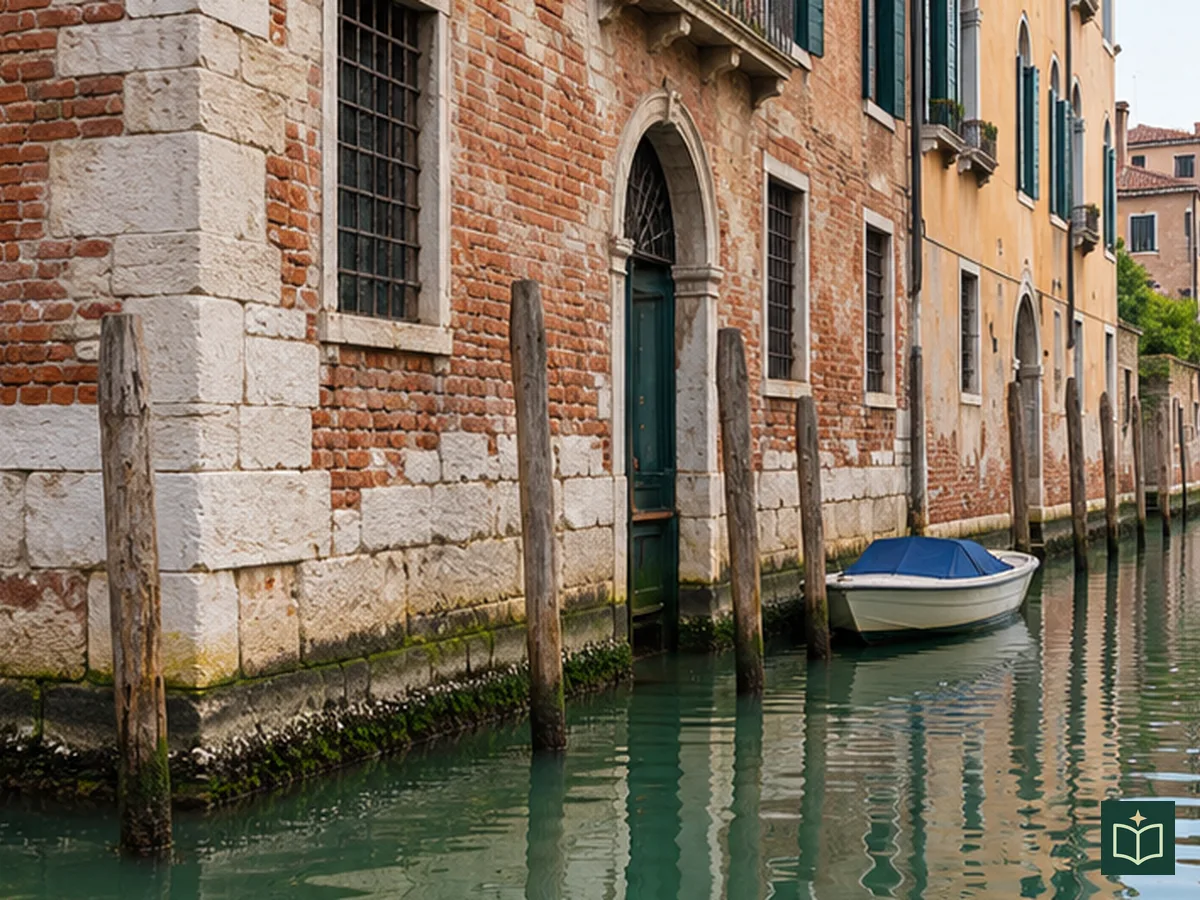
Venetian builders solved this by driving wooden piles, often of alder, larch or oak, deep into the mud. Workers hammered them in by hand with heavy weights, placing them close together, sometimes many per square metre. The piles reached down towards a layer of dense, compacted clay known locally as caranto, and their sheer number also compressed the surrounding soil, making it firmer. On top, builders laid horizontal planks or rafts of larch and oak, and above those courses of stone. Bricks and stone walls rose on this platform. The result spread the building's weight over a wide, stable base.
Why the wood has lasted
Wood exposed to air and water rots, but these piles are buried in waterlogged mud, where there is almost no oxygen. The fungi and insects that usually destroy timber need oxygen to survive, so they cannot attack. Some slow bacterial decay does occur, and studies of old piles show their outer layers softening over centuries, but the surrounding mud and water pressure help them keep doing their job. To protect walls where they meet the water, Venetians used Istrian stone, a dense limestone from across the Adriatic that resists water and salt. Damp still rises into the brick above, a constant problem for the city's conservators.
Forests for foundations
The quantity of timber was enormous. The Rialto Bridge, completed in 1591, is supported by thousands of piles on each bank. The church of Santa Maria della Salute, begun in 1631, is often said to stand on more than a million. Supplying such volumes required forests far beyond the lagoon. Venice drew larch and fir from the Cadore region in the Dolomites, floated down rivers, and oak from Istria and other territories it controlled. Over time the Republic carefully managed forests as strategic resources, since they also supplied timber for its shipyards. Venice's foundations are, in effect, a vast underground forest turned upside down.
Water as defence and highway
The lagoon shaped Venice's history. Shallow, shifting channels known only to local pilots protected the city: in 810 a Frankish army under Pepin, son of Charlemagne, failed to conquer it. Canals served as streets, and boats moved goods directly to warehouses and palaces. Venetian merchants built a maritime empire across the Adriatic and eastern Mediterranean, trading spices, silk and other luxuries between Europe and the Levant. The Arsenale, the state shipyard, could assemble galleys with remarkable speed. The Republic lasted until 1797, when it surrendered to Napoleon, ending more than a thousand years of independence in the lagoon and on the sea.
Living with rising water
Today Venice faces challenges that its builders could not have foreseen. The city has sunk over the past century, partly due to groundwater extraction, since halted, while sea levels have risen. Flooding known as acqua alta has become more frequent. In 1966 a severe flood caused major damage, and in 2019 water rose to one of its highest recorded levels. A system of mobile flood barriers called MOSE, installed at the lagoon's inlets, has been operating since 2020 to hold back high tides. The city's piles still hold, but its future depends on managing the lagoon as carefully as its founders once did.
Sources & further reading
Figures are rounded and widely published; check the linked organisations for the latest editions. These organisations do not endorse this website.