Many walls, many builders
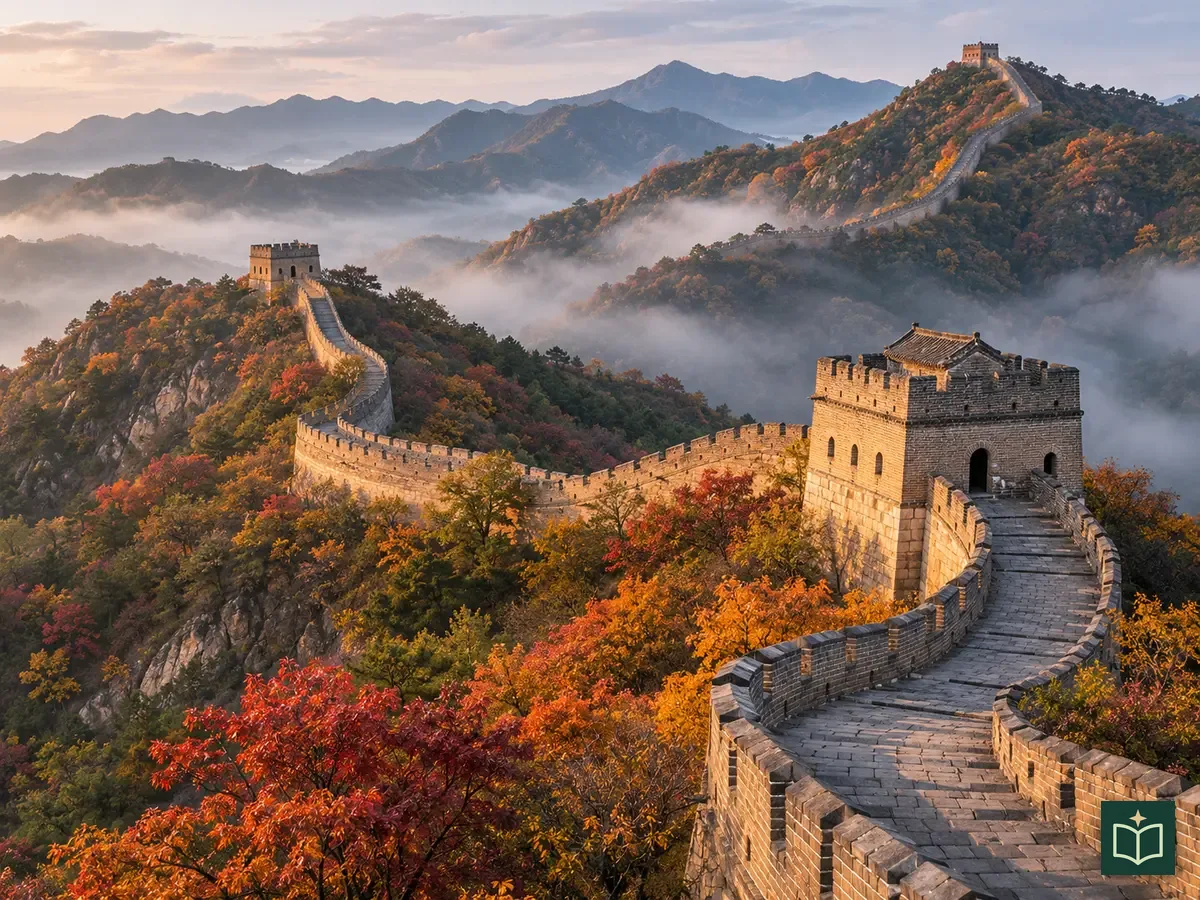
The Great Wall is not a single structure built at one time. From around the seventh century BCE, rival Chinese states built walls to protect their borders from each other and from peoples to the north. After Qin Shi Huang unified China in 221 BCE, his government connected and extended several northern walls. Later dynasties, notably the Han, built further walls far to the west, protecting routes into Central Asia. Other periods saw little wall-building at all. The sections visited by most tourists today, near Beijing at Badaling and Mutianyu, were built or rebuilt during the Ming dynasty, which ruled from 1368 to 1644.
How it was built
Construction methods depended on time and place. Early walls were often made of rammed earth, in which layers of soil were packed tightly between wooden frames. In deserts, builders used layers of gravel and reeds or tamarisk branches. The Ming used fired bricks and cut stone, with lime mortar, particularly near the capital where defence mattered most. Labour came from soldiers, conscripted peasants and convicts, and working conditions were harsh, with many deaths. Watchtowers, beacon towers, gates and forts were built along the line, and the wall often followed mountain ridges, using steep terrain to add to its defensive strength.
What it was for
The wall was designed to manage a frontier rather than seal it completely. It slowed raiding horsemen, channelled movement through fortified passes and gave garrisons time to respond. Beacon towers relayed warnings using smoke by day and fire by night. Gates also controlled trade, taxes and migration, and markets often operated at border crossings. The wall was not always effective. In 1644, the Manchus entered China through the Shanhai Pass, at the wall’s eastern end, after its commander opened the gates to them during a political crisis. Defences were only as strong as the political system that staffed and supplied them.
How long is it?
In 2012, Chinese authorities announced the results of a national survey that found the walls built by all dynasties totalled about 21,196 kilometres. This figure includes many parallel walls, branches, trenches and natural barriers such as rivers and hills, so it is not the length of a single continuous wall. The Ming walls alone were measured at about 8,850 kilometres in an earlier phase of the survey. Large stretches have eroded or vanished, especially earthen sections in the north-west, and some surviving parts are threatened by weathering, farming, building work and tourism. UNESCO inscribed the Great Wall as a World Heritage Site in 1987.
The space myth
A widely repeated claim says the Great Wall is the only human-made structure visible from space, or even from the Moon. It is not true. The wall is long but narrow, typically a few metres wide, and built of materials similar in colour to the surrounding land. From the Moon, no individual human structure can be seen with the naked eye. Even from low Earth orbit, astronauts report that the wall is extremely difficult or impossible to spot without aid, while cities, roads and airports are easier to see. China’s first astronaut, Yang Liwei, said after his 2003 flight that he could not see it.
Why it matters
The Great Wall has become a symbol of China and one of the world’s most visited monuments. Its real history is in some ways more interesting than the legend. It shows how successive states tried to manage relations with nomadic societies on the steppe, combining military defence with trade, diplomacy and migration control. It also shows the immense costs of such projects, paid in labour and lives. Conservation work today balances tourism with protection. When visiting, it is worth remembering that the polished Ming sections near Beijing are only one chapter in a story spanning more than two thousand years.
Sources & further reading
Figures are rounded and widely published; check the linked organisations for the latest editions. These organisations do not endorse this website.