From the steppe to empire
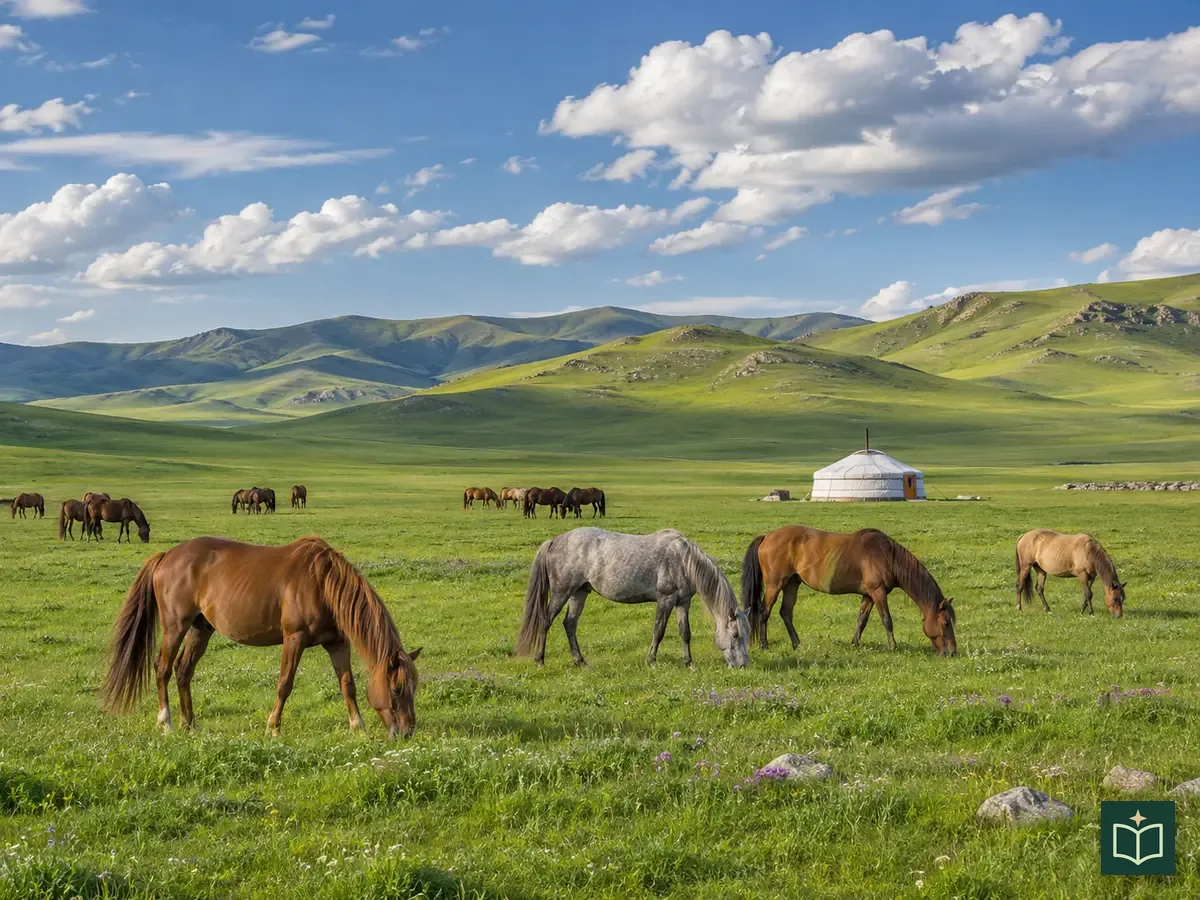
In the late twelfth century, the grasslands of Mongolia were home to rival nomadic tribes. A leader named Temüjin united them through warfare and alliances, and in 1206 an assembly proclaimed him Genghis Khan, usually translated as universal or oceanic ruler. He reorganised society into military units based on tens, hundreds and thousands, weakening old tribal loyalties. His armies then campaigned against northern China, Central Asia and Persia. By his death in 1227, the Mongols controlled a vast territory. His successors expanded further, invading Russia, Eastern Europe, the Middle East and eventually all of China, which Kublai Khan conquered by 1279.
How the armies worked
Mongol armies relied on cavalry. Each soldier typically had several horses, allowing long rides and rapid movement. Mounted archers using powerful composite bows could strike from a distance, retreat and attack again, and feigned retreats drew enemies into traps. Strict discipline, scouting and coordination between columns made the armies highly effective. The Mongols also learned quickly, recruiting engineers from China and the Islamic world to build siege engines. Conquest was often brutal. Cities that resisted could be destroyed, and the sack of Baghdad in 1258, which ended the Abbasid caliphate there, caused enormous loss of life and of cultural heritage.
The yam relay system
Holding such an empire together required communication. The Mongols built a relay system known as the yam. Stations were set up at intervals along major routes, often a day’s ride or less apart, supplied with horses, food and lodging. Official messengers carried a paiza, a tablet of metal or wood that served as a passport and authorised them to use the stations. By changing horses at each stop, riders could carry urgent messages hundreds of kilometres in a day. The system also served envoys, officials and sometimes merchants, and local populations were required to support the stations with supplies. It was an information highway.
Trade under Mongol rule
Although conquest was destructive, the period of Mongol rule also made long-distance travel across Eurasia safer and easier for a time, a situation historians sometimes call the Pax Mongolica. Merchants, missionaries and diplomats crossed from Europe and the Middle East to China. The Venetian Marco Polo described his journey to the court of Kublai Khan. Goods, technologies and ideas moved along overland routes, including paper money, gunpowder knowledge and medical and astronomical learning. Mongol rulers often valued trade and protected merchants, and they employed administrators from many cultures, including Persians, Chinese, Uyghurs and Muslims from Central Asia. Exchange flourished alongside violence.
Division and decline
The empire did not stay united for long. After the death of the Great Khan Möngke in 1259, disputes over succession split it into four main states: the Yuan dynasty in China, the Ilkhanate in Persia and Iraq, the Golden Horde in Russia and the western steppe, and the Chagatai Khanate in Central Asia. These states often fought each other. Over time, many Mongol rulers adopted local religions and customs; the Ilkhans, for example, converted to Islam. The Yuan dynasty was overthrown in 1368. The same routes that carried goods also helped spread the Black Death in the fourteenth century.
Size and legacy
At its peak in the late thirteenth century, the Mongol empire covered roughly 24 million square kilometres, making it the largest contiguous land empire in history. The British Empire later covered more territory in total, but it was spread across oceans. Assessments of the Mongol legacy are mixed. The conquests caused immense destruction and population loss in China, Central Asia, Persia and Eastern Europe. Yet the empire also linked distant regions, encouraged exchange and shaped later states, from Muscovite Russia to Mughal India, whose founders claimed Mongol descent. In Mongolia today, Genghis Khan is honoured as the father of the nation.
Sources & further reading
Figures are rounded and widely published; check the linked organisations for the latest editions. These organisations do not endorse this website.