Invented in China
Paper was developed in China. Tradition credits Cai Lun, a court official of the Han dynasty, who in 105 CE reported a method of making paper from tree bark, hemp, rags and old fishing nets. Archaeologists have since found earlier papers in China dating back to the second century BCE, so Cai Lun is better seen as improving and promoting the process rather than inventing it from nothing. Paper gradually replaced bamboo strips and silk as China’s main writing surface. It was cheaper than silk and lighter than bamboo, and it was used for documents, books, wrapping and even clothing and currency in later centuries.
How paper is made
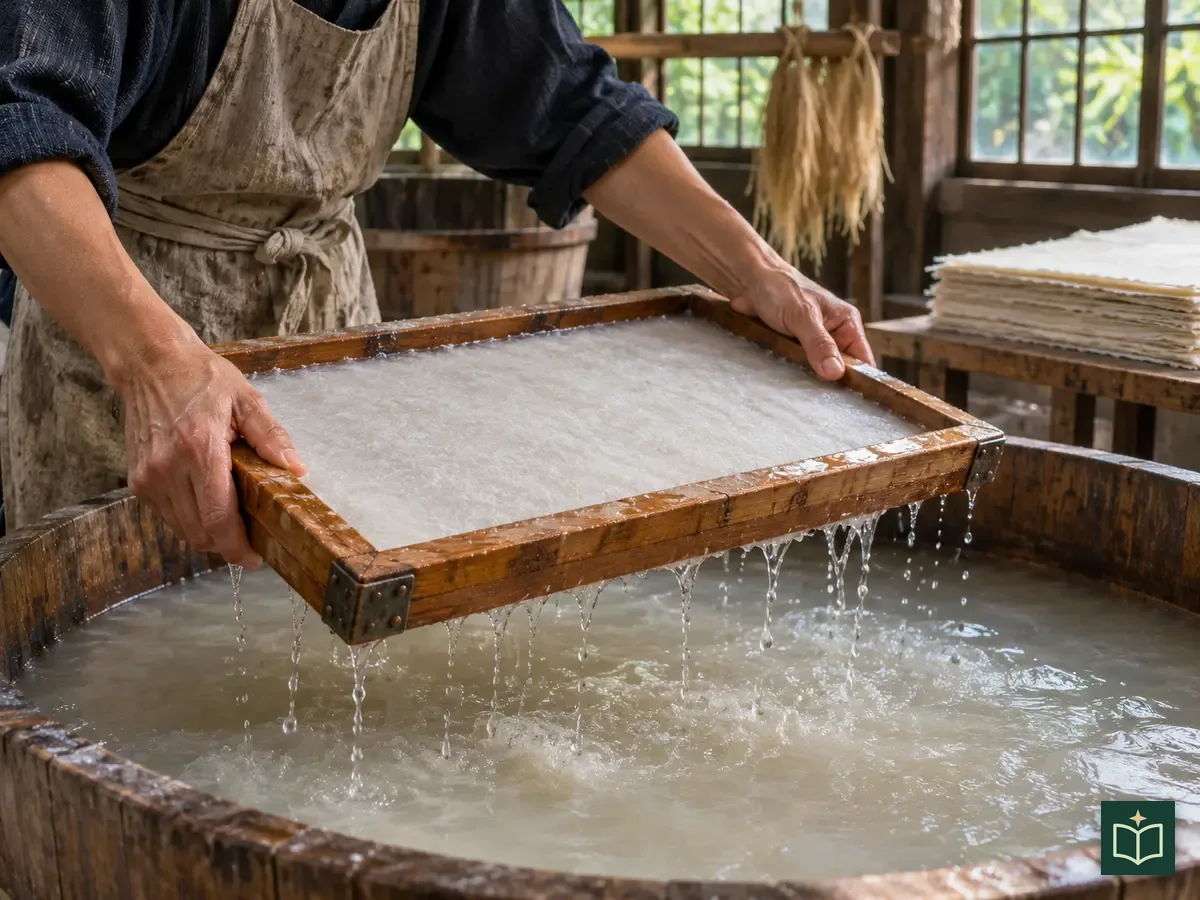
The basic method has changed surprisingly little. Plant fibres, such as mulberry bark, hemp or linen rags, are soaked and beaten until they break down into fine strands. The pulp is mixed with water in a vat. A papermaker dips a mould, a frame holding a fine screen, into the vat and lifts it out level, letting the water drain away. The fibres mat together into a thin, even layer. The sheet is turned out onto felt, pressed to remove water and hung to dry. It may then be coated or sized so that ink does not spread. Modern paper machines automate the same principle.
Westward through Samarkand
Paper spread slowly beyond China, first to Korea and Japan and into Central Asia along trade routes. A popular story says the Islamic world learned papermaking from Chinese prisoners captured at the Battle of Talas in 751. Historians now treat this as a simplification, as paper was already known in Central Asia, but Samarkand did become a famous centre of papermaking in the following decades. The technique adapted to local resources: where mulberry bark was scarce, makers used linen rags and hemp. Samarkand paper became a prized product, and the city’s reputation for high-quality sheets lasted for centuries. The craft kept moving west.
Baghdad’s paper boom
In the late eighth century, a paper mill was established in Baghdad, traditionally dated to the 790s during the reign of Harun al-Rashid. Paper soon became the standard material for government records, correspondence and books throughout the Abbasid lands. It was much cheaper than parchment, made from animal skin, or papyrus, which grew only in Egypt. Cheap paper helped support a vast culture of copying and bookselling. Baghdad, Damascus and Cairo had paper markets, and the wider availability of books helped fuel the scholarly activity of the Islamic Golden Age, including translation, commentary and new works in science and literature.
Into Europe
Paper reached Europe through the Islamic world. Muslim Spain had paper mills by the twelfth century, notably at Xàtiva, near Valencia. Paper was also imported into Italy and Sicily. In the thirteenth century, mills at Fabriano in Italy developed important innovations, including water-powered hammers to beat rags, animal-glue sizing for a smoother writing surface and watermarks to identify the maker. Paper mills spread across Europe over the next two centuries. When Gutenberg began printing with movable type in the mid-fifteenth century, a supply of affordable paper was already in place, and without it printing would have been far less economical.
Why it matters
Paper is easy to overlook because it is everywhere. Yet its arrival in each region changed how societies stored and shared information. Governments could keep more records, merchants more accounts and scholars more books. A common misconception is that paper and printing arrived together; in fact, paper spread centuries before printing became widespread outside East Asia. Its journey from China to Europe also shows how technologies travel, adapting to new materials and needs along the way. Today, digital screens have replaced much paper, but global paper production remains huge, and recycling has become a major industry in its own right.
Sources & further reading
Figures are rounded and widely published; check the linked organisations for the latest editions. These organisations do not endorse this website.