Who Zheng He was
Zheng He was born around 1371 in Yunnan, in south-western China, into a Muslim family; his father and grandfather are recorded as having made the pilgrimage to Mecca. As a boy he was captured when Ming armies conquered Yunnan and was made a eunuch in the service of a prince, who later seized the throne as the Yongle Emperor. Zheng He became a trusted commander and court official. In 1405 the emperor appointed him to lead a great naval expedition, the first of seven voyages that would make him one of the most famous mariners in Asian history. His background made him well suited to diplomacy with Muslim rulers.
The size of the fleets
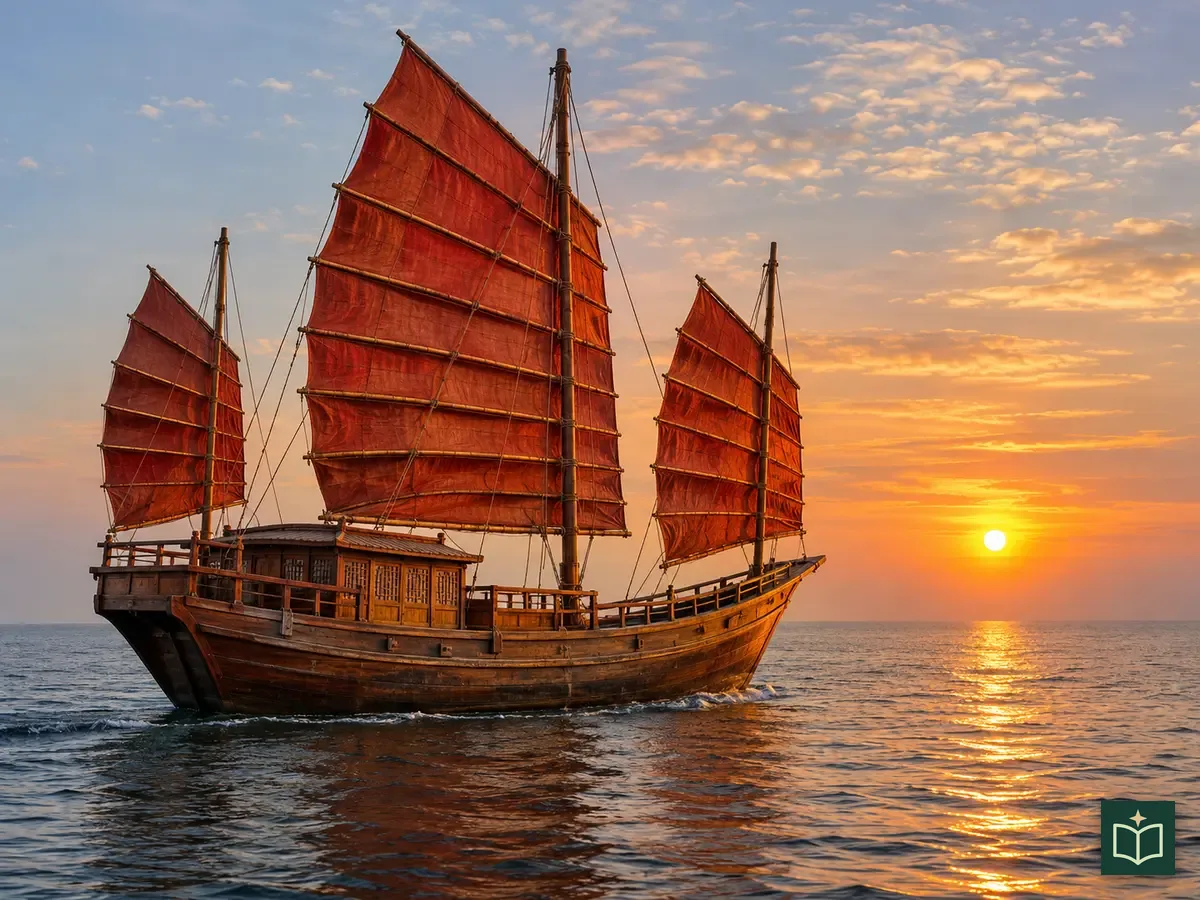
Ming sources describe fleets of extraordinary size. The first voyage is recorded as including more than 60 large treasure ships, supported by many smaller vessels, and around 27,000 men, including sailors, soldiers, interpreters, doctors and officials. Some later texts give the largest ships dimensions of more than 120 metres long. Many historians and naval architects doubt that wooden ships of that size could have sailed effectively, and the true dimensions remain debated. Even on cautious estimates, these were among the largest fleets the world had seen, far bigger than the small European expeditions that sailed to India later in the century.
Where they went
The fleets sailed with the monsoon winds, following routes long used by Arab, Persian, Indian and Malay traders. Ports of call included Champa in today’s Vietnam, Java, Sumatra, Malacca, Sri Lanka and Calicut on India’s south-west coast. Later voyages went further, reaching Hormuz at the entrance to the Gulf, Aden, the Arabian coast, and East African ports such as Mogadishu and Malindi. Detachments of the fleet are reported to have reached Jeddah, from where some members visited Mecca. Malacca, in particular, became an important partner, and the fleets used it as a base for storing goods and waiting for favourable winds.
What the voyages were for
The expeditions were primarily diplomatic and political. They displayed the power and wealth of the new Ming dynasty, invited foreign rulers to send envoys and tribute, and brought back luxury goods such as spices, gems, medicines and exotic animals. In 1414 a giraffe arrived at the court and was presented as a qilin, an auspicious mythical creature, to the emperor’s delight. The fleets also intervened in local politics on occasion and fought battles, including against a pirate leader in Sumatra and in Sri Lanka. They were not voyages of conquest or colonisation, and China did not attempt to establish permanent overseas colonies.
Why the voyages stopped
After the Yongle Emperor died in 1424, support for the expeditions weakened. A final voyage sailed in 1431 under the Xuande Emperor, and Zheng He is believed to have died around 1433, during or shortly after it. Officials argued that the voyages were extremely expensive and brought little practical benefit, while the empire faced threats on its northern land frontier and was investing heavily in a new capital at Beijing and in repairing the Grand Canal. Ming policy turned inward, and private overseas trade faced restrictions. Some stories say the voyage records were deliberately destroyed, but the details of this claim are uncertain.
Myths and meaning
Zheng He has inspired bold claims, including a popular theory that his fleets reached the Americas in 1421. Historians reject this because it lacks credible evidence. His real achievements need no embellishment. He commanded fleets that linked China with the Gulf and East Africa decades before Vasco da Gama reached India, using long-established Indian Ocean routes. Today he is honoured in China, Indonesia and Malaysia, where temples and museums recall his visits. His story raises an enduring historical question: how might the world have developed if Ming China had continued to project power across the oceans rather than turning away from them?
Sources & further reading
Figures are rounded and widely published; check the linked organisations for the latest editions. These organisations do not endorse this website.