A city built to be defended
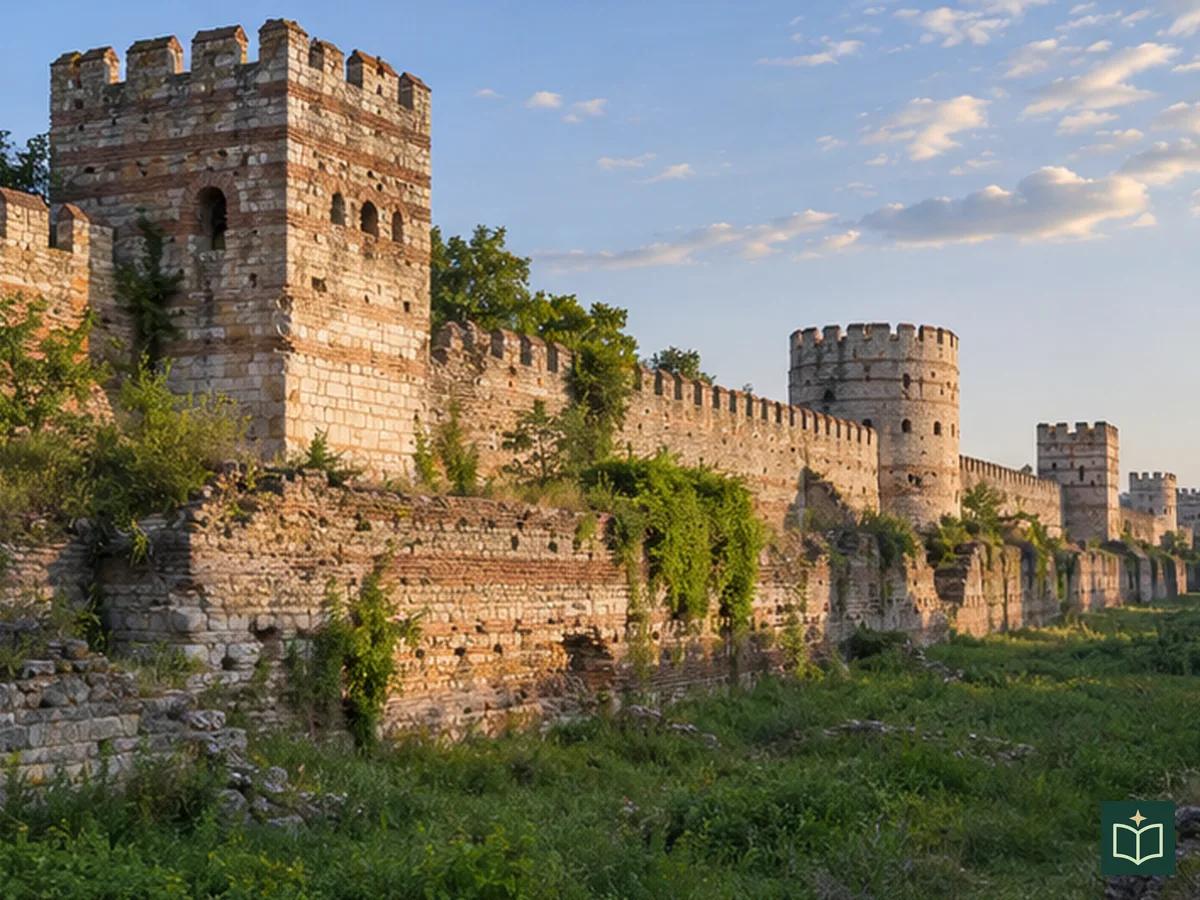
Constantinople was founded as a new Roman capital by Constantine the Great in 330, on a peninsula between the Sea of Marmara and the inlet known as the Golden Horn. Water protected it on two sides, and on the landward side the emperor Theodosius II built massive fortifications in the fifth century. The Theodosian Walls stretched for nearly six kilometres and had three layers: a wide moat, an outer wall with towers and a higher inner wall with larger towers. Sea walls guarded the shoreline, and a great chain could be stretched across the mouth of the Golden Horn to keep enemy ships out of the harbour.
A thousand years of sieges
For centuries these defences worked. Avars and Persians besieged the city in 626, and Arab forces in the 670s and again in 717–718; all failed. The Byzantines also had an incendiary liquid, known as Greek fire, used against enemy fleets. The great exception came in 1204, when the army of the Fourth Crusade captured and sacked the city by attacking from the harbour side. Byzantium recovered the city in 1261 but never regained its former strength. By the fifteenth century the empire had shrunk to little more than Constantinople and a few territories, surrounded by Ottoman lands in both Europe and Anatolia.
Mehmed prepares
Mehmed II became sultan in 1451, aged about nineteen, and made taking Constantinople his first priority. In 1452 he built a fortress, Rumeli Hisarı, on the European shore of the Bosphorus opposite an existing castle, allowing him to control shipping and block aid from the Black Sea. He also hired Orban, a cannon founder from Central Europe, to cast enormous bronze bombards able to fire stone balls weighing hundreds of kilograms. Mehmed assembled a large army, usually estimated at between about 50,000 and 80,000 men, and a substantial fleet. Against them, Emperor Constantine XI had perhaps 7,000 to 8,000 defenders, including Genoese and Venetian volunteers.
The siege
The siege began on 6 April 1453. Ottoman cannon bombarded the land walls, and the defenders worked each night to repair the damage with timber, earth and rubble. Ottoman ships failed to break the chain across the Golden Horn. On 22 April, Mehmed had dozens of ships dragged on greased rollers over the hill behind Galata and launched into the Golden Horn, forcing the defenders to spread their thin forces along the harbour walls too. Mining attempts were countered by defenders digging their own tunnels. Weeks of attacks were repulsed, but the walls were steadily weakened, and the garrison grew exhausted.
The final assault
Mehmed launched a general assault before dawn on 29 May. Waves of troops attacked the weakened section of the land walls. The Genoese commander Giovanni Giustiniani, who had led the defence there, was seriously wounded and carried away, which damaged the defenders' morale. Ottoman soldiers, including the elite Janissaries, broke through. Constantine XI died in the fighting, though exactly how is uncertain. The city was sacked for a period, as was customary when a city resisted. Mehmed entered Hagia Sophia, the great cathedral, and it was converted into a mosque. The Roman Empire in the east, 1,123 years after Constantinople's founding, had ended.
An Ottoman capital
Mehmed moved his capital from Edirne to Constantinople and set about restoring and repopulating it, bringing in Muslims, Christians and Jews from across his lands. The city, increasingly called Istanbul, became the heart of an empire that would last until the twentieth century. The conquest gave the Ottomans control of the straits between the Black Sea and the Mediterranean and confirmed them as a major power. Historians caution against seeing 1453 as the moment cannon alone ended the Middle Ages: the city was already isolated and weak. But its fall showed that gunpowder artillery could defeat even the strongest medieval walls.
Sources & further reading
Figures are rounded and widely published; check the linked organisations for the latest editions. These organisations do not endorse this website.