The problem to solve
By the 1870s, the electric telegraph could send coded messages across continents, but it could not carry the human voice. Several inventors were trying to change that. The challenge was to convert the complex, continuously varying pressure waves of speech into an electric current that varied in the same way, then convert it back. The telegraph worked by switching current on and off; speech required a smoothly changing signal. Many inventors were also working on the harmonic telegraph, a way to send several telegraph messages along one wire at different musical pitches. That research, funded by hopes of telegraph profits, led directly towards the telephone.
Bell's path
Alexander Graham Bell was born in Edinburgh in 1847 and moved to North America with his family. His mother was deaf, and he became a teacher of deaf students, deeply interested in the physics of sound and speech. In Boston, working with his assistant Thomas Watson, he experimented with the harmonic telegraph and became convinced that speech could be transmitted electrically. On 14 February 1876 his lawyer filed a patent application. His patent, number 174,465, was granted on 7 March. On 10 March, Bell transmitted the words, as he recorded in his notebook, asking Watson to come to him, and Watson heard them.
The rivals
Bell was not alone. On the same day that Bell's application was filed, the American inventor Elisha Gray filed a caveat, a notice of an invention in progress, describing a telephone design using a liquid transmitter. In Germany, Philipp Reis had built a device in 1861 that transmitted musical tones and, by some accounts, fragments of speech. In the United States, the Italian immigrant Antonio Meucci had developed voice-transmitting devices and filed a caveat in 1871 but could not afford to renew it. In 2002 the US House of Representatives passed a resolution recognising Meucci's contribution. Who deserves credit remains a matter of genuine historical debate.
Patents and courts
Bell's patent proved enormously valuable, and it was challenged repeatedly. The Bell company fought around six hundred lawsuits over its patents, against rivals including the powerful Western Union telegraph company, which backed alternative designs by Gray and Thomas Edison. In 1879 Western Union settled, leaving the telephone business to Bell. In 1888 the US Supreme Court upheld Bell's patent in a consolidated set of disputes known as the Telephone Cases, by a narrow majority. Questions about the timing of Bell's and Gray's filings fuelled suspicion for decades, though the court found in Bell's favour. The patents gave Bell's company a powerful early lead.
Making it practical
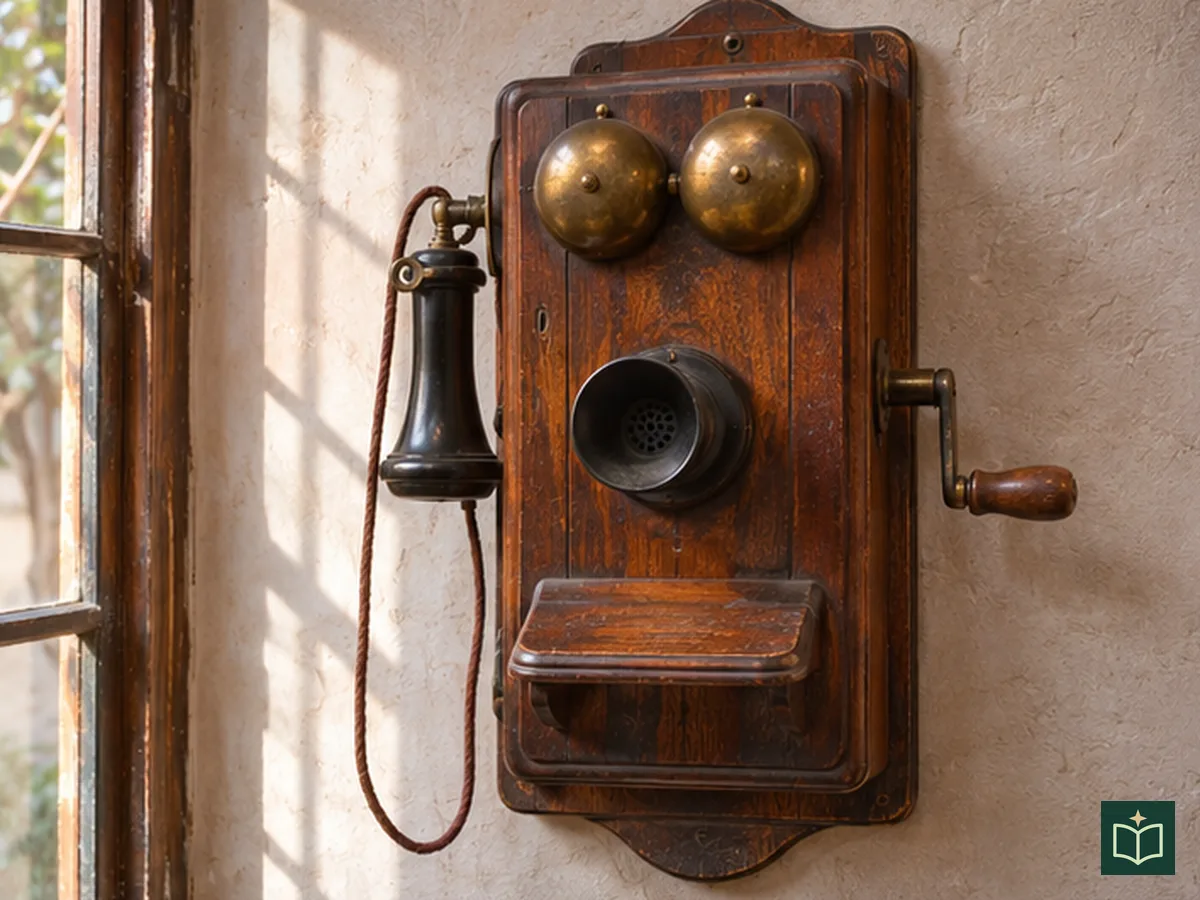
Bell's early telephone was weak and worked best over short distances. Others improved it quickly. Edison developed a carbon transmitter in 1877, which varied the current more strongly as sound pressed on carbon granules, producing louder, clearer speech. Similar carbon microphones became standard for nearly a century. Bell demonstrated his invention at the Centennial Exhibition in Philadelphia in 1876 and founded the Bell Telephone Company in 1877. Telephones were at first sold in pairs, connecting two places directly. That approach could not scale: linking every phone to every other would require an impossible number of wires. The answer was the exchange.
Exchanges and networks
The first commercial telephone exchange opened in New Haven, Connecticut, in January 1878 with 21 subscribers. Each line ran to a central switchboard, where an operator connected callers by hand. Exchanges spread rapidly through American and European cities, employing large numbers of operators, many of them young women. In 1891 Almon Strowger patented an automatic switching system, allowing callers to connect themselves with a dial. Long-distance lines extended steadily, and in 1915 the first transcontinental call linked New York and San Francisco. Within a few decades the telephone had changed business, journalism, emergencies and family life, setting the pattern for today's global networks.
Sources & further reading
Figures are rounded and widely published; check the linked organisations for the latest editions. These organisations do not endorse this website.