A universe that seemed static
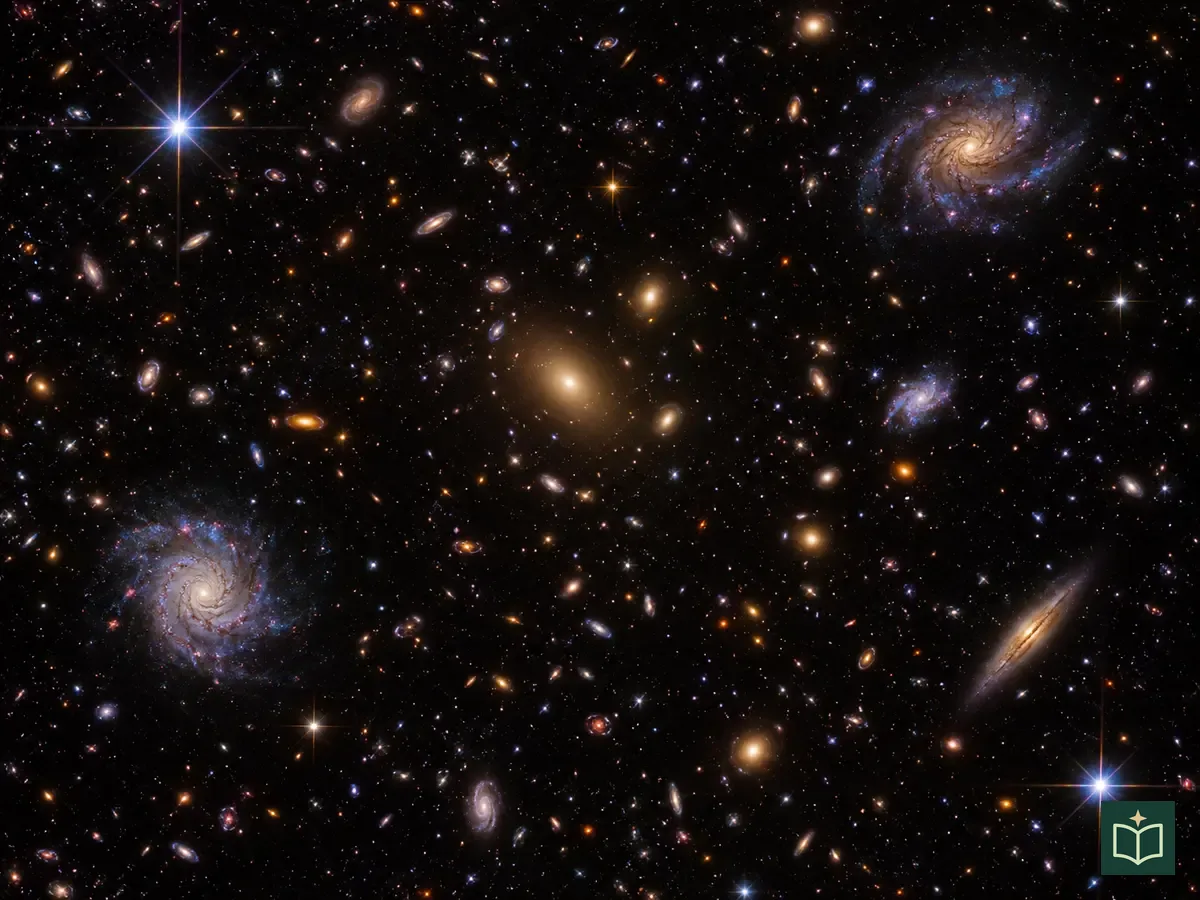
In the early 20th century, most astronomers assumed the universe was static and eternal. It was not even clear whether the spiral ‘nebulae’ seen through telescopes were separate galaxies or clouds within the Milky Way. In the 1920s, Edwin Hubble measured distances to several of them using Cepheid variable stars, whose brightness changes in a pattern linked to their true luminosity. He showed that they lay far beyond our galaxy. At the same time, measurements, many by Vesto Slipher, showed that light from most of these galaxies was shifted towards red wavelengths, meaning they were moving away. Putting distance and redshift together produced a revolutionary result.
Hubble’s law
In 1929, Hubble published evidence that more distant galaxies recede faster, in rough proportion to their distance. Two years earlier, the Belgian physicist and priest Georges Lemaître had derived the same relationship from Einstein’s equations and proposed that the universe was expanding. The relationship is now called the Hubble–Lemaître law, and the rate is the Hubble constant, roughly 70 kilometres per second for every megaparsec of distance, a megaparsec being about 3.26 million light-years. Running the expansion backwards implies that the universe was once extremely hot and dense, the starting point of the Big Bang model, about 13.8 billion years ago.
Not an explosion into space
The expansion is often pictured as galaxies flying away from a central point, like debris from an explosion. That picture is misleading. There is no centre, and every observer in every galaxy would see the same pattern of recession. A helpful analogy is a loaf of raisin bread rising in an oven: as the dough expands, every raisin moves away from every other, and more distant raisins separate faster. The galaxies are the raisins; space is the dough. As light travels through expanding space, its wavelengths stretch, producing the cosmological redshift. The Big Bang was not an explosion at one location but the rapid expansion of space everywhere.
Not everything expands
Expansion does not pull apart everything. Gravity, and the forces holding atoms together, are far stronger than the effect of cosmic expansion on small scales. Earth, the solar system and the Milky Way are not growing because of it. Galaxies bound together in groups and clusters also stay together. Our nearest large neighbour, the Andromeda galaxy, is actually approaching the Milky Way, with its light slightly blueshifted, and the two may eventually merge, billions of years from now. Expansion becomes dominant only on the largest scales, between groups and clusters of galaxies. This is why ‘the universe is expanding’ does not mean that you, or your city, are slowly stretching.
An accelerating surprise
Astronomers long expected gravity to slow the expansion over time. In 1998, two teams studying distant exploding stars called type Ia supernovae found the opposite: the expansion is speeding up. The discovery earned the 2011 Nobel Prize in Physics. The cause has been named dark energy, a mysterious property of space that appears to make up roughly two-thirds of the universe’s total energy content. Its nature is unknown. A further puzzle, known as the Hubble tension, is that the expansion rate measured from nearby galaxies, about 73, differs from the value inferred from the early universe, about 67. Whether this reflects measurement errors or new physics is hotly debated.
Why it matters
The expanding universe connects to almost every big question in cosmology. It explains why the cosmic microwave background, the afterglow of the early universe, has cooled to just 2.7 degrees above absolute zero. It sets the size of the observable universe, which extends about 46 billion light-years in every direction, larger than 13.8 billion because space has expanded while light was travelling. Large surveys and space telescopes, including the European Space Agency’s Euclid mission, are mapping billions of galaxies to measure how expansion has changed over time. Their results will help determine whether dark energy is constant and how the universe’s distant future will unfold.
Sources & further reading
Figures are rounded and widely published; check the linked organisations for the latest editions. These organisations do not endorse this website.