Rayleigh scattering
When sunlight meets gas molecules much smaller than its wavelength, some of it is redirected. Physicist Lord Rayleigh showed in the nineteenth century that the strength of this scattering rises steeply as wavelength gets shorter: roughly with the inverse fourth power. Blue light, at about 450 nanometres, is scattered around five times more than red light at about 700 nanometres.
Why not violet?
Violet light has an even shorter wavelength, so why is the sky not violet? Sunlight contains less violet than blue, some violet is absorbed high in the atmosphere, and our eyes are much less sensitive to violet. The colour receptors in the eye combine the scattered mixture into the familiar sky blue.
Red sunsets
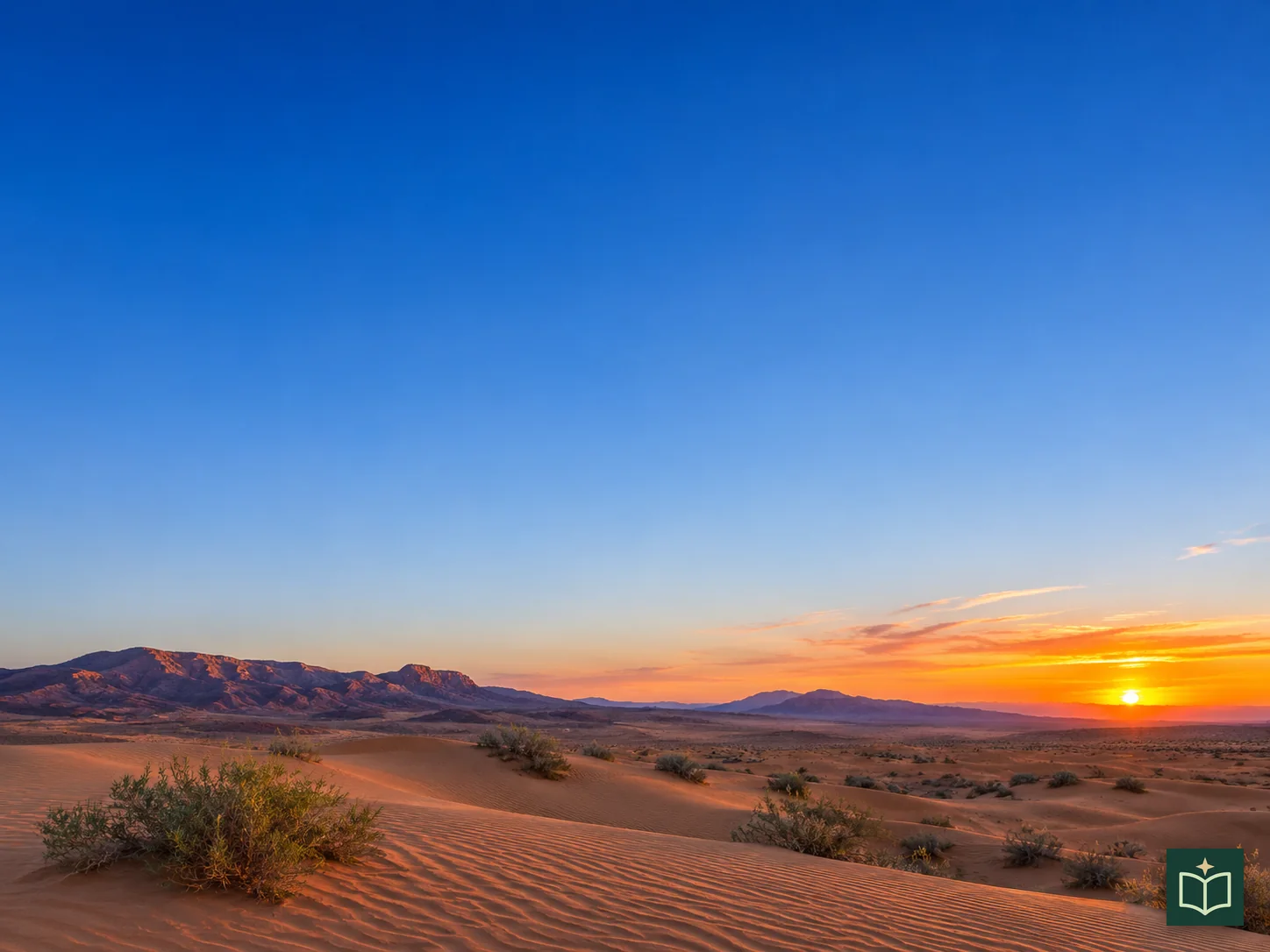
At sunrise and sunset, light travels through far more air before reaching you. Much of the blue is scattered out of the direct beam along the way, leaving the oranges and reds. Dust, smoke and pollution particles can deepen those colours, which is why sunsets after wildfires or volcanic eruptions can be especially vivid.
No air, no blue
On the Moon, which has almost no atmosphere, there is nothing to scatter sunlight, so the sky looks black even in daylight. Mars has a thin, dusty atmosphere: its daytime sky tends towards butterscotch, while Martian sunsets can look bluish because fine dust scatters light differently.
Sources & further reading
Figures are rounded and widely published; check the linked organisations for the latest editions. These organisations do not endorse this website.