Head in the fire, feet in the water
An old Arabic saying describes the date palm well: it likes its head in the fire and its feet in the water. Phoenix dactylifera tolerates summer heat close to 50°C, dry air and fairly salty soil, yet it needs a steady supply of water at its roots. That combination suits places where groundwater, springs or channels reach the surface in an otherwise arid landscape. Few other productive trees can survive such conditions, which is why the palm became the foundation of oasis life from Morocco to Oman. Its fruit is dense in sugar, keeps for months once dried, and travels well, making it an ideal food for desert communities and traders.
A canopy that changes the climate
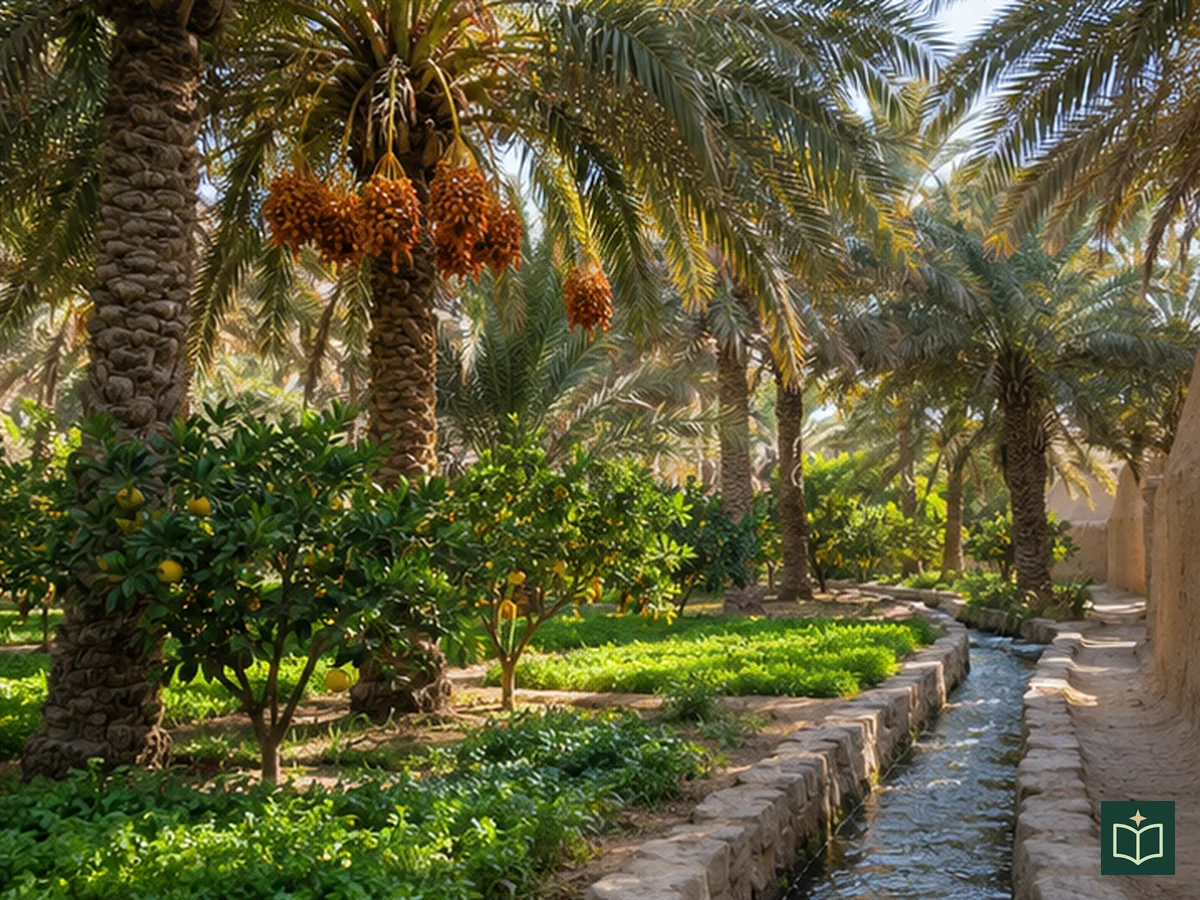
The palm’s greatest gift may be its shade. A dense grove of fronds blocks much of the direct sunlight, lowers the temperature at ground level and slows the wind. Less sun and less wind mean less evaporation, so water applied to the soil goes further. Inside a mature grove the air feels noticeably cooler and more humid than the open desert just beyond. This small, man-made microclimate allows plants that would scorch in full sun to thrive. In effect, the palms create a second, gentler environment beneath themselves, and the whole oasis economy depends on that shelter as much as on the water itself.
Farming in layers
Traditional oasis agriculture is built in three storeys. The top layer is the date palm. The middle layer is made of smaller fruit trees such as citrus, pomegranate, fig, mango and banana. The bottom layer holds vegetables, herbs and fodder crops such as alfalfa for goats and camels. Each level uses light and water left over by the one above. In the UAE, the oases of Al Ain and Liwa followed this pattern for generations, watered in Al Ain by falaj channels that carry groundwater along gentle slopes. Al Ain’s oases are now part of a UNESCO World Heritage site.
A tree that needs a farmer
Date palms are either male or female, and only females bear fruit. In the wild, wind and insects carry pollen between them, but the result is unreliable for a harvest. For thousands of years farmers have climbed female palms in spring to tie in strands of male flowers by hand, so a single male tree can pollinate many females. New palms are usually grown from offshoots that sprout at the base of a mother tree, because a seed does not reliably produce the same variety. The Arab world now grows hundreds of named varieties, each with its own texture, sweetness and season.
Every part has a use
Before modern supply chains, the palm provided far more than food. Its trunks became roof beams and bridges across falaj channels. Its fronds were woven into mats, baskets, fans and the walls of light summer houses. Fibre from the trunk was twisted into rope, and the midribs of the fronds made fences and fish traps. The dates themselves were eaten fresh, dried, pressed into paste or boiled into a thick syrup called dibs. The archaeological record shows how old this partnership is: charred date stones on Dalma island, off Abu Dhabi, suggest people in the Gulf were eating dates about seven thousand years ago.
Pressure on an ancient system
Today the date palm remains a symbol of the region and a significant crop, but the oasis system faces strain. Heavy pumping in many areas has lowered water tables, and as groundwater drops it often becomes saltier, which even the hardy palm eventually cannot tolerate. The red palm weevil, an invasive beetle whose larvae tunnel inside trunks, has damaged groves across the Middle East. Many younger people have also left farming for city jobs. Conservation efforts focus on careful irrigation, pest monitoring and protecting heritage oases as living landscapes. The lesson of the oasis endures: in a harsh climate, one well-chosen tree can make room for everything else.
Sources & further reading
Figures are rounded and widely published; check the linked organisations for the latest editions. These organisations do not endorse this website.