A green ring around the Arctic
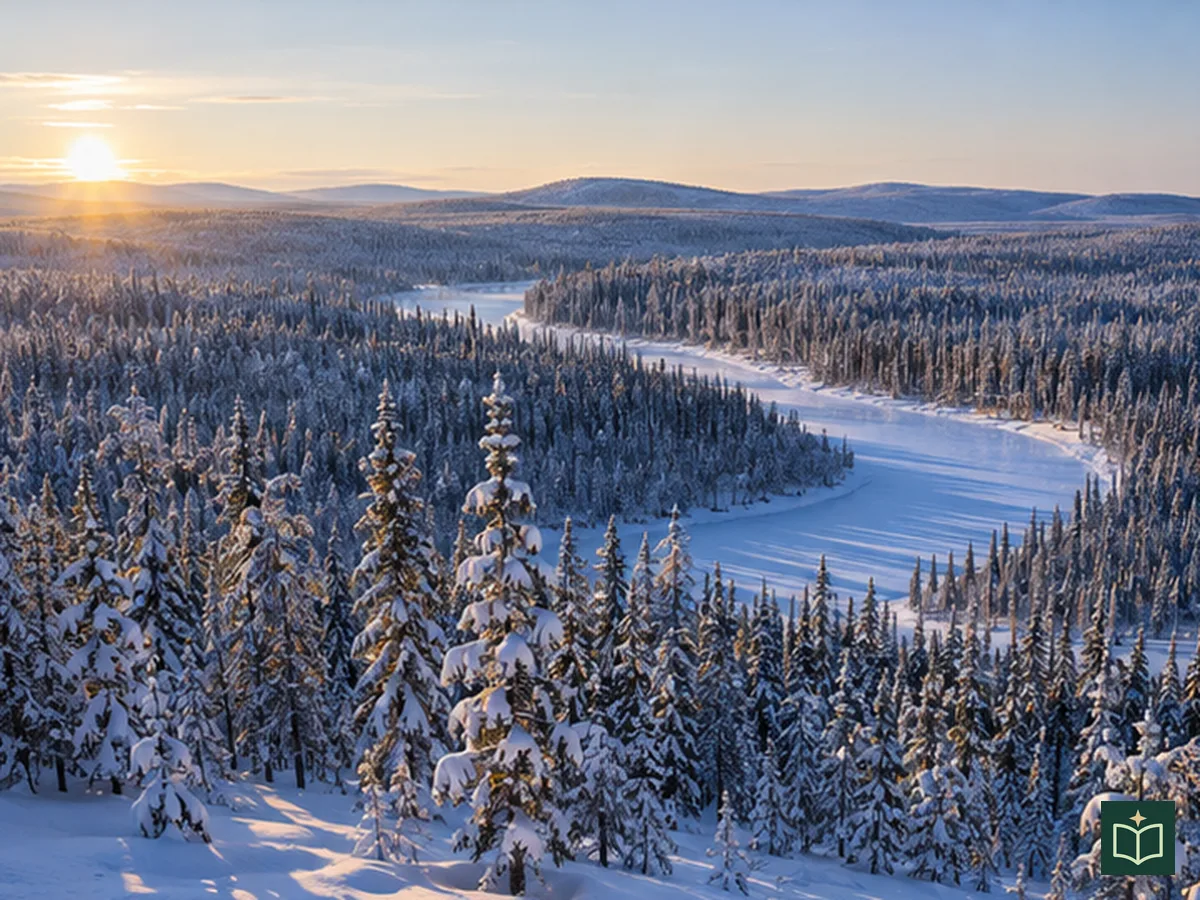
The taiga, also called the boreal forest, is a broad belt of coniferous woodland stretching across northern Russia, Scandinavia, Finland, Canada and Alaska. It lies roughly between 50 and 70 degrees north, bordered by tundra to the north and by temperate forest or grassland to the south. The word taiga comes from Russian, while boreal comes from Boreas, the Greek god of the north wind. According to the UN Food and Agriculture Organization, the boreal domain holds about 27 per cent of the world’s forest area, making it the largest land biome. There is almost no equivalent in the Southern Hemisphere, because there is too little land at the same latitudes.
Few species, vast spaces
Compared with tropical forests, the taiga has few kinds of trees. Spruce, fir, pine and larch dominate, often mixed with hardy broadleaf trees such as birch, aspen and willow. Huge areas may be covered by just one or two species. The soils are typically podzols: thin, acidic and low in nutrients, because cold slows decomposition and needle litter releases acids. In places, especially eastern Siberia, permanently frozen ground lies beneath. The growing season may last only three or four months. Winters are long and harsh, and in the interior of Siberia temperatures can fall below minus 60°C, among the lowest recorded anywhere outside Antarctica.
Built for snow and ice
Boreal conifers have evolved a toolkit for winter. Their narrow, conical shape and downward-sloping, flexible branches allow snow to slide off rather than build up and break the tree. Needles have a small surface area and a thick, waxy coating that reduces water loss when the ground is frozen and roots cannot draw moisture. Because most species keep their needles year-round, they can start photosynthesising as soon as conditions allow, without spending energy on new leaves. Inside, trees prepare for frost by shifting water out of their cells and concentrating sugars, so ice crystals form in the gaps between cells rather than tearing them apart.
The larch that drops its needles
The coldest parts of the taiga belong to an unusual conifer. Larches, which dominate vast areas of eastern Siberia, are deciduous: their needles turn gold and fall each autumn. Shedding needles might seem a disadvantage in a short growing season, but it allows larches to survive cold so extreme that evergreen needles would be damaged. They avoid the problem of losing water through foliage in winter altogether, then grow a fresh set of soft needles each spring. Larches also cope well with shallow soils over permafrost, spreading their roots sideways near the surface. This strategy lets them form the northernmost forests on Earth, reaching beyond the Arctic Circle in Siberia.
Fire, insects and renewal
Fire is a natural part of the boreal cycle. Lightning-sparked blazes clear old stands and release nutrients locked in dead wood. Some species depend on it: jack pine in Canada holds many of its cones sealed with resin, which opens in the heat of a fire to release seeds onto freshly cleared ground. Outbreaks of insects such as bark beetles and spruce budworm also thin forests periodically. After a disturbance, birch and aspen often move in first, followed slowly by conifers. The taiga is home to moose, brown bears, wolves, lynx and many migratory birds that breed there in summer.
A carbon store under pressure
The boreal forest holds a vast store of carbon, much of it not in the trees but in cold soils and peatlands, where decomposition is slow. It also supplies much of the world’s timber, pulp and paper. Scientists track the taiga closely because high latitudes are warming faster than the global average. Warmer conditions can lengthen growing seasons, but they also bring more frequent and intense wildfires, insect outbreaks and the thawing of frozen ground, which can release stored carbon. At its northern edge, trees are advancing into tundra in some places; at its southern edge, drought stress is a growing concern. How this vast forest responds matters well beyond the north.
Sources & further reading
Figures are rounded and widely published; check the linked organisations for the latest editions. These organisations do not endorse this website.