The cotton castle
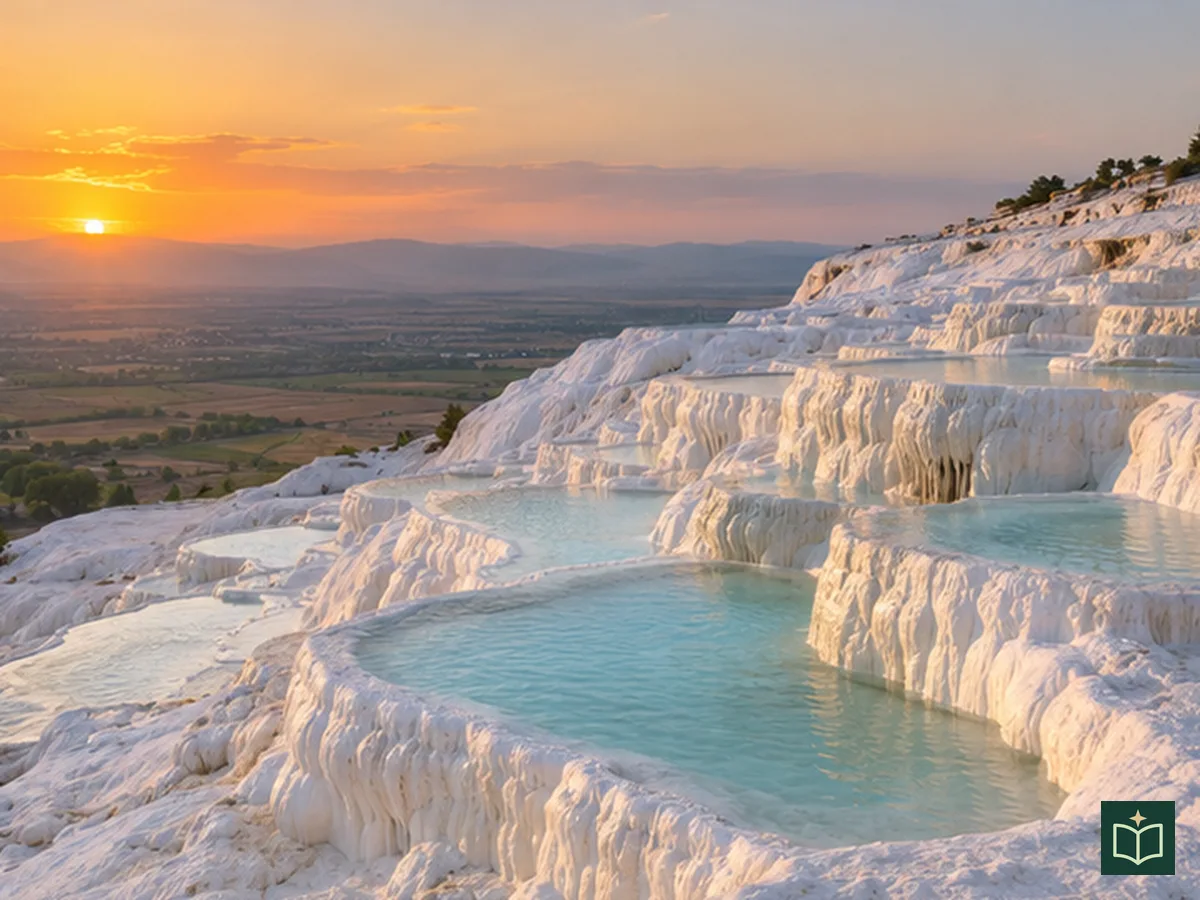
Pamukkale, near the city of Denizli in south-western Türkiye, means cotton castle in Turkish. From a distance the hillside looks snow-covered, even in summer. Up close it is a cascade of white mineral basins, petrified waterfalls and shallow pools of turquoise water, stretching roughly 2.7 kilometres along a slope that rises about 160 metres above the plain. The rock is travertine, a form of limestone deposited from water rather than laid down on an ancient sea floor. Above the terraces lie the ruins of Hierapolis, a Greco-Roman spa city. Together, the natural formations and the ancient city are listed as a UNESCO World Heritage site.
Chemistry in the open air
The story starts underground. Rain soaks into the hills and circulates deep through limestone, where it is warmed by heat linked to the region’s active faults. Under pressure, the water absorbs carbon dioxide, which makes it slightly acidic and able to dissolve large amounts of calcium carbonate. When the water emerges at springs at around 35°C, the pressure drops. Carbon dioxide escapes into the air, much as fizz leaves an opened bottle. The water can no longer hold all its dissolved calcium, so calcium carbonate comes out of solution and coats every surface it flows across. The thinner and faster the film of water, the quicker the gas escapes.
Why the pools form steps
The terraces build themselves. Wherever water flows over a slight lip, it speeds up, thins out and loses gas faster, so deposition is greatest at the edge. Small rims grow upward, holding back pools behind them. As the rims rise, they trap more water, and the pools deepen. Over time the slope becomes a staircase of basins, each overflowing into the next. Fine ripples on the rim surfaces record changes in flow. The brilliant whiteness comes from the purity of the carbonate, while the pale blue of the pools is caused by sunlight reflecting off the white floor through clear water. Algae and bacteria can add tints of colour.
A spa for two thousand years
People were drawn here long before modern tourism. Hierapolis was founded in the second century BCE and flourished under Roman rule as a place to bathe in the warm waters, which were believed to be healing. The city had baths, temples, a large theatre and an extensive necropolis of tombs, many of them now partly encrusted with travertine. One ancient pool, still used by visitors, is strewn with fallen marble columns beneath warm water. Earthquakes repeatedly damaged the city, a reminder that the same faults that heat the springs also make the region seismically active. Hierapolis eventually declined and was abandoned in the medieval period.
Damage and repair
In the twentieth century the terraces suffered. Hotels built on top of the site diverted spring water into their own pools, and a road ran across the formations. Many basins dried out and turned grey, as dust and dirt settled on the surface without fresh mineral to cover it. After the area was declared a World Heritage site in 1988, the hotels were removed and the road closed. Today, water is directed to different sections in rotation, allowing dried areas to whiten again while others rest. Visitors must walk barefoot on designated paths, as shoes scratch and stain the soft travertine. The site shows how quickly human use can disrupt a growing landform.
Terraces elsewhere
Pamukkale is famous, but the process is widespread. Mammoth Hot Springs in Yellowstone National Park builds similar white and orange terraces from thermal water. Huanglong in China’s Sichuan province has golden pools fed by cooler carbonate springs. In Iran, the Badab-e Surt springs leave orange and red terraces stained by iron. Travertine also has a long history as a building stone; much of ancient Rome was built from it, quarried near Tivoli. Studying these deposits helps geologists understand groundwater chemistry and past climates, because travertine layers can preserve records of water temperature and flow, like tree rings written in stone.
Sources & further reading
Figures are rounded and widely published; check the linked organisations for the latest editions. These organisations do not endorse this website.