Towers versus buildings
Engineers distinguish towers from buildings by how much of the structure people can use. The Council on Tall Buildings and Urban Habitat, which keeps official height records, defines a building as a structure in which at least half the height is occupied by usable floors. Towers fail that test: they are mostly slender shafts supporting broadcast antennas, observation decks and restaurants near the top. That is why Dubai’s Burj Khalifa, at about 828 metres, is counted as the world’s tallest building rather than a tower. This table also excludes guyed masts, thin steel structures held up by cables, some of which are taller than most of the towers here.
Tokyo Skytree
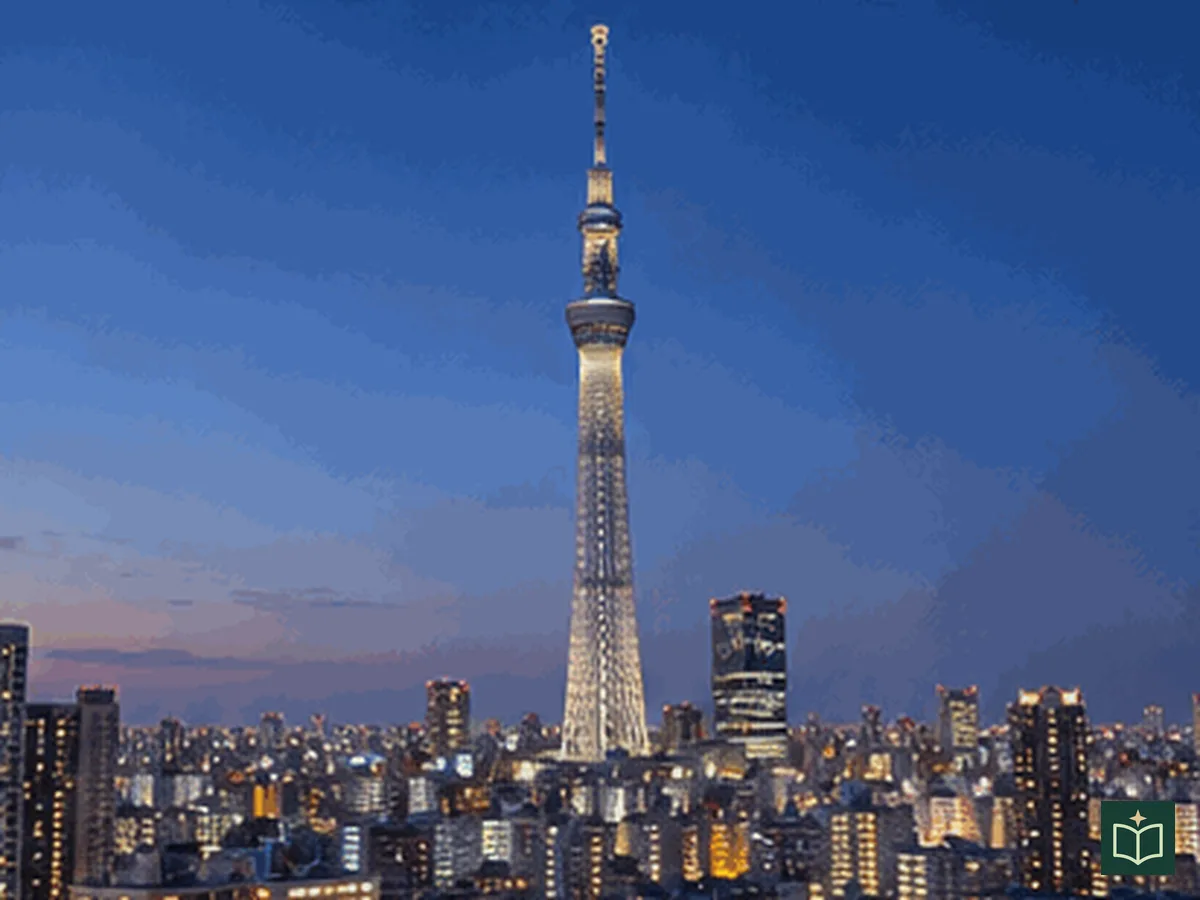
Tokyo Skytree was completed in 2012 to broadcast digital television and radio signals over a city crowded with high-rise buildings that blocked lower antennas. Its height of 634 metres was chosen partly because the numbers six, three and four can be read in Japanese as Musashi, the old name of the region around Tokyo. Japan is one of the most earthquake-prone countries on Earth, so the tower has a central concrete column that is structurally separate from the steel outer frame. During a quake, the two sway out of step and damp each other’s motion, a principle inspired by the central pillars of traditional wooden pagodas.
Canton, Toronto and Moscow
Guangzhou’s Canton Tower, about 604 metres tall, opened in 2010. Its twisting lattice of white steel tubes narrows at the waist, giving it a distinctive hourglass shape, and a ring of passenger pods circles its top. Toronto’s CN Tower, completed in 1976, was the tallest free-standing structure in the world for more than thirty years, until the Burj Khalifa overtook it during construction. Visitors can walk around the outside of its main pod, harnessed to an overhead rail. Moscow’s Ostankino Tower, completed in 1967, held the record before the CN Tower. Its concrete shaft is held in compression by steel cables running through its interior.
Asia’s television towers
Most of the remaining towers in the table are in Asia and were built between the 1990s and 2010s as cities expanded television and radio coverage and sought new landmarks. Shanghai’s Oriental Pearl Tower, with its stacked pink spheres, stands opposite the historic Bund across the Huangpu River. Tehran’s Milad Tower combines broadcasting with a conference centre and hotel at its base. The Kuala Lumpur Tower rises from a forested hill, which adds to its apparent height. Several Chinese cities, including Tianjin, Beijing and Zhengzhou, built towers of about 400 metres, partly as symbols of modernisation and civic pride, with viewing decks open to visitors.
Kuwait’s tower and the Gulf
The Gulf has its own tall tower. Kuwait City’s Liberation Tower, about 372 metres high, is the tallest tower in the region and sits just outside this table. Construction began in the 1980s, was interrupted by the Iraqi invasion in 1990, and resumed after the war. It opened in 1996 and was named to mark the country’s liberation. It houses telecommunications equipment and a revolving restaurant. Elsewhere in the Gulf, the record-breaking structures are buildings rather than towers. Dubai’s Burj Khalifa is the tallest structure ever built, and Jeddah Tower in Saudi Arabia, now under construction, is planned to exceed it.
Why towers stopped growing
Broadcasting towers grew taller through the twentieth century because higher antennas could send signals over the horizon to more homes. Satellite television, cable networks, fibre-optic cables and mobile internet have since reduced the need for single giant transmitters. New towers are now built mainly as landmarks and tourist attractions, and their height is often limited by cost and by competition from skyscrapers that provide offices and homes as well as views. The order of this table has been stable for over a decade. The main changes in tall structures now come from new skyscrapers, which are ranked separately as buildings.
Sources & further reading
Figures are rounded and widely published; check the linked organisations for the latest editions. These organisations do not endorse this website.