Printing before the book
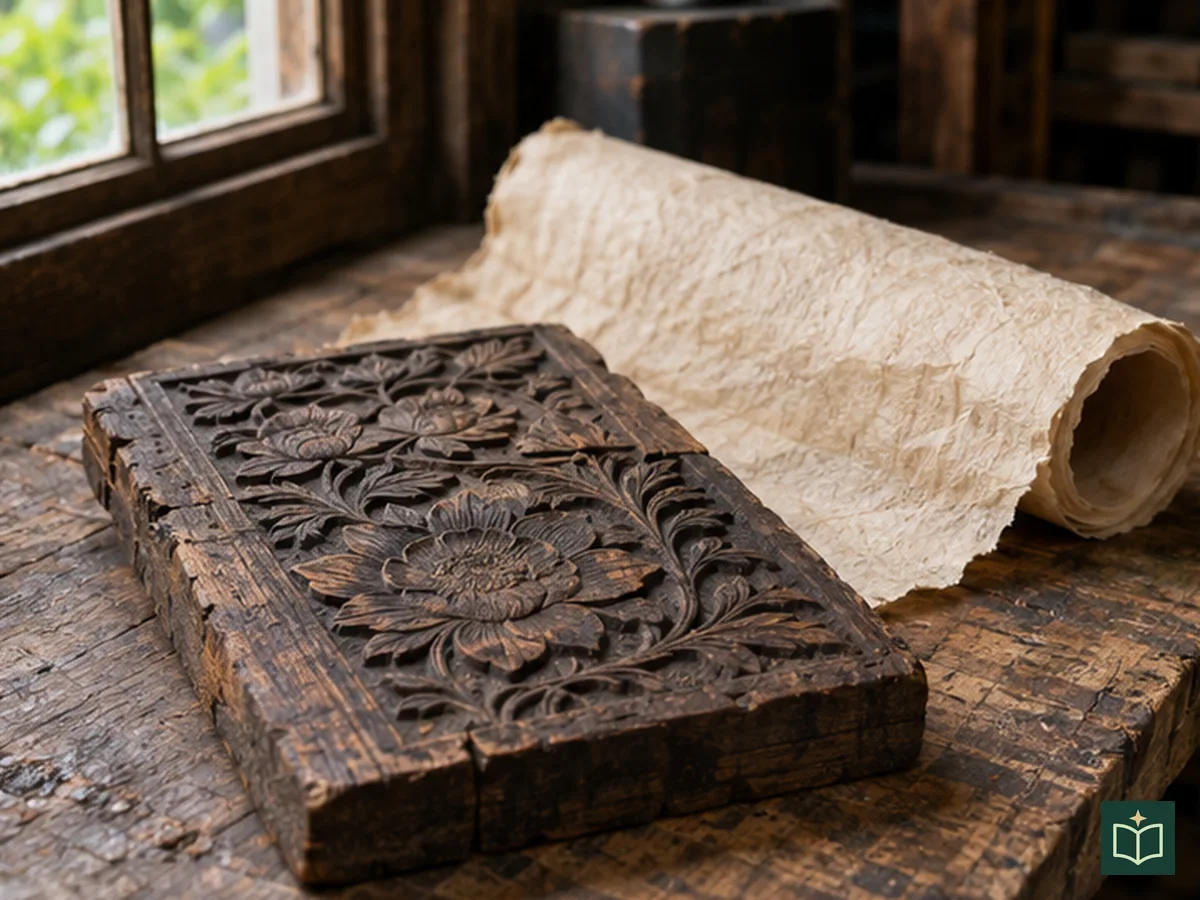
The earliest printing in East Asia used woodblocks. A craftsman pasted a written page face down on a smooth block, carved away the blank wood and left the characters standing in reverse. Inked and pressed onto paper, the block produced an identical copy every time. It spread through China by the eighth century and reached Korea and Japan with Buddhism, which valued multiplying sacred texts. The oldest survivors are therefore small charms and scrolls rather than books with bound pages. This ranking lists printed items in the order they were made, and it separates objects that carry their own date from those dated by the place where they were found.
Charms sealed in pagodas
In 1966 restorers opening the Seokgatap pagoda at Bulguksa temple in Gyeongju, South Korea, found a printed scroll of the Mugujeonggwang Great Dharani Sutra. The pagoda was completed in 751, so the scroll cannot be younger, although some scholars argue it was printed in China and carried to Korea. In Japan, Empress Shōtoku ordered a million small wooden pagodas, each holding a printed Buddhist charm, after a rebellion in 764. The project was finished around 770 and thousands of the pagodas survive at Hōryū-ji temple. Together these finds show that printing in quantity was already routine in East Asia more than a thousand years ago.
The Diamond Sutra of 868
The world’s oldest complete printed book with a date was found in 1900 in a sealed library cave at the Mogao caves near Dunhuang in western China. The Diamond Sutra is a scroll more than five metres long, made of printed panels pasted together, with a detailed picture of the Buddha at the start. A short note at the end says it was made by Wang Jie on behalf of his parents, on a date that corresponds to 11 May 868. Its fine carving suggests a long-established craft. The same cave yielded a printed almanac for 877, a reminder that printers also produced calendars and other everyday texts.
Whole libraries in wood
Under the Song dynasty, China printed the entire Buddhist canon. The Kaibao Canon was cut in Sichuan between 971 and 983, and only scattered volumes survive. Korea followed with its own canon; the second version, the Tripitaka Koreana, still exists as more than 80,000 woodblocks at Haeinsa temple. Movable type also began in China. In the 1040s an artisan named Bi Sheng made individual characters from baked clay, according to the scholar Shen Kuo, but none of his printing survives. The oldest surviving book printed with movable type is a Buddhist tantra from the Tangut kingdom of Western Xia, made with wooden type in the twelfth century.
Metal type: Jikji and Gutenberg
Korean printers cast type in metal. Jikji, an anthology of Zen Buddhist teachings, was printed at Heungdeok temple in Cheongju in 1377, and its surviving second volume is held by the National Library of France. UNESCO added it to the Memory of the World register in 2001 as the oldest extant book printed with movable metal type. In Mainz, Johannes Gutenberg combined cast metal letters with oil-based ink and a screw press adapted from wine-making. His 42-line Bible was completed around 1455. Fewer than fifty copies survive, some incomplete. Gutenberg did not invent printing, but his system made it fast and cheap enough to transform Europe.
Firsts that came after
Gutenberg’s Bible carries no printed date. The Mainz Psalter of 1457, produced by his former partner Johann Fust and Peter Schöffer, was the first European printed book to state its date and its printers, and it was printed in red and blue as well as black. Printing spread quickly. William Caxton produced the Recuyell of the Historyes of Troye in Bruges around 1473, the first book printed in English, before setting up a press in Westminster. Books printed in Europe before 1501 are called incunabula, from the Latin for cradle, and around 30,000 editions are known. The oldest printed books outside Europe, however, remain far older than any of them.
Sources & further reading
- Britannica · History of publishing and printing ↗
- British Library · Collection items ↗
- UNESCO · Memory of the World ↗
Figures are rounded and widely published; check the linked organisations for the latest editions. These organisations do not endorse this website.