How the list works
Islands hold some of the world’s most striking mountains, but a fair ranking needs a rule. This list takes only the highest summit on each island, measured above sea level. That is why Mauna Loa, at about 4,169 metres, does not appear: it shares the island of Hawaiʻi with the taller Mauna Kea. New Guinea also has several summits above 4,800 metres, but only Puncak Jaya counts. Greenland’s highest point, Gunnbjørn Fjeld, falls just short at about 3,694 metres, and Java’s Semeru at 3,676 metres misses out by a similar margin. Continents are excluded, so Antarctica and Australia do not count, although Ross Island off the Antarctic coast does.
New Guinea’s limestone summit
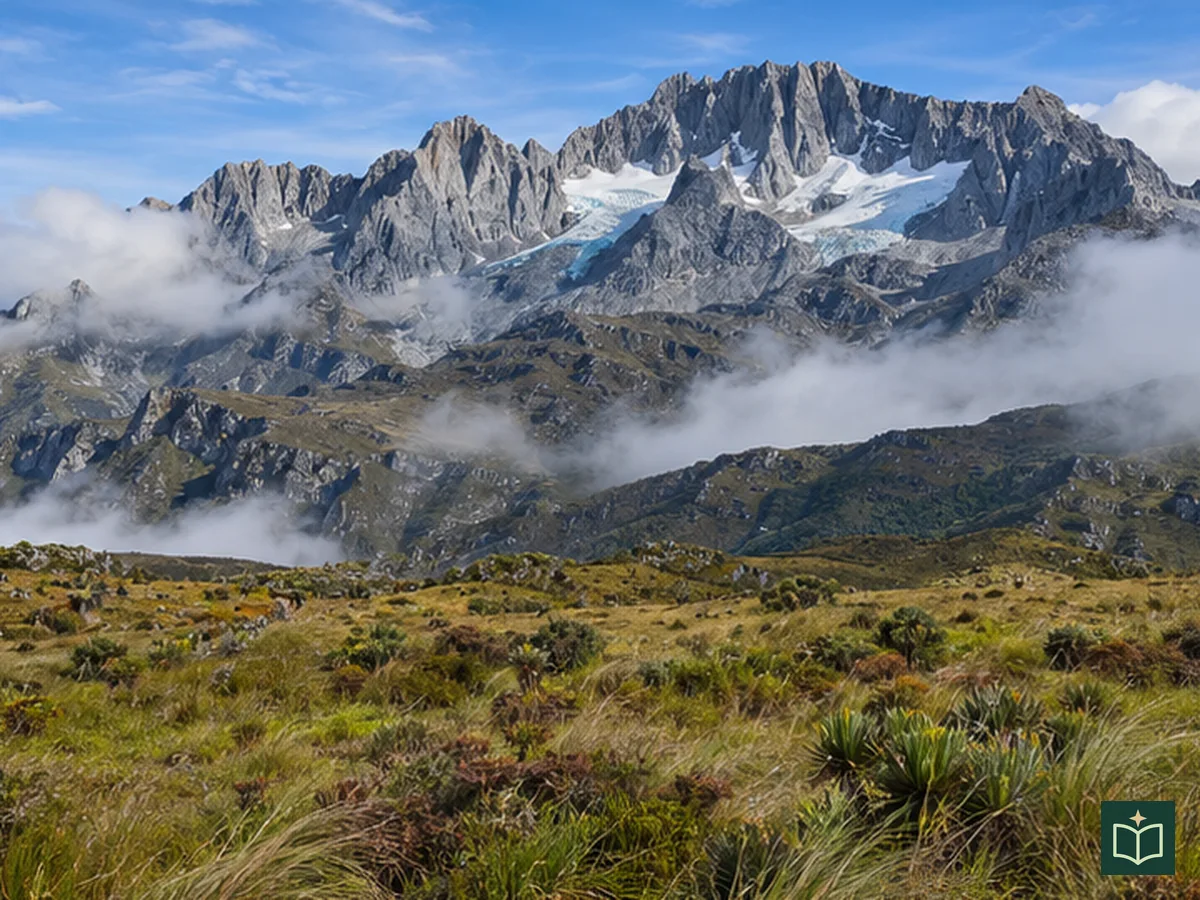
Puncak Jaya, also called Carstensz Pyramid, rises from the Sudirman Range in the Indonesian province of Central Papua. The mountain is built of limestone that formed on a shallow sea floor and was lifted more than four kilometres as the Australian plate pushed north into the plates of the Pacific. Its height has changed on paper: early expeditions estimated 5,030 metres, and that figure still appears on some maps, but a 1973 survey that placed a beacon on the summit measured 4,884 metres. Small glaciers still cling to the slopes near the equator, though they have shrunk sharply over the past century and may disappear within decades.
Volcanoes built from the sea
Five of the ten summits are volcanoes. Mauna Kea and Teide grew from the ocean floor over hotspots, where plumes of hot rock rise from deep in the mantle. Measured from its base on the Pacific floor, Mauna Kea is taller than Everest, although only 4,207 metres stand above the waves. Kerinci in Sumatra, Rinjani on Lombok and Fuji on Honshu belong to chains of volcanoes above subduction zones, where one plate sinks beneath another. Mount Erebus on Ross Island is the southernmost active volcano on Earth and holds one of the planet’s few long-lived lava lakes inside its summit crater.
Mountains pushed up by plates
The other summits were raised by collisions rather than eruptions. Taiwan sits where the Philippine Sea plate meets the Eurasian plate, and its mountains are among the fastest-rising on Earth; Yushan, at 3,952 metres, is the island’s highest point and stands above a range of more than 200 peaks over 3,000 metres. Mount Kinabalu in Borneo is a mass of granite that cooled underground and has been pushed up in geologically recent times. Aoraki in New Zealand’s Southern Alps rises along the Alpine Fault, where uplift is fast but so is erosion from heavy rain and ice, which keeps the peaks from growing much taller.
Heights that change
Island summits are a reminder that mountains are not fixed. Aoraki was measured at 3,764 metres before a huge rock avalanche in 1991 knocked about ten metres off its top. Continued erosion of the summit ice cap led to a new survey in 2014 that gave 3,724 metres, only two metres below Rinjani. Satellite positioning now allows much more precise measurements than the triangulation of the past, and the gap between some neighbours on this list is small enough that future surveys could reorder them. For comparison, the Hajar Mountains of Oman and the UAE reach about 3,000 metres, well short of every summit here.
Islands in the sky
High island mountains act as islands within islands. Their cool upper slopes are cut off from similar habitats elsewhere, so plants and animals there often evolve into unique species. Kinabalu Park, a UNESCO World Heritage Site, is one of the richest places for plants on Earth, with thousands of species and many orchids found nowhere else. The clear, dry air above Mauna Kea and Teide has made both summits major sites for astronomy, with observatories placed above much of the moisture and haze in the atmosphere. The same heights make these mountains landmarks for millions of people below, from pilgrims on Fuji to climbers on Kinabalu.
Sources & further reading
Figures are rounded and widely published; check the linked organisations for the latest editions. These organisations do not endorse this website.