Ceiling and floor
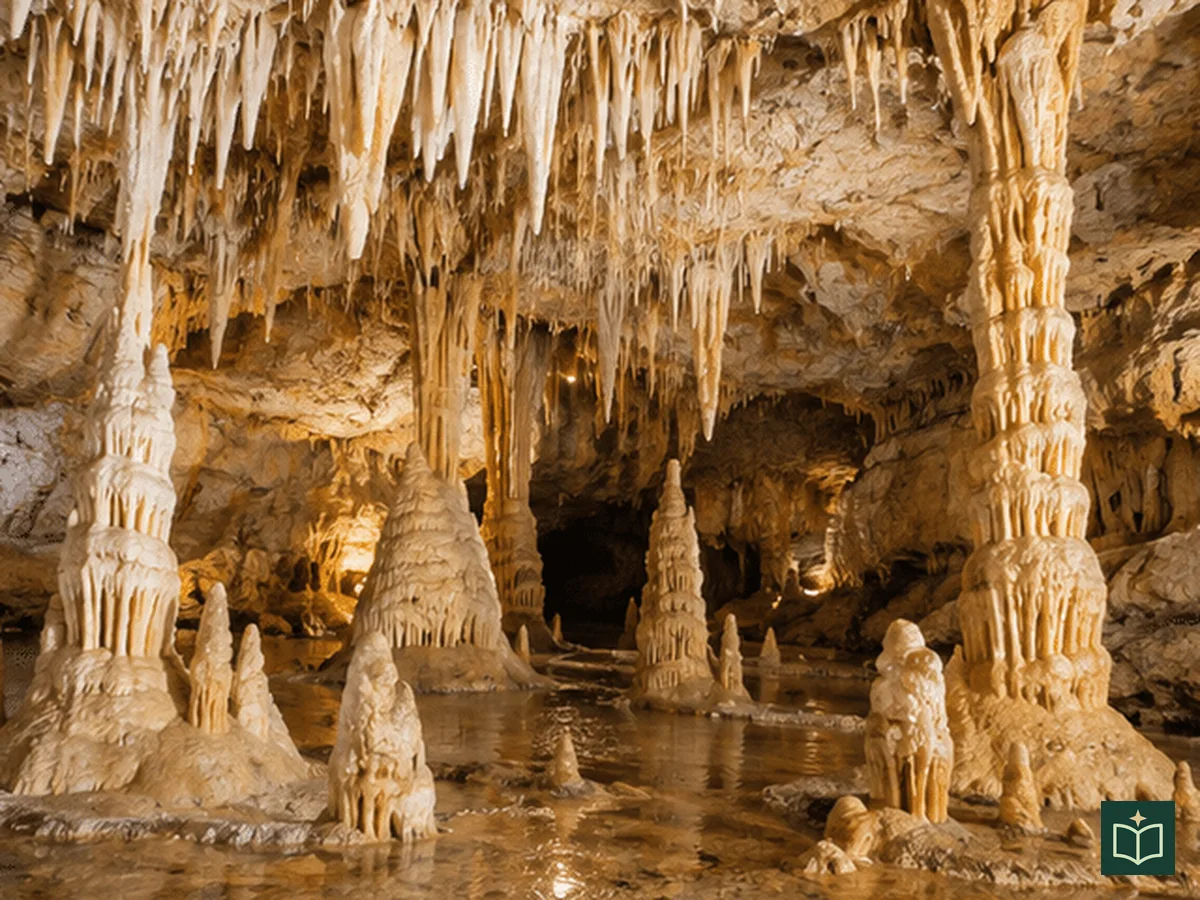
Stalactites and stalagmites are the most familiar cave formations, known collectively with other mineral deposits as speleothems. A stalactite hangs from the ceiling of a cave, like a stone icicle. A stalagmite rises from the floor, usually beneath a stalactite, as a rounded mound or column. A classic way to remember which is which is that stalactites hold tight to the ceiling, while stalagmites might one day reach the top; another is that the c in stalactite stands for ceiling and the g in stalagmite for ground. The names come from Greek words meaning 'dripping' and 'drop', a reminder that both are built by the same process of slowly dripping water.
The chemistry of a drip
The process begins at the surface. Rainwater picks up carbon dioxide from the air and, more importantly, from the soil, forming a weak carbonic acid. As this water seeps down through cracks in limestone, it dissolves calcium carbonate from the rock. When it emerges into a cave, where the air contains less carbon dioxide than the soil, some of the dissolved gas escapes from the water, much as fizz escapes from an opened bottle. That makes the water unable to hold all its dissolved mineral, and a tiny amount of calcite crystallises out. Repeated over countless drops, the deposits accumulate into formations of remarkable size and shape.
How each one grows
A stalactite usually begins as a thin, hollow tube called a soda straw, the width of a single drop. Water runs down the inside and deposits a ring of calcite at the tip, extending the tube. If the central channel becomes blocked, water flows over the outside instead, and the stalactite thickens into the familiar cone. Water that still holds some mineral then falls to the floor. When it splashes, more carbon dioxide escapes and further calcite is deposited, building a stalagmite upwards. Because the falling drops spread out, stalagmites are usually broader and blunter than stalactites, and lack the central tube. Where the two eventually meet, they form a column.
Measured in centuries
Growth is typically very slow. Many stalactites lengthen by around a tenth of a millimetre a year, about a centimetre in a century, though rates vary enormously with the amount of water, the carbon dioxide in the soil above, the temperature and the airflow in the cave. In wet tropical caves some formations can grow several millimetres a year, while in dry periods growth may stop completely. A stalagmite a metre tall can therefore represent thousands of years of deposition, and the largest formations in the world, some tens of metres high, have been growing for hundreds of thousands of years. Breaking one off destroys a record that cannot be replaced within any human timescale.
Caves of Arabia
The Arabian Peninsula, though famous for sand, has significant limestone cave systems. In the mountains of northern Oman, show caves such as Al Hoota contain stalactites and stalagmites, along with an underground lake. Scientists have studied stalagmites from Omani caves to reconstruct the region's past climate. Because stalagmites grow only when water drips, layers dated by the decay of uranium within them reveal when rain fell. These records show that Arabia went through humid periods, when the monsoon reached further north, and long dry spells. They help explain when early humans could cross the peninsula, and they offer a long-term context for the arid climate the region knows today.
Protecting the slow builders
Speleothems are fragile, and human visits can damage them in ways that are invisible at first. Touching a formation leaves skin oils that can stop calcite depositing on that spot, permanently changing its growth. Breath, body heat and lighting alter cave air and encourage algae on wet surfaces. Show caves manage these risks with walkways, controlled lighting and limits on visitor numbers. Many countries legally protect cave formations, and collecting them is forbidden in national parks and protected areas. Similar formations can also appear in tunnels and under concrete bridges, where water dissolves lime from the concrete, and these can grow much faster, sometimes several centimetres a year.
Sources & further reading
- US National Park Service · Cave formations ↗
- Britannica · Stalactite and stalagmite ↗
- USGS · Karst and caves ↗
Figures are rounded and widely published; check the linked organisations for the latest editions. These organisations do not endorse this website.