A fan of stone
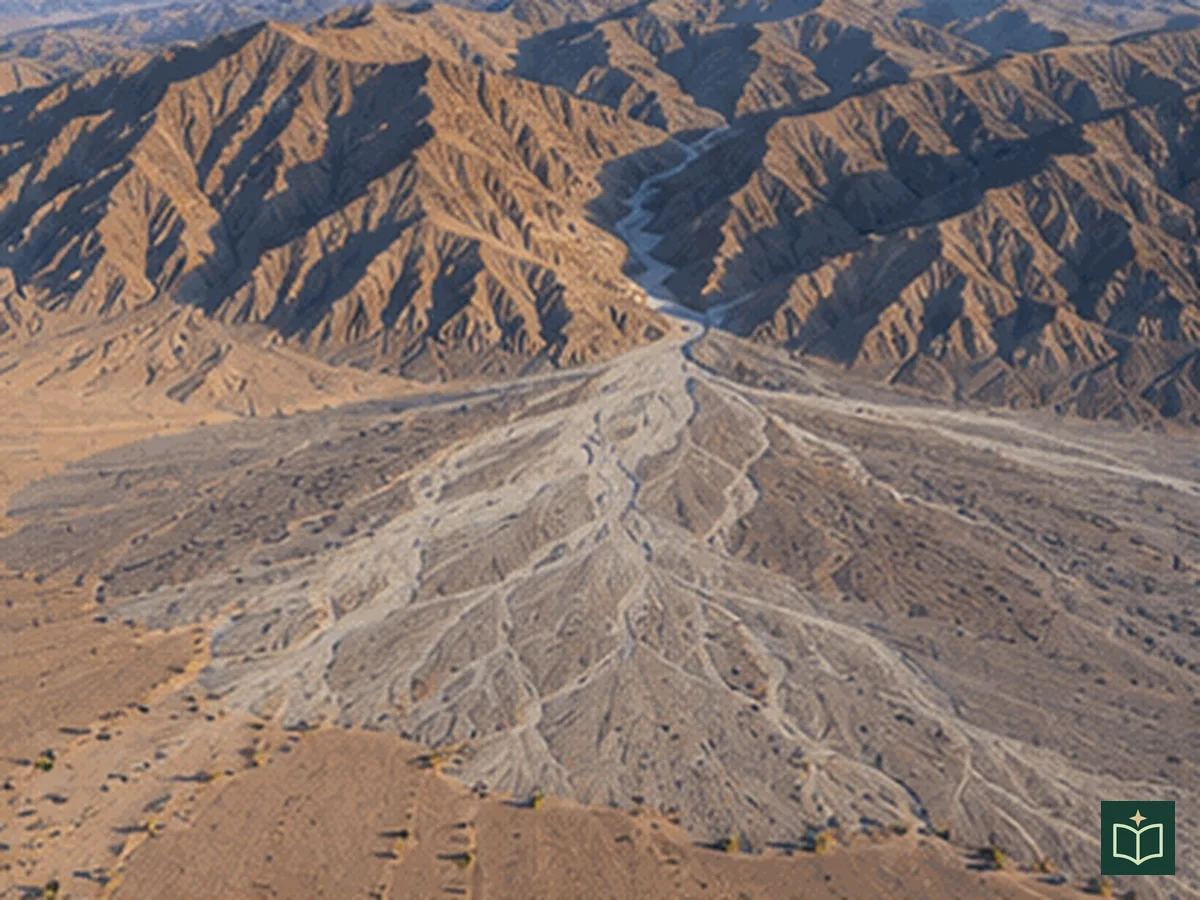
An alluvial fan is a cone-shaped spread of sediment that forms where a stream leaves a steep, narrow valley and emerges onto flatter, open ground. Seen from above it looks like a half-opened fan, with its narrow point, the apex, at the mouth of the valley and its broad edge spreading out across the plain. Fans range from a few hundred metres across to many kilometres. They are most striking in dry, mountainous regions such as Death Valley in California, the edges of the Tibetan Plateau and the Arabian Peninsula, where bare slopes and occasional violent floods supply abundant loose rock and little vegetation hides the landform.
Why the flood drops its load
A river’s ability to carry sediment depends heavily on its speed and depth. Inside a mountain wadi, storm water is squeezed into a narrow channel and races downhill, rolling boulders and carrying gravel and sand in suspension. At the mountain front the confining walls disappear. The flow spreads out across a much wider surface, becomes shallower and slows abruptly, and it also soaks quickly into the porous ground. Losing speed and volume, it can no longer carry its load. The largest stones drop first near the apex, while finer gravel, sand and silt travel further towards the fan’s outer edge, sorting the deposit by size.
A channel that keeps moving
Fans grow by shifting. As sediment builds up along one channel, that path becomes higher than the ground beside it. During the next big flood, water breaks out sideways and finds a lower route, a process called avulsion. Over thousands of floods the active channel sweeps back and forth like a garden hose left running, spreading gravel evenly in every direction and giving the fan its rounded shape. Some floods arrive as thick, muddy debris flows that carry boulders the size of cars. Others spread as thin sheets of water. Each leaves a layer, so a fan is built from countless overlapping deposits.
The Hajar’s gravel apron
The western side of the Hajar mountains shows this process on a grand scale. Wadis draining the range carry floods out of the mountains towards the interior of the UAE and Oman. Where each leaves the hills, it has built a fan of gravel, and neighbouring fans have merged into a continuous sloping apron, which geographers call a bajada. These gravel plains stretch west from the mountains around Al Ain, Al Dhaid and Hatta before giving way to sand dunes. Many date from wetter periods in the past, when larger rivers flowed more often. Today they remain active only during rare heavy storms, when flash floods briefly reshape their channels.
Water stored in gravel
Alluvial fans are valuable because they hold water. Their coarse gravel is full of pore spaces, and each flood soaks rapidly into the ground rather than running off. The fans along the Hajar front therefore form some of the most important aquifers in the region. For centuries, aflaj, gently sloping tunnels and channels, tapped this groundwater and carried it to oases such as those of Al Ain and Buraimi. Modern wells draw on the same layers to irrigate farms. Heavy pumping since the 1970s has lowered water tables in many places, which is one reason recharge dams have been built across wadis to slow floods and let more water soak in.
Living on a fan
Fans offer flat, well-drained land with water below, so towns and farms often grow on them. That brings risk. The same floods that built the fan still happen, and their channels can switch suddenly, sending water and debris across roads and homes that seemed safely away from the main wadi. Engineers map fan surfaces to identify active channels and older, more stable areas, and they design culverts, embankments and drainage to guide floods. Understanding how fans form helps planners in mountain-front cities, from the Hajar to the Andes and the Alps, decide where it is wise to build and where the next flood is likely to go.
Sources & further reading
Figures are rounded and widely published; check the linked organisations for the latest editions. These organisations do not endorse this website.