What spent fuel is
Nuclear reactors run on ceramic pellets of uranium oxide, sealed in metal tubes bundled into fuel assemblies. An assembly typically stays in a reactor for a few years before it can no longer sustain the chain reaction efficiently. When it comes out it is called spent, or used, fuel, though most of it is still uranium. Roughly 95 per cent is uranium, about one per cent is plutonium created during operation, and a few per cent are fission products and other heavy elements. Those fission products make fresh spent fuel intensely radioactive and hot. Globally, reactors discharge around 10,000 tonnes of spent fuel a year, a small volume compared with waste from fossil-fuel power.
Years in the pool
Spent fuel is moved under water into a deep pool, usually beside the reactor. The water does two jobs: it carries away the heat that radioactive decay continues to produce, and it shields workers from radiation, since a few metres of water absorb it effectively. Pools are cooled and monitored constantly. The heat and radioactivity fall steeply in the first years, so fuel typically stays in the pool for at least five years and often much longer. The 2011 Fukushima accident drew attention to pool safety when cooling was lost, prompting reforms around the world, including backup water supplies and better instruments to monitor pool levels and temperatures.
Dry casks
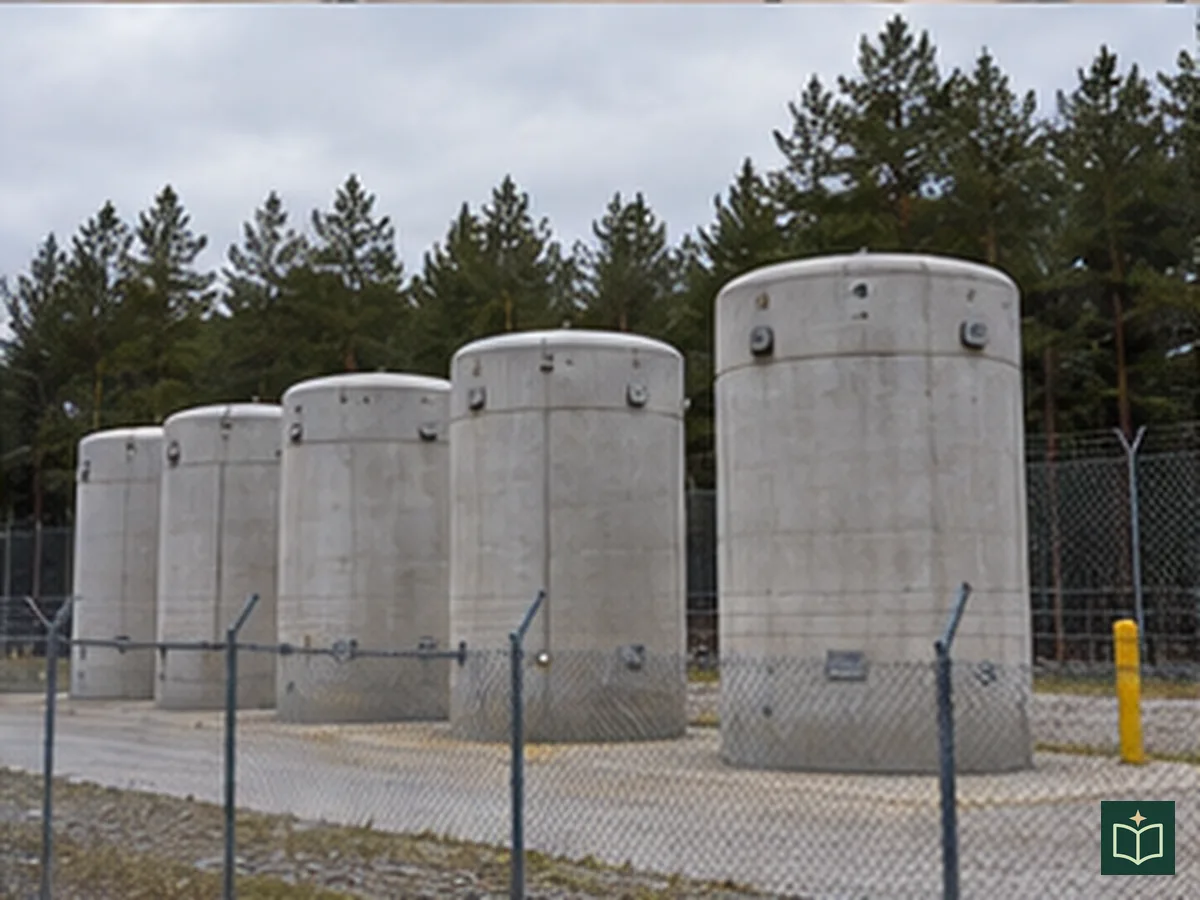
Once fuel has cooled enough, it can be moved to dry storage. Assemblies are loaded into thick steel canisters, the water is drained, the canisters are dried and filled with inert gas such as helium, and then welded or bolted shut. These sit inside massive concrete or steel casks, often on open pads at the plant site, cooled only by natural airflow. Dry storage needs no pumps or power and has a strong safety record over several decades. It is regarded as an interim solution, designed for decades rather than millennia, though licences are often extended. Many countries, including the United States, store most of their accumulated spent fuel this way while awaiting a permanent repository.
Onkalo and deep disposal
Most experts and international bodies favour deep geological disposal as the permanent answer. Finland is furthest ahead. At Olkiluoto, the company Posiva has built Onkalo, a network of tunnels around 400 to 450 metres deep in granite bedrock that has been stable for well over a billion years. The design places spent fuel in thick copper canisters with cast-iron inserts, sets them in holes drilled into the tunnel floor, and surrounds them with bentonite clay, which swells when wet and seals out water. Tunnels are then backfilled. The aim is to isolate the fuel for around 100,000 years. Sweden has approved a similar design, and France and Switzerland are developing their own repositories.
Why it stays hazardous
Radioactivity falls with time, but not uniformly. The short-lived fission products that make fresh fuel so hot decay over decades to a few centuries. Longer-lived elements, especially plutonium and other actinides, remain radioactive for tens of thousands of years, which is why repositories are designed for geological timescales. After several centuries the fuel’s radioactivity is far lower, yet it would still be dangerous if swallowed or inhaled. Repository safety is therefore built on several barriers working together: the solid fuel, the canister, the clay and the rock. Each slows the movement of radioactive material so that any eventual leakage would be tiny and long delayed.
Reprocessing and the UAE
Some countries reprocess spent fuel instead of disposing of it directly. France, at La Hague, chemically separates the uranium and plutonium for reuse, often as mixed-oxide fuel, leaving fission products to be melted into glass for disposal. This shrinks the volume of the most hazardous waste and recovers fuel, but it is costly, handles separated plutonium that must be tightly guarded, and still needs a repository. The UAE, whose Barakah plant supplies a large share of its electricity, has committed not to enrich uranium or reprocess spent fuel at home. Its used fuel is stored at the site, first in pools and then in dry storage, while longer-term options are studied.
Sources & further reading
Figures are rounded and widely published; check the linked organisations for the latest editions. These organisations do not endorse this website.