An annual balance, not a cut-off
A net-zero energy building produces as much renewable energy over a year as it uses. It is rarely self-sufficient at every moment. On a bright afternoon its solar panels may export surplus electricity to the grid; at night, and on the hottest evenings, it draws power back. What matters is that the two totals cancel out across twelve months. The US Department of Energy's definition, published in 2015, counts the energy delivered to the building against the renewable energy it exports, measured on a source-energy basis. Other schemes measure carbon rather than energy, or allow off-site renewables bought under contract. Comparing labels therefore means checking exactly what was counted and where.
Demand comes first
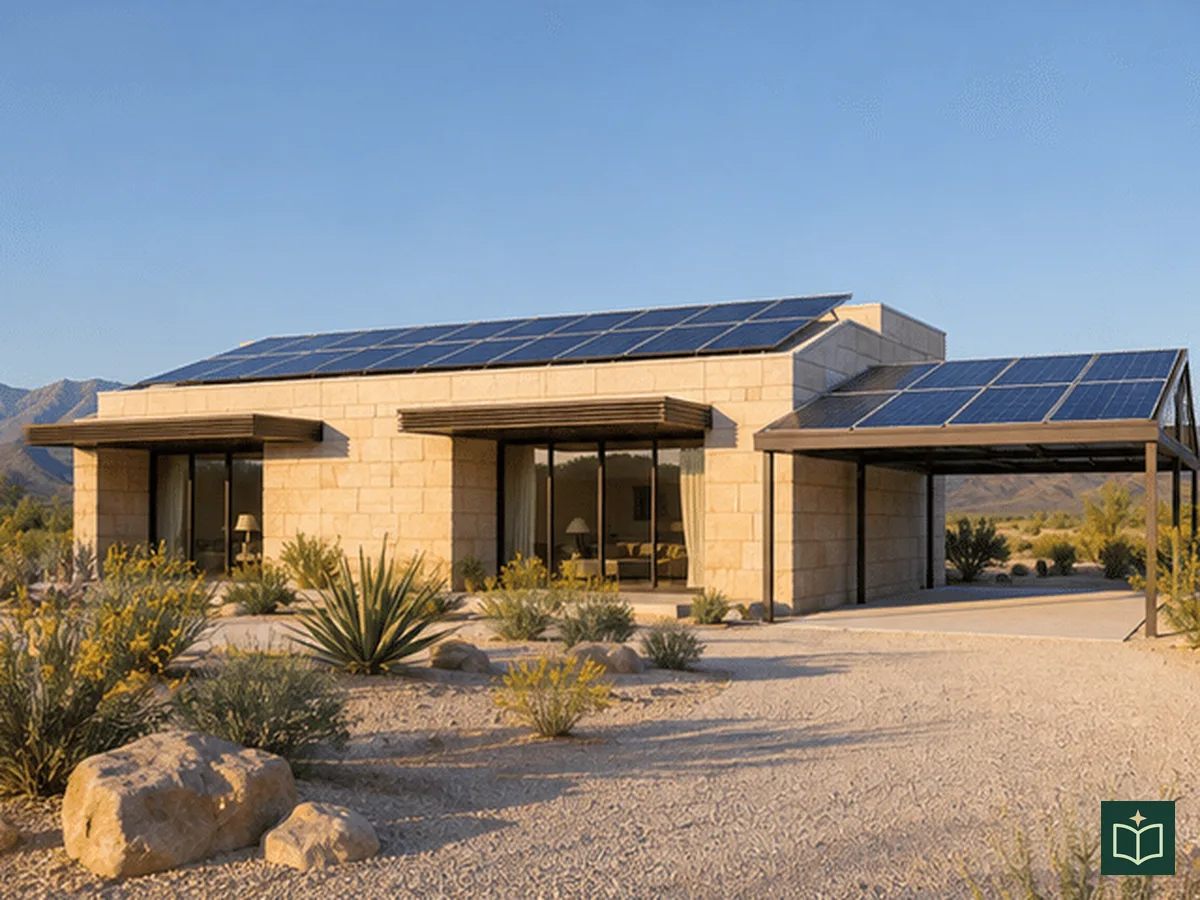
Designers almost always begin by shrinking the load, because every kilowatt-hour saved is one that panels do not have to supply. In hot climates that means keeping heat out: shading windows, choosing glazing that admits light but blocks infrared, insulating roofs and walls and sealing air leaks. Next come efficient systems, such as high-performance chillers or heat pumps, LED lighting with daylight sensors, and fans and pumps with variable-speed drives. Orientation matters too, since east and west façades take the harshest low sun. A well-designed building can use half the energy of a conventional one, which turns an impossible generation target into one a roof can realistically meet.
Then generate on site
Solar photovoltaics are the usual source because they are modular, quiet and easy to mount on roofs, car-park canopies and sometimes façades. Solar water heating can cover hot water directly, and a few sites add small wind turbines or geothermal heat pumps. Batteries are optional: they shift solar output into the evening but do not change the annual balance, and charging them loses some energy. The grid acts as the building's seasonal store. Dubai's Shams Dubai programme, launched by the utility DEWA in 2015, allows owners to connect rooftop systems and offset exported electricity against imports, the kind of net-metering arrangement that makes the accounting work.
A villa and a tower
Assume, as a rough illustration, that a square metre of panel in the UAE yields about 340 kWh a year. A two-storey villa of 300 square metres with 100 square metres of panels could produce around 34,000 kWh, enough for a very efficient home using 100 kWh per square metre, or 30,000 kWh a year. Now take a 40-storey office tower of 40,000 square metres using 150 kWh per square metre: 6 million kWh a year. Even with 600 square metres of panels covering its roof, it generates only about 204,000 kWh, roughly 3 per cent of its needs. The roof simply grows far more slowly than the floors beneath it.
Why towers struggle
The problem is geometry. Floor area rises with every storey, but roof area does not, and façades receive sunlight only at an angle and are often shaded by neighbouring buildings. Gulf towers face extra burdens: cooling loads that run for most of the year, extensive glazing, lifts, water pumping to upper floors and long operating hours. Dense data rooms and retail podiums add more. As a result, most high-rise projects that call themselves net zero rely on renewable power generated elsewhere and supplied through the grid or a contract, or they target net-zero carbon instead. Low-rise schools, offices, warehouses and villas, with large roofs relative to their floor area, are far better candidates.
What the label leaves out
Net-zero energy usually covers only operational energy: cooling, lighting, equipment and hot water. It normally excludes the energy and emissions embodied in concrete, steel, glass and aluminium during construction, which can be substantial. It also says little about when energy is used. A building that exports at midday and imports at the evening peak still pushes demand onto the grid at its most stressful hour. For that reason, newer approaches reward buildings that shift loads, store cold or heat, and respond to grid signals. A useful test for any net-zero claim is to ask what was counted, over what period, and whether efficiency or offsets did most of the work.
Sources & further reading
- US Department of Energy · Building Technologies Office ↗
- IEA · Buildings ↗
- Dubai Electricity and Water Authority ↗
Figures are rounded and widely published; check the linked organisations for the latest editions. These organisations do not endorse this website.