Two words often swapped
Films, headlines and even school projects sometimes use solar system and galaxy as if they meant the same thing, but they differ in scale by a factor of millions. A solar system is a star together with everything gravitationally bound to it: planets, moons, asteroids, comets and dust. Ours is called the Solar System, with capital letters, because it belongs to the Sun, known in Latin as Sol. Systems around other stars are often called planetary systems. A galaxy is something far larger, a huge collection of stars, gas, dust and dark matter, held together by gravity and turning around a common centre.
What a solar system holds
Our Solar System has one star, eight planets, several known dwarf planets, hundreds of moons and countless smaller bodies. The Sun contains more than 99% of the system's mass, which is why everything else orbits it. Neptune, the outermost planet, lies about 4.5 billion kilometres from the Sun, and light takes roughly four hours to make that journey. Beyond lie the Kuiper Belt and, much farther out, the hypothesised Oort Cloud of icy bodies, which may stretch more than a light-year away. Since the 1990s astronomers have confirmed more than 5,000 planets around other stars, showing that planetary systems are common.
What a galaxy holds
The Milky Way, our home galaxy, is a barred spiral disc about 100,000 light-years across, containing an estimated 100 billion to 400 billion stars. A light-year is the distance light travels in a year, about 9.5 trillion kilometres. At the centre sits a supermassive black hole about four million times the mass of the Sun. The galaxy also contains vast clouds of gas where new stars form, and it is surrounded by a halo of dark matter that outweighs all the stars combined. The Sun sits about 26,000 light-years from the centre and takes roughly 230 million years to complete one orbit around it.
Putting the scales together
A scale model helps. If the orbit of Neptune were shrunk to one centimetre across, the Milky Way on the same scale would be about 1,000 kilometres wide. The nearest other star, Proxima Centauri, would be around 30 metres away. In other words, the space between solar systems dwarfs the systems themselves, and a galaxy is mostly empty. Galaxies themselves are spread through the universe in groups and clusters. The Andromeda Galaxy, the nearest large spiral, is about 2.5 million light-years away. Astronomers estimate that the observable universe contains hundreds of billions of galaxies, and possibly more, each with its own multitude of stars.
How the confusion arose
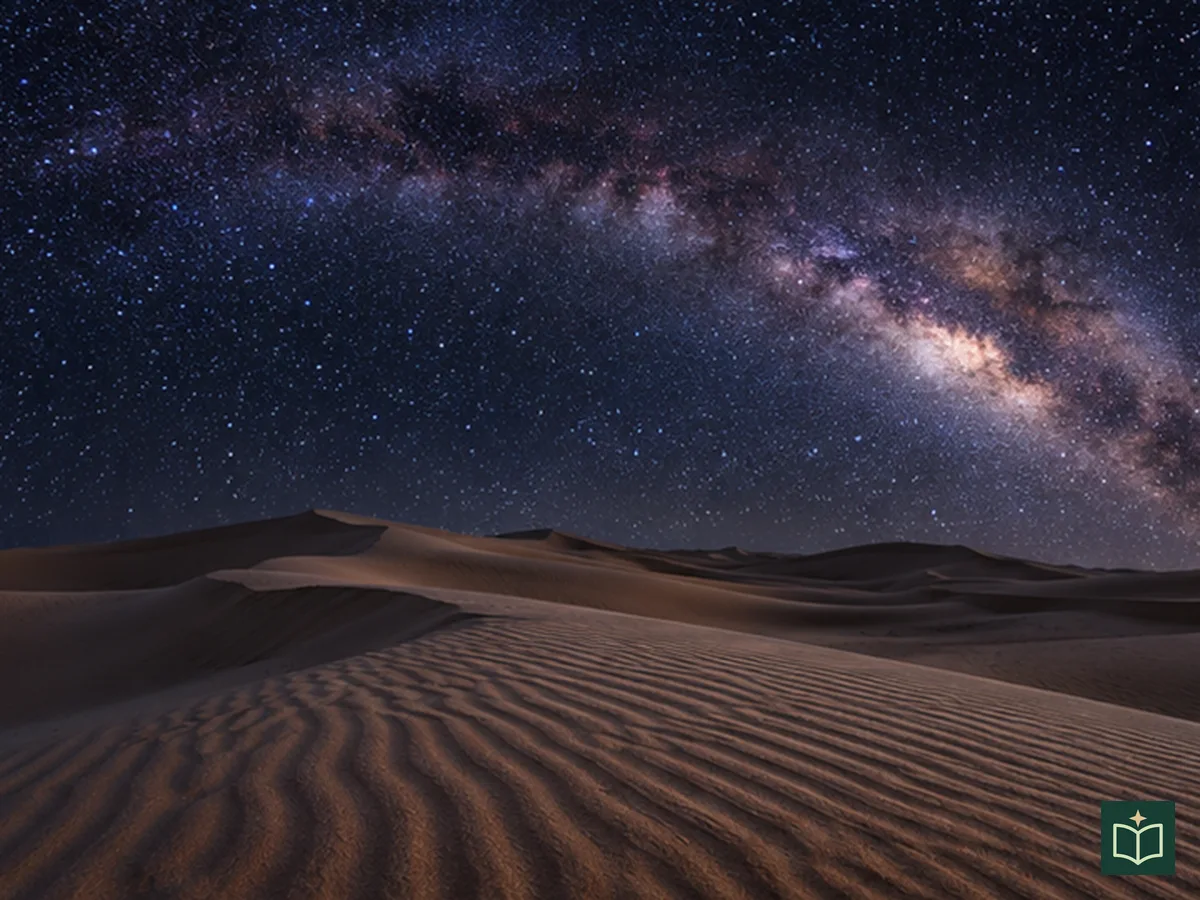
The idea of other galaxies is surprisingly recent. Until the 1920s, many astronomers thought the Milky Way was the entire universe and that faint spiral smudges in telescopes were clouds of gas within it. In 1924 Edwin Hubble measured the distance to stars in the Andromeda 'nebula' and showed it lay far outside our galaxy, making it a galaxy in its own right. The word galaxy itself comes from the Greek for milk, a reference to the pale band of light across the night sky. That band, visible from dark desert sites in the UAE and Oman, is the combined glow of billions of distant stars in our galaxy's disc.
Common mistakes
One frequent error is saying that a spacecraft has left the galaxy when it has merely crossed into interstellar space. Voyager 1, launched in 1977, passed the edge of the Sun's bubble of solar wind in 2012, but it remains deep inside the Milky Way and will for an unimaginably long time. Another mistake is calling a distant star cluster or nebula a galaxy. Clusters and nebulae are parts of galaxies. A third is imagining that the Solar System sits at the centre of the Milky Way; it lies in a quiet region of one spiral arm, about halfway out from the centre to the visible edge of the disc.
Sources & further reading
Figures are rounded and widely published; check the linked organisations for the latest editions. These organisations do not endorse this website.