No legal size limit
Most people assume a pond is simply a small lake, and in everyday speech that is roughly how the words are used. But there is no internationally agreed size at which one becomes the other. Different countries, scientists and conservation groups have proposed thresholds, and they do not match. One widely used UK definition, from the Freshwater Habitats Trust, treats any water body between one square metre and two hectares that holds water for at least four months a year as a pond. Other definitions use depth instead of area. Ecologists tend to prefer functional tests based on how the water body behaves, rather than on its surface area alone.
The light test
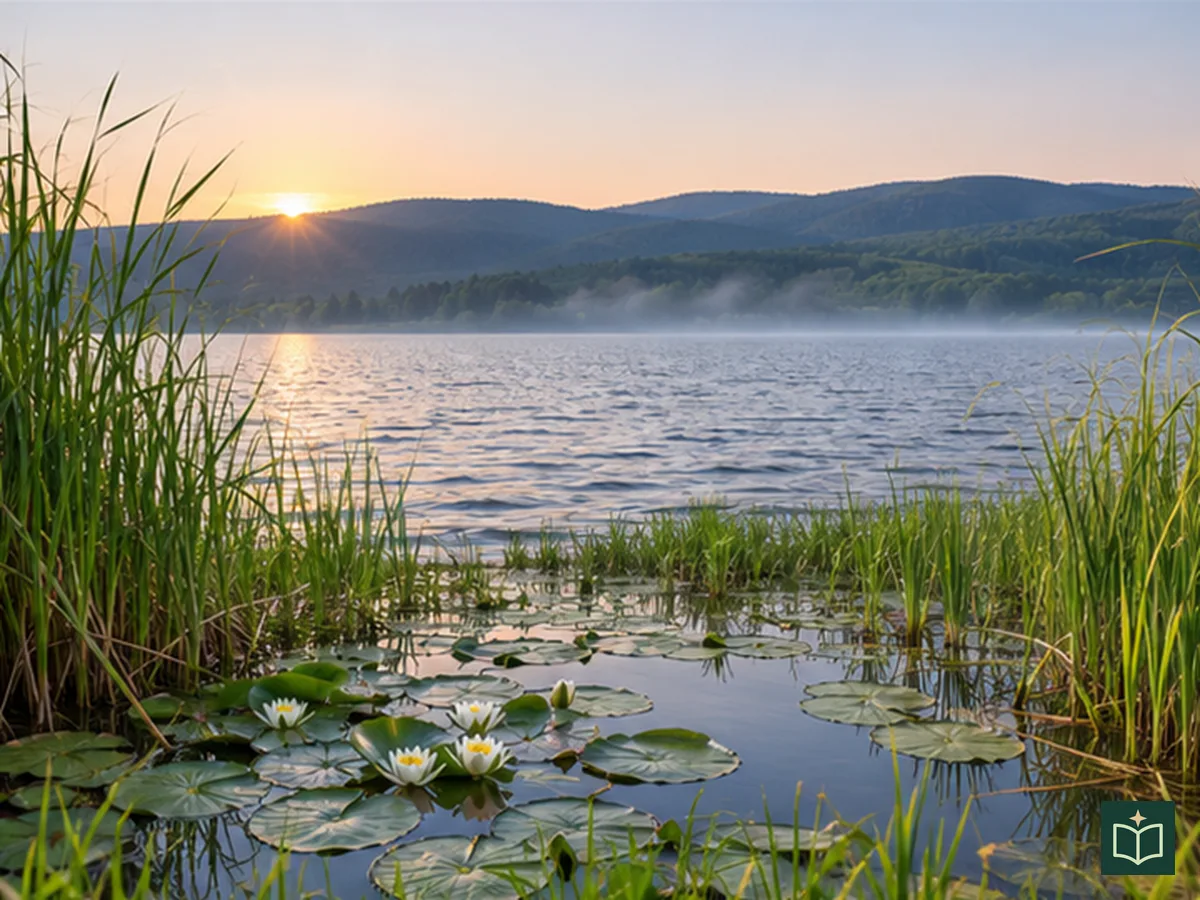
The most useful scientific distinction concerns sunlight. In a pond, light reaches the bottom across most or all of the basin, so rooted plants such as reeds and water lilies can grow from shore to shore. The whole water body sits within what ecologists call the photic zone. In a lake, the water is deep enough that light fades before it reaches the bottom in the middle, creating a dark profundal zone where rooted plants cannot survive. Life there depends on organic matter sinking from above. How deep light reaches varies with clarity, so a clear, shallow lake and a murky, deeper pond can blur the line between categories.
The temperature test
Depth also controls temperature. In summer, the surface of a lake warms while deeper water stays cold, and the two layers separate, with a sharp boundary between them called the thermocline. Because warm water is lighter, the layers resist mixing until autumn cooling or strong winds stir them again. This seasonal stratification affects oxygen levels, nutrients and where fish can live. A pond is usually too shallow for stable layers to form. Its water is mixed from top to bottom by wind and daily temperature changes, and its temperature follows the air more closely. Ponds therefore warm and cool faster, and in cold climates they freeze more readily.
The wave test
A third test is wave action. On a lake, wind blowing across a long stretch of open water builds waves strong enough to erode the shore, sort pebbles and sand, and stop plants from rooting along exposed edges. The longer the distance the wind blows over, known as the fetch, the bigger the waves. On a pond, the fetch is short and the waves stay small, so plants can grow right to the water's edge and the shoreline is shaped by vegetation rather than by surf. These tests usually agree with each other, but not always, which is why some water bodies remain hard to classify scientifically.
Names that break the rules
Place names often ignore the science. In New England in the United States, many sizeable water bodies are called ponds by tradition. Walden Pond in Massachusetts, made famous by the writer Henry David Thoreau, is about 30 metres deep, far deeper than many lakes. Meanwhile, small ornamental waters in parks are sometimes called lakes because the word sounds grander. Reservoirs created by dams are frequently called lakes too. In the UAE, natural freshwater lakes are rare, and well-known lakes such as those at Al Qudra near Dubai are artificial, created in the desert and fed by treated water to support wildlife and recreation.
What to take away
The difference between a lake and a pond is best understood as a spectrum rather than a line. At one end are shallow, plant-filled, well-mixed waters where light reaches everywhere; at the other are deep, layered bodies with dark depths and wave-beaten shores. Where a particular water body sits on that spectrum tells ecologists far more than its name on a map. For anyone visiting a lake or pond, the clues are visible: plants growing across the middle suggest a pond, a pebble beach shaped by waves suggests a lake. And when a name seems wrong, it is usually tradition, not science, that chose it.
Sources & further reading
Figures are rounded and widely published; check the linked organisations for the latest editions. These organisations do not endorse this website.