Beyond the chillers
In a Gulf skyscraper, cooling usually dominates the energy bill, often accounting for well over half of electricity use. But height brings its own costs that low-rise buildings barely notice. Thousands of people must be carried up and down every day. Water for drinking, washing, cooling towers and fire protection must be pumped hundreds of metres. Fresh air must be drawn in, filtered, conditioned and pushed through long vertical shafts. Façades and lobbies are lit for long hours. Each of these loads is modest on its own, but together they can make up a significant share of a tower's consumption, and they grow with the number of floors above the ground.
Lifts and counterweights
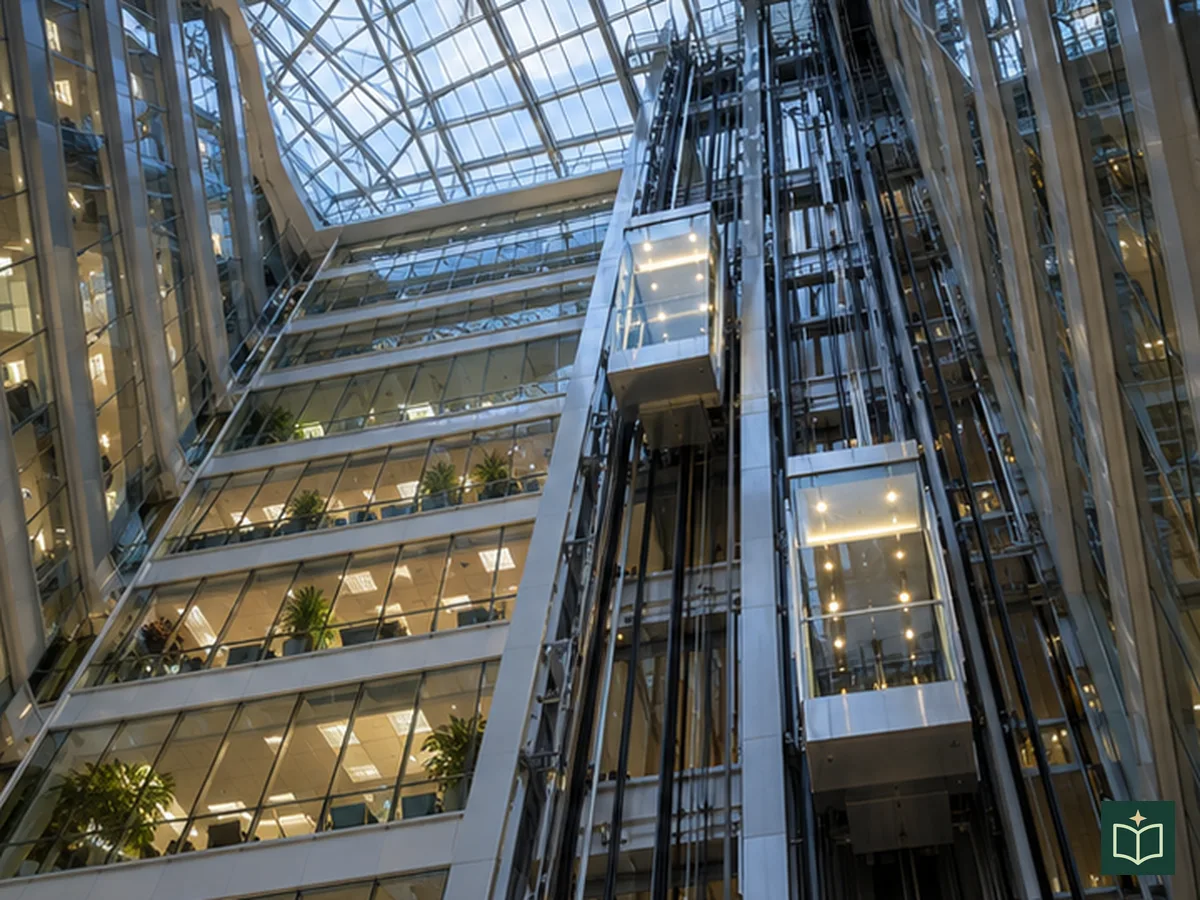
A lift does less work than it seems, because its car is balanced by a counterweight, typically equal to the empty car plus roughly 40 to 50 per cent of its rated load. The motor mainly supplies the difference and overcomes friction. Modern gearless machines with regenerative drives go further: when a heavy car descends or a light one rises, the motor acts as a generator and feeds electricity back into the building. Destination-dispatch systems, where passengers select their floor in the lobby, group journeys and cut empty trips. Very tall towers use sky lobbies and double-deck cars so that fewer shafts serve more people. Lifts commonly use several per cent of a tall building's electricity.
Pumping water uphill
Water pressure rises by about one bar for every 10 metres of height, so no single pump or pipe can serve a 300-metre tower comfortably. Engineers divide the building into pressure zones. Pumps lift water in stages to storage tanks on mechanical floors, and each tank feeds the floors below by gravity, with pressure-reducing valves where needed. Lifting one cubic metre of water 300 metres takes about 0.82 kilowatt-hours in theory; with pumps around 70 per cent efficient, about 1.2. A tower using 500 cubic metres a day would therefore spend roughly 580 kilowatt-hours daily just on lifting water, which is why careful zoning and efficient fixtures matter.
Air that must travel
Ventilation fans run whenever a building is occupied and often longer. In tall towers, air travels through long shafts and ducts, so fans must work harder against friction. Variable-speed drives let fans slow down when fewer people are present, and because fan power falls roughly with the cube of speed, running at 80 per cent speed needs only about half the power. Carbon-dioxide sensors adjust fresh-air intake to actual occupancy. Energy-recovery wheels transfer coolness from outgoing exhaust air to hot incoming air, a valuable trick in Gulf summers. The stack effect, in which pressure differences drive air up or down shafts, also has to be managed with careful sealing and revolving doors.
Lights inside and out
Lighting runs for long hours in deep-plan offices, car parks, corridors and stairwells. LED fittings, daylight sensors near windows and occupancy controls in less-used spaces can cut lighting energy sharply compared with older fluorescent systems. Façade lighting, which turns some towers into night-time landmarks, also uses LEDs today, and many owners now schedule displays for specific hours rather than all night. Lift lobbies, signage and car-park ventilation add smaller loads that run around the clock. A building management system can tie these together, switching off what is not needed and flagging equipment that runs when it should not, such as fans left on at weekends.
Why height still costs
Even with every trick, tall buildings face a structural disadvantage. More of their floor area is given over to lift shafts, plant rooms and risers, and their roof area is tiny relative to their floors, limiting on-site solar. Mechanical floors, staged water tanks and lift banks are themselves energy-saving responses to height. Supertall towers are therefore judged less on absolute consumption than on intensity, measured in kilowatt-hours per square metre per year, and on how well their systems are tuned after opening. For planners, the energy question is not whether to build tall, but how to make vertical living and working move as little mass as possible.
Sources & further reading
Figures are rounded and widely published; check the linked organisations for the latest editions. These organisations do not endorse this website.