Who made the list
The idea of seven wonders comes from Greek writers after the conquests of Alexander the Great, when Greek-speaking travellers could visit a wide region around the eastern Mediterranean and the Near East. They called these places 'theamata', things to be seen, rather than wonders. Several versions of the list existed. The best-known early list appears in a poem by Antipater of Sidon in the second century BC, and a short work attributed to Philo of Byzantium describes them too. The canonical seven settled later. The number seven was considered special and complete. All seven were in lands the Greeks knew well, which is why monuments from China, India or the Americas are absent.
The Great Pyramid
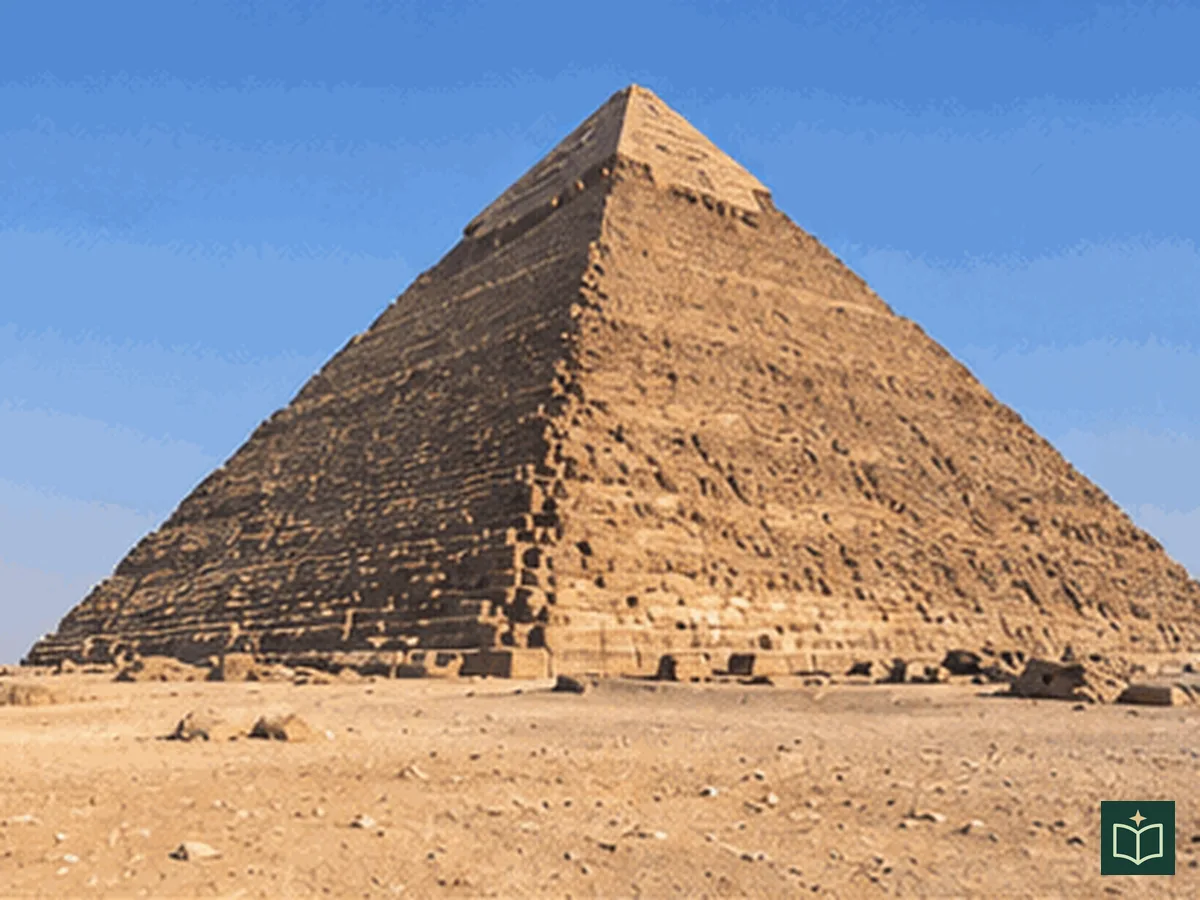
The oldest wonder, and the only survivor, is the Great Pyramid at Giza, built for the pharaoh Khufu around 2560 BC. It was already more than 2,000 years old when the Greek lists were written. Originally about 146 metres tall, it was the tallest human-made structure on Earth for nearly 4,000 years. It now stands about 139 metres, because its smooth outer casing of white limestone and its top stones were removed, much of the casing taken for building in medieval Cairo. Its survival owes much to its shape and solidity: a vast mass of stone blocks, with its weight spread across a broad base, is extremely hard to topple.
Gardens, a temple and a statue
The Hanging Gardens of Babylon, said to have been built by King Nebuchadnezzar II, are the most mysterious. No Babylonian text mentions them, and archaeologists have not found them; some scholars suggest they were actually at Nineveh, and some doubt they existed at all. The Temple of Artemis at Ephesus, in today's Turkey, was a vast marble temple. It was burned by an arsonist in 356 BC, rebuilt, and later destroyed during raids and the decline of the city. The Statue of Zeus at Olympia, made by the sculptor Phidias from ivory and gold around 435 BC, stood about 12 metres tall and was lost by the fifth century AD.
A tomb, a giant and a lighthouse
The Mausoleum at Halicarnassus, now Bodrum in Turkey, was the tomb of Mausolus, a regional ruler, finished around 350 BC; it gave us the word mausoleum. Earthquakes damaged it, and in the fifteenth century crusader knights used its stones to build Bodrum castle. The Colossus of Rhodes, a bronze statue of the sun god Helios about 33 metres tall, stood by the harbour for only around 54 years before an earthquake toppled it in 226 BC. The Lighthouse of Alexandria, on the island of Pharos, rose perhaps 100 metres and guided ships for over a thousand years, before earthquakes ruined it. Sultan Qaitbay built a fort on its site in 1477.
Why six disappeared
The six lost wonders fell for different reasons, but a pattern stands out. Several stood in earthquake zones around the eastern Mediterranean. Others were made of materials that people valued for reuse: bronze from the Colossus, which later accounts say was sold for scrap centuries after it fell; gold and ivory from the Zeus statue; and dressed stone from the Mausoleum and lighthouse. Temples lost their purpose when religions changed. The Great Pyramid escaped most of these risks. Egypt's Giza plateau is relatively stable, its core stones were too large and rough to be worth taking in quantity, and its shape is about as stable as a building can be.
New lists of wonders
The idea of listing wonders has never gone away. Medieval writers made lists that included Stonehenge and the Colosseum, and modern magazines and organisations produce lists of natural and engineering wonders. In 2007 a private foundation organised a global public vote for 'New Seven Wonders', choosing sites including the Great Wall of China, Petra, the Colosseum, Chichén Itzá, Machu Picchu, the Taj Mahal and the Christ the Redeemer statue in Rio de Janeiro; the Great Pyramid was given honorary status. UNESCO's World Heritage List, with more than a thousand sites, is a more systematic successor. The ancient list still matters as a window into what Greek travellers found most astonishing.
Sources & further reading
Figures are rounded and widely published; check the linked organisations for the latest editions. These organisations do not endorse this website.