An island of statues
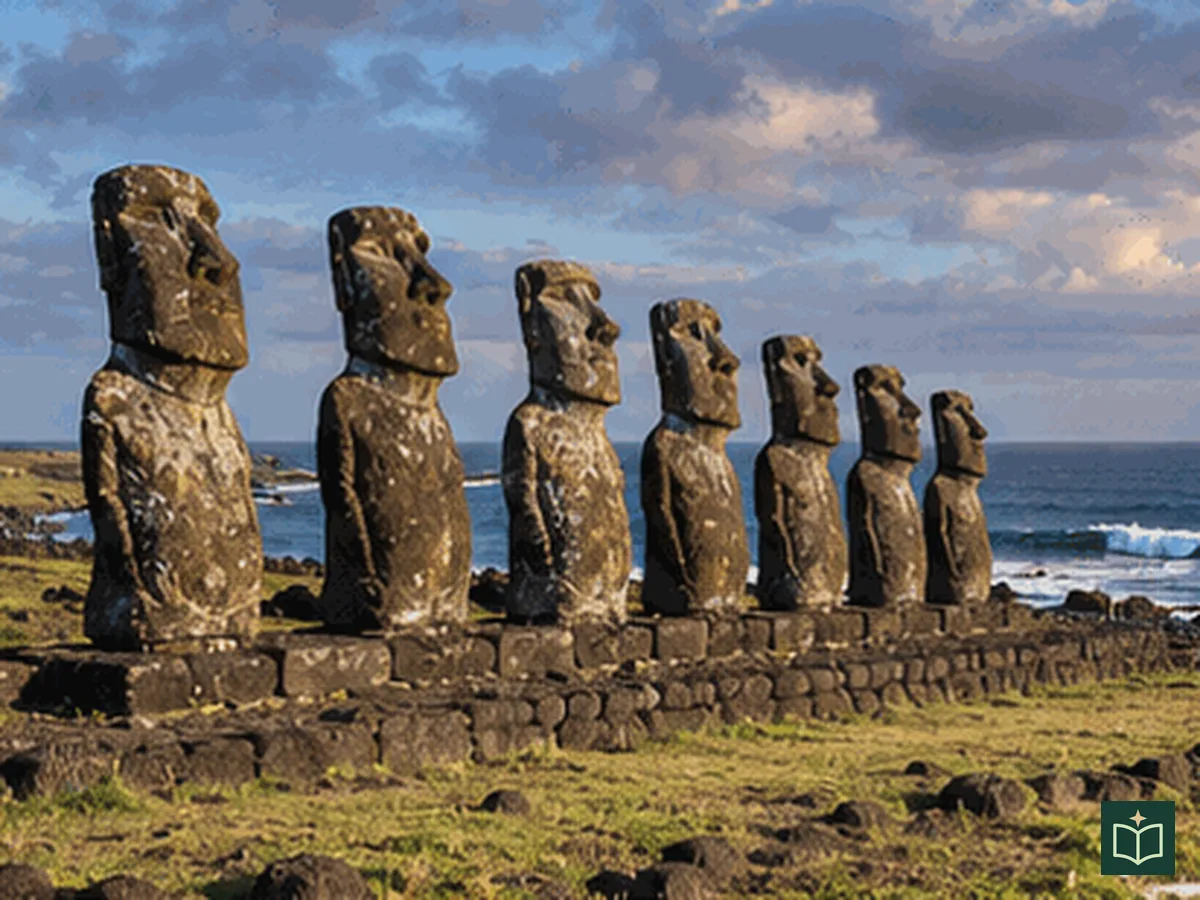
Rapa Nui, also called Easter Island, is a small volcanic island in the south-eastern Pacific, about 3,700 kilometres west of Chile, which governs it today. Polynesian voyagers settled it, most researchers now think, around AD 1200. Over the next few centuries the islanders carved the moai, stone figures with large heads and long ears, representing deified ancestors. Many were set up on stone platforms, called ahu, near the coast, usually facing inland towards the communities they protected. Nearly a thousand have been recorded. They average about four metres tall and weigh around twelve tonnes, though the largest erected moai, known as Paro, stood about ten metres tall.
The quarry at Rano Raraku
Almost all the moai were carved from volcanic tuff, a relatively soft compacted ash, at Rano Raraku, an extinct volcanic crater. Hundreds of statues remain there, at every stage of work. Some are still attached to the rock face, showing how carvers cut channels around a figure, shaped its front and sides with basalt hand tools, and finally detached it along its back. One unfinished giant, nicknamed El Gigante, would have stood about 21 metres tall had it been completed. Finished statues were slid down the slope and stood upright in pits to have their backs finished. Many were then moved, some as far as 18 kilometres, to platforms around the island.
The puzzle of transport
How did people without wheels, large draught animals or cranes move statues weighing many tonnes across hilly ground? Many theories have been proposed. Some imagined moai laid flat on wooden sledges and dragged over rollers, a method that would need many people and large quantities of timber. That idea fed a popular story that islanders cut down all their trees to move statues, causing ecological collapse. Yet Rapa Nui oral traditions told a different story: the moai walked from the quarry to their platforms, moved by mana, spiritual power. For a long time outsiders treated this as myth rather than as a possible description of a technique.
The walking experiment
In 2012 the archaeologists Terry Hunt and Carl Lipo, working with Rapa Nui colleagues, tested the walking idea. They built a concrete replica of about 4.35 metres and roughly five tonnes, shaped like moai found abandoned along ancient roads. A team of 18 people used three ropes: one on each side and one behind. By pulling the side ropes in turn, they rocked the statue so it pivoted forward on one edge of its base, then the other, while the rear rope kept it from falling forwards. The replica 'walked' about 100 metres in under an hour. The method needed far fewer people and no timber.
Clues in the roads
Further evidence supports the idea. Moai found abandoned along the ancient roads differ from those set up on platforms: they have wider bases with a D-shaped front edge and lean forward, features that help a statue rock and step. Their eye sockets were not yet carved, a detail added after arrival. Fallen road moai lie both face down and on their backs, consistent with statues that toppled while upright. The roads themselves are about 4.5 metres wide and slightly concave in cross-section, which would help keep a rocking statue stable and centred. Researchers have also used computer models to show how lean and base shape make walking efficient.
Rethinking the collapse story
The walking evidence feeds into a wider debate about Rapa Nui's history. The island did lose its palm forests, but recent research points to several causes, including rats introduced by the first settlers, which ate palm seeds. Many researchers now argue that the population was relatively stable before European contact in 1722, and that the true catastrophe came afterwards, through introduced diseases and nineteenth-century slave raids that carried away many islanders. Rapa Nui National Park is a UNESCO World Heritage Site, and Rapa Nui communities today take a leading role in managing it. The moai stand as evidence of engineering skill, not of a society that destroyed itself.
Sources & further reading
Figures are rounded and widely published; check the linked organisations for the latest editions. These organisations do not endorse this website.