Egypt's southern neighbour
Kush was the name Egyptians gave to Nubia, the stretch of the Nile valley south of Aswan that lies mostly in today's Sudan. The region was home to complex societies with roots almost as deep as Egypt's own, and the town of Kerma was a powerful capital by about 2000 BC. Egypt conquered Nubia during the New Kingdom, valuing its gold, ivory, ebony and soldiers. When Egyptian control faded after about 1070 BC, a new Kushite state arose around Napata, beside the flat-topped mountain of Jebel Barkal, which Kushites and Egyptians alike regarded as a home of the god Amun.
When Kush ruled Egypt
Around 727 BC the Kushite king Piye marched north and subdued a divided Egypt, recording his campaign on a great granite stela at Jebel Barkal. His successors ruled from the Mediterranean to beyond the Fourth Cataract, a span of more than 1,500 kilometres along the river. Known as Egypt's 25th Dynasty, they presented themselves as restorers of old traditions, repairing temples and reviving earlier artistic styles. The best known, Taharqa, built widely in both lands. Their rule ended when Assyrian armies invaded Egypt in the 660s BC and drove the Kushites back south, but the kingdom itself carried on for another thousand years.
Pyramids of a different shape
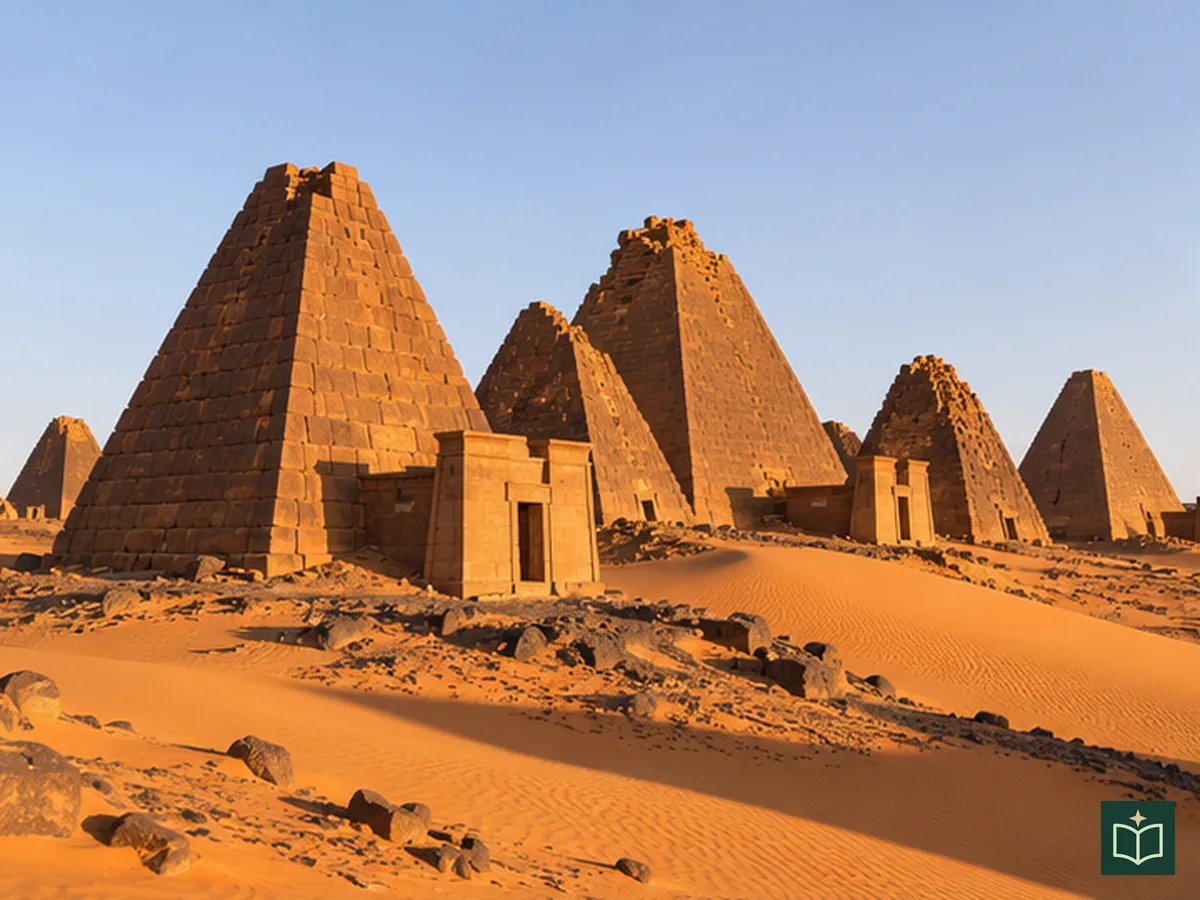
Kushite kings revived pyramid burial, which Egyptian rulers had abandoned centuries earlier. Their pyramids look different: they are much smaller, typically between about 6 and 30 metres high, and much steeper, with sides rising at around 70 degrees. Each usually had a small offering chapel built against its eastern face, while the burial itself lay in chambers cut into the rock beneath, reached by a stairway. The earliest royal pyramids stand at El-Kurru and Nuri, near Napata. Taharqa's pyramid at Nuri is the largest of them all. Later, the royal cemetery moved to Meroë, where clusters of pyramids still crowd the sandy ridges.
Meroë, a city of iron
From around the third century BC Meroë, between the Fifth and Sixth Cataracts, became the main royal city. It sat where rain-fed grasslands met the river, good country for cattle and crops, and on routes linking the Nile with the Red Sea and Central Africa. Large mounds of slag around the town show that iron was smelted there on a substantial scale, using local ore and charcoal from acacia woodland. Meroë's rulers, who included several powerful queens known by the title kandake, developed their own Meroitic script. Scholars can read the sounds of its signs, but the language itself is still only partly understood.
Damage and survival
Many of Meroë's pyramids have lost their tops. Much of that damage is recent: in the 1830s an Italian adventurer, Giuseppe Ferlini, demolished several in a hunt for treasure and did find a cache of gold jewellery, which encouraged others to dig. Wind-blown sand, erosion and occasional floods add slower but steady damage. The kingdom of Kush declined in the fourth century AD as trade shifted towards the Red Sea and the rising kingdom of Aksum, whose ruler Ezana records a campaign in the region. In 2011 UNESCO listed the archaeological sites of the Island of Meroë as a World Heritage Site.
Why Kush matters
Kush is often treated as a footnote to Egypt, but it was a major African power in its own right for well over a millennium. It shows how ideas travelled up and down the Nile in both directions: Egyptian gods, writing and pyramids were adopted, then adapted to local beliefs, styles and needs. Meroë's iron industry, independent script and powerful queens point to a society with its own priorities. Today the pyramid fields north of Khartoum are among the most striking ancient landscapes in Africa, though conflict in Sudan has made research and visits difficult and raised concern for the sites' protection.
Sources & further reading
- UNESCO World Heritage · Archaeological Sites of the Island of Meroe ↗
- Britannica · Meroe ↗
- Britannica · Kush, ancient kingdom ↗
Figures are rounded and widely published; check the linked organisations for the latest editions. These organisations do not endorse this website.