Later than you might think
The wheel is often treated as the first great invention, but it came surprisingly late. People had farmed for several thousand years, built towns, woven cloth and fired pottery before anyone made a wheeled vehicle. The earliest evidence clusters around 3500 to 3300 BC. A clay pot from Bronocice in Poland bears what appears to be a picture of a four-wheeled wagon, and early pictographs from Uruk in Mesopotamia show similar vehicles. Remains of wheels from roughly the same centuries have been found from the Rhine to the steppes north of the Caucasus. Wheels appeared across this wide area within a few centuries, and archaeologists still debate where they began.
The potter's wheel came first
A rotating platform for shaping clay was in use in Mesopotamia before wheeled vehicles. Early versions, sometimes called tournettes, turned slowly by hand and helped potters finish rims evenly. Faster wheels, spun with enough momentum to throw a pot from a lump of clay, followed. The potter's wheel showed that a heavy disc could spin around a fixed point. But it turns in place on a pivot. A vehicle wheel has a different job: it must carry a load while rolling along the ground, turning around an axle that itself moves forward, and survive bumps, ruts and sideways forces without jamming or snapping.
Why the axle was hard
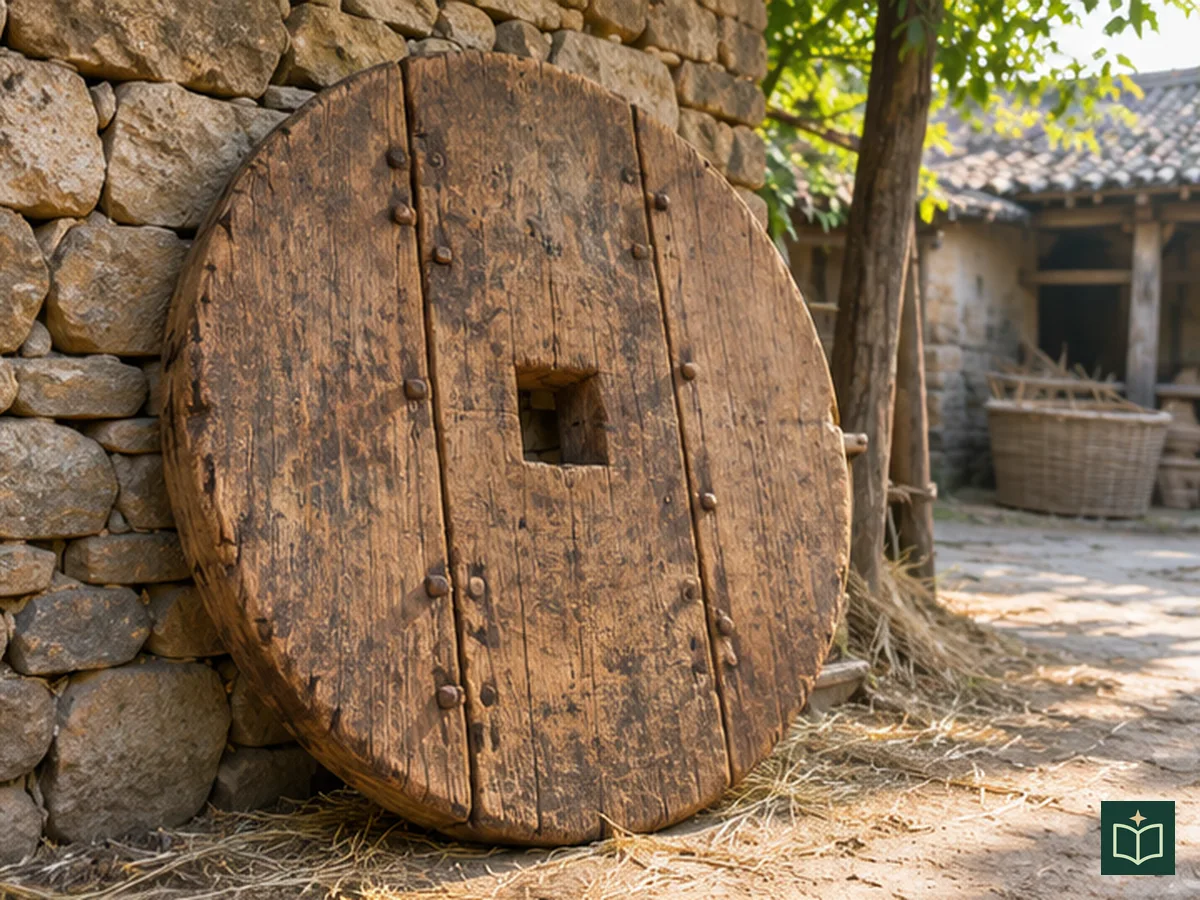
The circle was never the problem. The challenge lay where wheel and axle meet. If the hole in the hub is too loose, the wheel wobbles and wears itself out; too tight, and friction stops it turning. The axle's ends must be smooth and truly round, and both wheels on a pair must be the same size. Early wheels were usually solid discs made from two or three planks joined together, with the grain arranged for strength. Shaping these parts accurately was far easier with copper and later bronze chisels, which may help explain why the wheel spread during the metal-using Copper Age.
Animals made it worthwhile
A wheel is only useful with something to pull it and somewhere to roll. Early wagons were heavy and slow, drawn by oxen, and were used for hauling crops, building materials and goods over short distances. Around 2000 BC, peoples of the steppe developed light wheels with spokes, which cut weight dramatically. Combined with horses, they produced the war chariot, which spread quickly across Egypt, the Near East, India and China. In the Americas, people made small wheeled figurines in Mesoamerica but no wheeled vehicles, partly because there were no large animals suitable for pulling carts, and steep terrain favoured porters and llamas.
When the camel beat the wheel
Wheels did not always win. In the Middle East and North Africa, wheeled carts became rare during the first millennium AD, replaced largely by camel caravans. The historian Richard Bulliet argued in The Camel and the Wheel that camels were cheaper: they needed no roads or bridges, carried heavy loads across sand and rocky tracks, and could go for long periods without water. For a region of deserts, mountains and scattered settlements, that made pack animals more efficient than carts. Wheeled vehicles returned in force only with modern roads and motor transport, a reminder that the best technology depends on its setting.
Why the story matters
The wheel shows that inventions rarely arrive as a single flash of insight. It depended on a mix of earlier developments: woodworking skill, metal tools, domesticated animals and settled farming societies with goods to move. Once those were in place, the idea spread remarkably quickly, perhaps because it could be copied by anyone who saw a working cart. Its descendants are everywhere, from gears and pulleys to turbines and hard drives, all built on the same principle of something turning smoothly around an axis. The next time a suitcase rolls easily behind you, the real ancient breakthrough is in the little axle, not the wheel.
Sources & further reading
Figures are rounded and widely published; check the linked organisations for the latest editions. These organisations do not endorse this website.