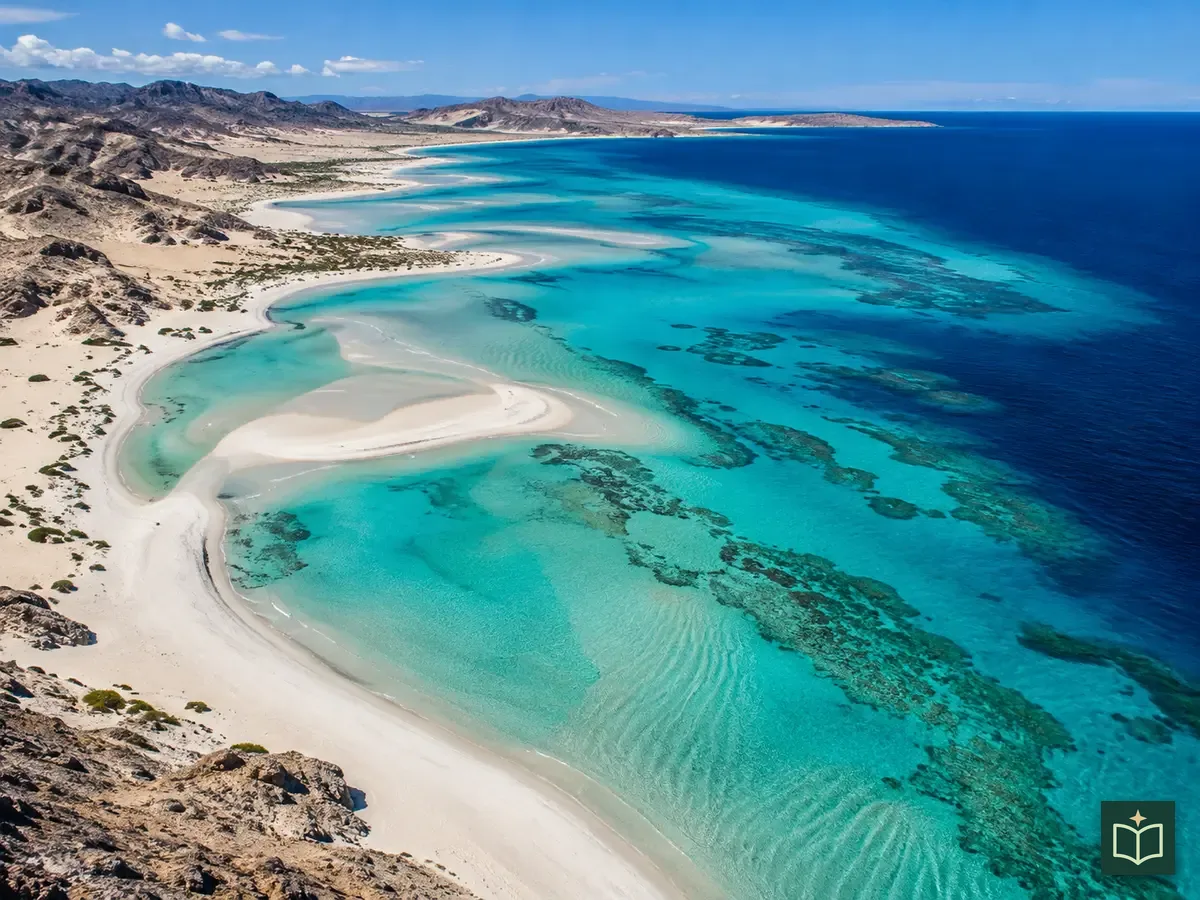
One ocean, many names
Scientifically, there is one interconnected world ocean, covering about 71% of Earth's surface. For convenience, it is divided into five oceans: the Pacific, Atlantic, Indian, Southern and Arctic. The Pacific is the largest and deepest, covering roughly a third of the planet. Seas are smaller bodies of salt water, usually located where an ocean meets land and partly enclosed by coastlines, islands or underwater ridges. The Mediterranean, the Arabian Sea and the Caribbean are examples. Gulfs and bays are typically inlets enclosed on three sides, such as the Gulf of Oman, while the Arabian Gulf is a shallow sea joined to the ocean through the Strait of Hormuz.
How they differ
Oceans are vast and deep, with average depths around 3,700 metres and trenches reaching nearly 11 kilometres. They are bounded by continents and set the large-scale circulation of currents that redistributes heat around the planet. Seas are generally shallower and more strongly influenced by surrounding land. Rivers, evaporation and limited exchange with the open ocean can make their temperature and saltiness very different. The Arabian Gulf, for example, averages only about 35 metres deep, and high evaporation makes it saltier and warmer in summer than the open Indian Ocean. The Baltic Sea, fed by many rivers, is much less salty than the Atlantic.
Gulf and regional examples
The waters around the Arabian Peninsula illustrate the hierarchy. The Arabian Gulf connects through the Strait of Hormuz to the Gulf of Oman, which opens into the Arabian Sea, itself part of the Indian Ocean. The Red Sea, on the peninsula's western side, is a narrow sea formed by the spreading apart of the African and Arabian plates and is among the saltiest seas linked to the ocean. It connects to the Indian Ocean through the Bab al-Mandab strait and to the Mediterranean through the Suez Canal. Each of these bodies has distinct temperatures, salinity and marine life, yet all exchange water with the wider ocean.
Where they are similar
Seas and oceans are made of the same salty water, typically about 3.5% dissolved salts, though the figure varies. Both have tides, waves and currents, and both host marine ecosystems from plankton to whales, coral reefs to seagrass meadows. Both absorb heat and carbon dioxide from the atmosphere, influencing weather and climate. Both are governed by the same international framework, the United Nations Convention on the Law of the Sea, which defines territorial waters and exclusive economic zones regardless of whether the water is called a sea or an ocean. In everyday speech the words overlap, as in going to the sea for a swim.
Misconceptions and odd names
Names do not always follow the rules. The Sargasso Sea in the Atlantic has no coastline at all; it is defined by surrounding currents. The Caspian Sea and the Dead Sea are actually lakes, because they have no natural connection to the ocean, though they are salty. The Southern Ocean was delineated by the International Hydrographic Organization in 2000, although that proposal was never formally ratified, and some institutions adopted it as the fifth ocean only in 2021. Another misconception is that seas are always smaller than any ocean in every measure. The Arctic Ocean is the smallest ocean but is larger than any sea, which shows that classification depends on several factors together.
Why it matters
The distinction helps scientists, sailors and governments describe conditions accurately. Marginal seas such as the Arabian Gulf are especially sensitive to warming, pollution and coastal development, because shallow, semi-enclosed waters exchange slowly with the open ocean. That makes local protection of coral reefs, mangroves and fisheries particularly important. Shipping routes, territorial claims and resource rights all depend on how waters are defined and named. For readers, knowing that every sea is part of the global ocean is a useful reminder that what happens in one stretch of water can, over time, affect others thousands of kilometres away. The ocean is one system.
Sources & further reading
- NOAA · What is the difference between an ocean and a sea? ↗
- NOAA · How many oceans are there? ↗
- Britannica · Ocean ↗
Figures are rounded and widely published; check the linked organisations for the latest editions. These organisations do not endorse this website.