Two halves of a circuit
The circulatory system is a closed loop of vessels driven by the heart. Arteries carry blood away from the heart, branching into smaller arterioles and then into microscopic capillaries, where oxygen, nutrients and waste are exchanged with tissues. Capillaries merge into venules and then veins, which carry blood back to the heart. There are two circuits. In the systemic circuit, arteries carry oxygen-rich blood to the body and veins return oxygen-poor blood. In the pulmonary circuit, the pattern reverses: the pulmonary arteries carry oxygen-poor blood to the lungs and the pulmonary veins bring oxygen-rich blood back. So direction, not oxygen, defines each vessel.
Built for different jobs
Arteries face high pressure with every heartbeat, so their walls are thick, muscular and elastic. The largest, the aorta, stretches as the heart contracts and recoils between beats, smoothing the flow. Smaller arteries can tighten or relax to direct blood where it is needed. Veins carry blood at low pressure, so their walls are thinner and less muscular, and their channels wider. Many veins, especially in the legs, contain one-way valves that stop blood falling backwards. Contracting leg muscles squeeze veins and push blood upwards, a mechanism sometimes called the muscle pump. That is one reason walking helps circulation on long flights.
Pulse, pressure and colour
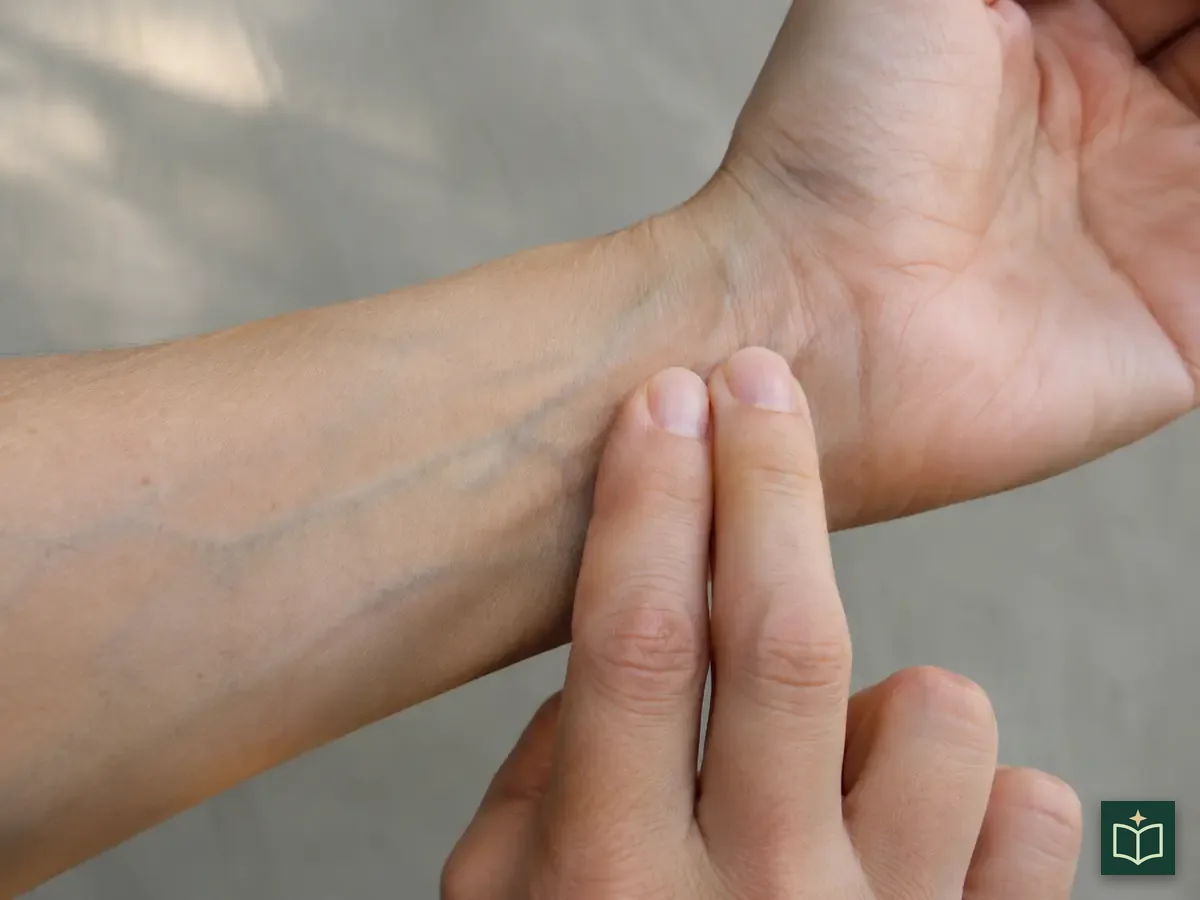
You can feel your pulse in arteries close to the skin, such as at the wrist or neck, because each heartbeat sends a pressure wave along them. Blood pressure, measured with a cuff on the upper arm, is arterial pressure; a typical healthy resting reading is around 120 over 80 millimetres of mercury. Veins have no pulse you can feel, and pressure within them is much lower. That is why blood samples are usually drawn from veins and why a cut artery bleeds in spurts while a cut vein bleeds steadily. Veins look bluish through the skin, but this is an effect of how light passes through tissue.
Where they are similar
Arteries and veins share the same basic construction of three layers: an inner lining of smooth cells called the endothelium, a middle layer of muscle and elastic fibres, and an outer layer of connective tissue. The proportions differ, not the plan. Both are part of the same circuit and carry the same blood, and both often run side by side through the body, frequently alongside nerves. Both can change their diameter in response to signals from the nervous system and hormones. Both can also develop disease, and both are essential: a failure in either half of the circuit disrupts the delivery of oxygen to the body.
Misconceptions and disease
A persistent myth is that blood in veins is blue. Blood is always red, darker when it carries less oxygen. Another misconception is that all arteries carry oxygen-rich blood, which overlooks the pulmonary arteries. The two kinds of vessel suffer different problems. Arteries can narrow and stiffen as fatty plaques build up, a process called atherosclerosis, which can lead to heart attacks and strokes. Veins can develop varicose veins when valves weaken, or deep vein thrombosis, a clot usually in the leg that can travel to the lungs. This is general information; symptoms such as chest pain or a swollen, painful leg need urgent medical attention.
Why it matters
Understanding arteries and veins explains many routine medical practices, from taking a pulse and measuring blood pressure to placing a drip or giving an injection. It also underpins advice on heart health, such as not smoking, staying active, managing blood pressure and cholesterol, and eating a balanced diet, all of which help keep arteries healthy. For travellers on long flights from Gulf hubs, moving the legs and staying hydrated support the venous return. Cardiovascular disease remains a leading cause of death worldwide, and much of it begins in the arteries. Knowing how the system works makes guidance from doctors easier to understand and follow.
Sources & further reading
- US National Heart, Lung, and Blood Institute · How the heart works ↗
- Britannica · Artery ↗
- World Health Organization · Cardiovascular diseases ↗
Figures are rounded and widely published; check the linked organisations for the latest editions. These organisations do not endorse this website.