The other desert
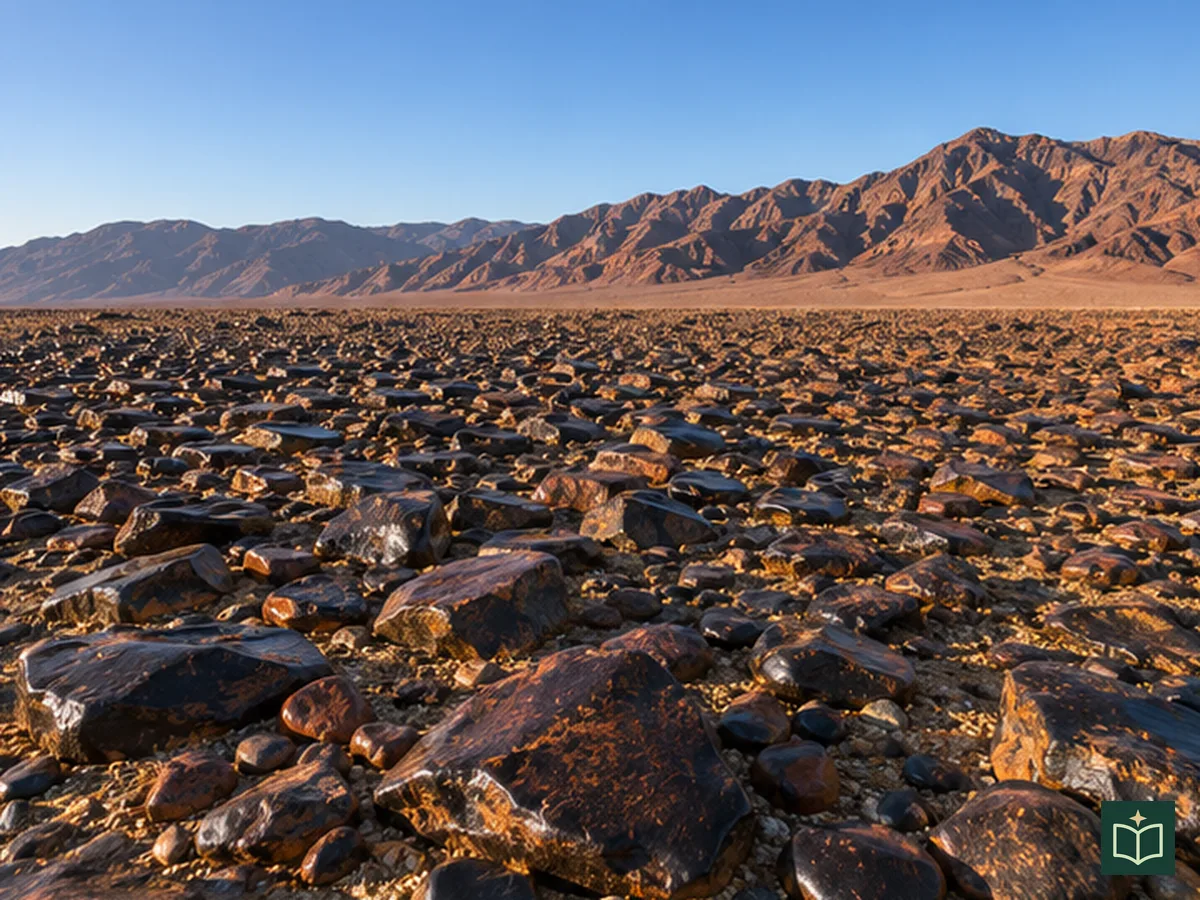
Much of the world's desert is not sand. Vast areas are covered by gravel and stones, often packed so tightly that they look as though they have been laid by hand. These surfaces are called desert pavements. In the UAE, gravel plains stretch across parts of the interior between the dune fields and the Hajar Mountains, built from rock washed out of the mountains by ancient floods. Their stones are often darker on top than underneath, coated with a thin, shiny layer called desert varnish or rock varnish. Together, pavement and varnish record thousands of years of quiet change, driven by wind, rare rain and microscopic life.
How a pavement forms
For a long time, scientists explained pavements as the work of wind. Over centuries, it was thought, the wind blew away fine sand and silt, leaving a layer of stones too heavy to move. This process, deflation, plays a part, but studies in the deserts of the American south-west suggested a second mechanism. Windblown dust settles among the stones and is washed beneath them by rare rains. Over time this builds a layer of fine material under the surface, gradually lifting the stones on top. They remain at the surface while the dust accumulates below them, settling into a close-fitting mosaic. In many pavements, the soil directly beneath the stones is almost stone-free.
Varnish: a coat thinner than paper
Desert varnish is a dark brown to black coating on exposed rock surfaces. It is extraordinarily thin, usually less than a fifth of a millimetre, and made mostly of clay minerals cemented by oxides of manganese and iron. Manganese is far more concentrated in the varnish than in the surrounding dust or the rock beneath, which has long puzzled scientists. One leading explanation is that microbes living on rock surfaces capture manganese from dust and dew and help fix it in place. Varnish grows extremely slowly, perhaps only micrometres per thousand years, so a dark coating usually indicates a surface that has been exposed and undisturbed for a very long time.
Rock art through the varnish
People have used varnish as a canvas for thousands of years. By pecking or scratching through the dark coating, they exposed the lighter rock beneath, creating petroglyphs that stand out clearly. Such images of animals, riders and symbols are found from the American south-west to the Sahara and Arabia, including sites in the Hajar Mountains of the UAE and Oman. Over time, new varnish slowly re-forms over the carvings, gradually darkening them. Archaeologists have tried to use that re-varnishing as a rough clock to estimate the age of rock art, though the method is debated because varnish growth depends on local climate and dust supply.
Fragile and slow to heal
A desert pavement may look tough, but it is fragile. Its tight mosaic protects the soil beneath from wind and water erosion. When vehicles drive across it, the stones are pushed aside or buried, exposing the fine material underneath to the wind. Dust storms can then lift it, and tracks remain visible for decades or longer. Studies of old military training grounds in the Mojave Desert have found scars still clear after many decades. Because varnish takes thousands of years to form, a damaged surface may never regain its dark tone in a human lifetime. Driving on established tracks protects these ancient surfaces.
What the desert floor records
Pavements and varnish are useful records of desert history. Geologists compare the darkness of varnish and the tightness of pavements to tell older alluvial fans and terraces from younger ones, since older surfaces are generally darker and smoother. Dust trapped beneath pavements preserves information about past winds and climate. Planetary scientists study varnish because similar coatings might form on Mars and could hint at past microbial activity. For visitors, they explain the strange beauty of gravel plains that glint dark under the sun. What looks like empty ground is a surface that has been slowly assembled and painted over thousands of years.
Sources & further reading
Figures are rounded and widely published; check the linked organisations for the latest editions. These organisations do not endorse this website.