Measuring a river’s size
Length is the most familiar way to compare rivers, but hydrologists usually care more about discharge: the volume of water flowing past a point each second, measured in cubic metres per second. Gauging stations estimate it by measuring the width and depth of the channel and the speed of the current, then multiplying area by velocity. Near the sea, tides and branching delta channels make direct measurement difficult, so values at the mouth are often modelled from upstream gauges. The figures in this table are long-term averages for whole river systems as they reach the ocean. Single wet or dry years can push a river’s flow well above or below these averages.
The Amazon in a class of its own
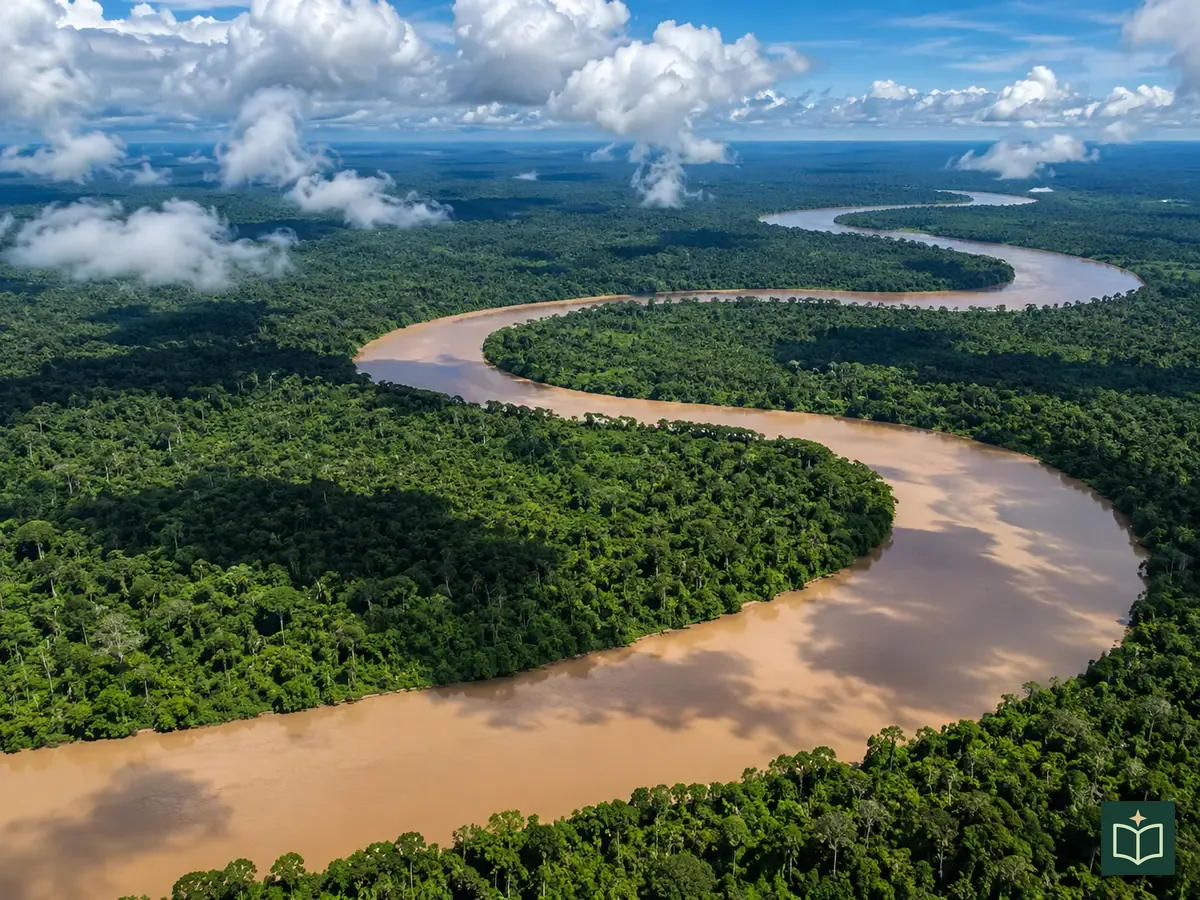
The Amazon’s average discharge, roughly 209,000 cubic metres per second, is about five times that of the Congo and accounts for around a fifth of all river water reaching the oceans. Its basin covers roughly seven million square kilometres of South America, much of it rainforest receiving heavy rainfall throughout the year. So much fresh water pours out that it lowers the salinity of the Atlantic far offshore; early European sailors reported drinking fresh water out of sight of land. Remarkably, no bridge crosses the main stem of the Amazon. Its wide, shifting channel and seasonal floods, which can raise water levels by many metres, make construction impractical.
Tropical rain rules
Most of the rivers in this table drain the wet tropics. The Congo, second, crosses the equator twice, so some part of its basin is always in a rainy season, giving it an unusually steady flow. The Ganges, Brahmaputra and Meghna, which merge in Bangladesh to form the world’s largest delta, are driven by the South Asian monsoon and swell dramatically each summer. The Orinoco in Venezuela and Colombia and the Yangtze in China both drain large, rainy basins. The Paraná and Uruguay rivers empty together into the Río de la Plata estuary between Argentina and Uruguay, which is why they are counted as one system here.
Arctic and temperate rivers
Two of the entries flow north into the Arctic Ocean. The Yenisei and the Lena drain much of Siberia, and their flow is highly seasonal: most of it arrives in late spring, when snow melts and river ice breaks up, sometimes causing ice jams and floods. Their fresh water influences the salinity and sea ice of the Arctic Ocean. The Mississippi, ninth, drains about 40% of the contiguous United States and carries enormous loads of sediment and nutrients into the Gulf of Mexico. The Mekong, tenth, flows through six countries and supports one of the world’s largest inland fisheries, providing food and income for tens of millions of people.
Why sources disagree
River discharge is harder to pin down than length. Estimates for the Amazon range from about 175,000 to over 220,000 cubic metres per second, depending on the period studied and where the measurement is taken. Lower down the list the gaps are smaller than the uncertainties: the St Lawrence and the Mekong can each appear in tenth place depending on whether a source measures at the river mouth or at an upstream gauge. Some large tributaries, such as the Amazon’s Madeira and Negro, carry more water than most rivers on Earth but are excluded because they feed a larger river. The figures here are therefore rounded and approximate.
Rivers in a dry region
The Nile, often cited as the world’s longest river, carries on average only about 2,800 cubic metres per second, less than 2% of the Amazon’s flow, because much of its course crosses desert where water evaporates or is withdrawn for farming. The Arabian Peninsula has no permanent rivers at all, which is why Gulf countries rely heavily on groundwater and on desalinating seawater. The Tigris and Euphrates, which meet in southern Iraq as the Shatt al-Arab, are the nearest large rivers to the Gulf, and their flow has declined as upstream dams and irrigation expand. Discharge, in other words, is a measure of water security as much as geography.
Sources & further reading
Figures are rounded and widely published; check the linked organisations for the latest editions. These organisations do not endorse this website.