Six metals, one family
Platinum and palladium are the best-known members of the platinum-group metals, but the family has four more: rhodium, ruthenium, iridium and osmium. All six sit together in the periodic table, resist corrosion, melt at high temperatures and act as powerful catalysts. They also occur together in nature, usually in tiny amounts locked in the same ores, so they are mined and refined as a group. The English chemist William Hyde Wollaston isolated rhodium in the early 1800s and named it after the Greek word for rose, from the pink colour of its salts. Smithson Tennant found osmium and iridium at the same time.
Rarer than gold
Rhodium is among the scarcest metals in Earth's crust, rarer than gold by most estimates, and it is almost never mined for its own sake. It is a by-product of platinum and palladium production, making up only a small fraction of the metal in typical ore. Around four-fifths of world supply comes from the Bushveld Complex in South Africa, a vast layered body of ancient igneous rock, with most of the rest from Russia's nickel mines near Norilsk. Annual output is roughly 20 to 30 tonnes. Gold mines produce more than 3,000 tonnes a year, so for every tonne of rhodium the world digs about 120 tonnes of gold.
The exhaust specialist
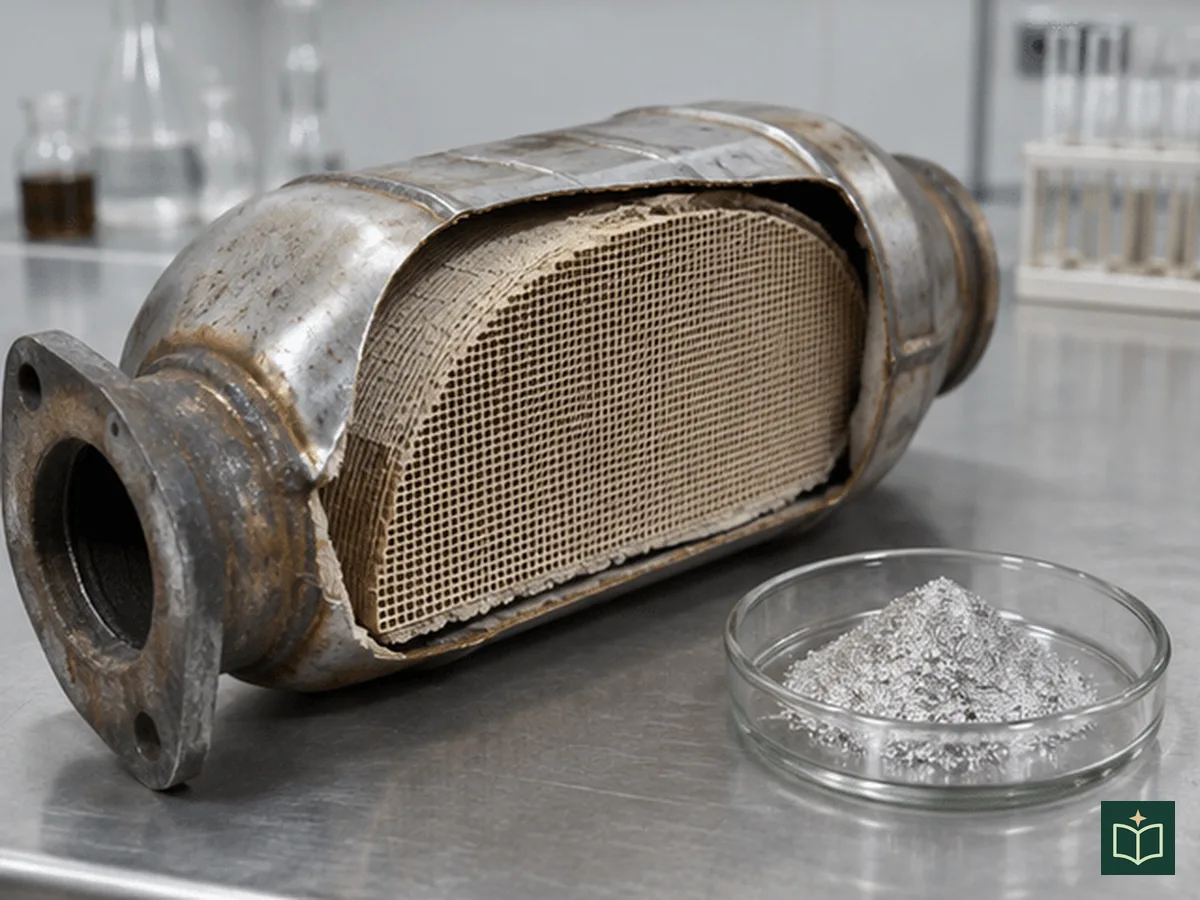
About four-fifths of rhodium goes into catalytic converters. A modern three-way converter for a petrol car does three jobs at once. Platinum and palladium mainly oxidise carbon monoxide and unburnt hydrocarbons into carbon dioxide and water. Rhodium handles the hardest task: reducing nitrogen oxides, which form smog and harm the lungs, back into harmless nitrogen. It does this better than any affordable alternative and survives the heat and vibration of an exhaust system for years. The metal is spread as a fine coating on a ceramic honeycomb, so each car contains only a small amount, but millions of vehicles add up to most of world demand.
Rhodium beyond the car
Smaller uses reveal rhodium's toughness. An alloy of platinum and rhodium forms the gauzes that catalyse the conversion of ammonia to nitric acid for fertilisers, and the heat-resistant bushings through which molten glass is drawn into fibres. Platinum-rhodium thermocouples measure temperatures in furnaces above 1,500 °C. Jewellers plate white gold with a thin layer of rhodium to give it a bright, hard, white finish, which wears away over years and needs renewing. Rhodium compounds also catalyse chemical processes that make ingredients for plastics and other products. In each case a little metal does a great deal of work, which is why buyers tolerate its cost.
The other three
Iridium and osmium are the densest elements known, each about twice as dense as lead. Iridium resists corrosion so well that it was alloyed with platinum for the old international prototype kilogram, and it tips long-life spark plugs. A thin layer enriched in iridium in rocks worldwide helped scientists link the extinction of the dinosaurs to an asteroid impact. Osmium is the hardest-wearing of the group but forms a toxic oxide, so its uses are few. Ruthenium hardens platinum and palladium alloys, appears in electronics such as chip resistors and hard-disk layers, and serves as a catalyst in chemical industry.
Volatile and hard to replace
With so little produced and no way to mine more on demand, rhodium is famously volatile in price. Over the past two decades it has swung from a few hundred dollars an ounce to tens of thousands and back, driven by stricter emissions rules, mine disruptions in South Africa and changes in car sales. That volatility pushes carmakers to thrift, using thinner coatings, and to recycle; converters from scrapped cars are now an important secondary source. The rise of battery electric vehicles, which need no exhaust catalyst, could ease demand over time, while hybrids still need it. This is general information, not investment advice.
Sources & further reading
- Royal Society of Chemistry · Rhodium ↗
- USGS · Platinum-group metals statistics and information ↗
- Britannica · Platinum group metal ↗
Figures are rounded and widely published; check the linked organisations for the latest editions. These organisations do not endorse this website.