Steel from a sealed pot
Wootz was a crucible steel made in southern India and Sri Lanka from at least the early first millennium AD, with some evidence of crucible processes even earlier. Smiths packed pieces of iron with carbon-rich material such as wood and leaves into small clay crucibles, sealed them and heated them for many hours. The iron absorbed carbon and melted, and on slow cooling formed a dense, rounded cake about the size of a hockey puck. The name wootz is thought to be an English rendering of a South Indian word for steel, such as ukku. The ingots were traded west across the Indian Ocean and through Persia.
Damascus and the watered blade
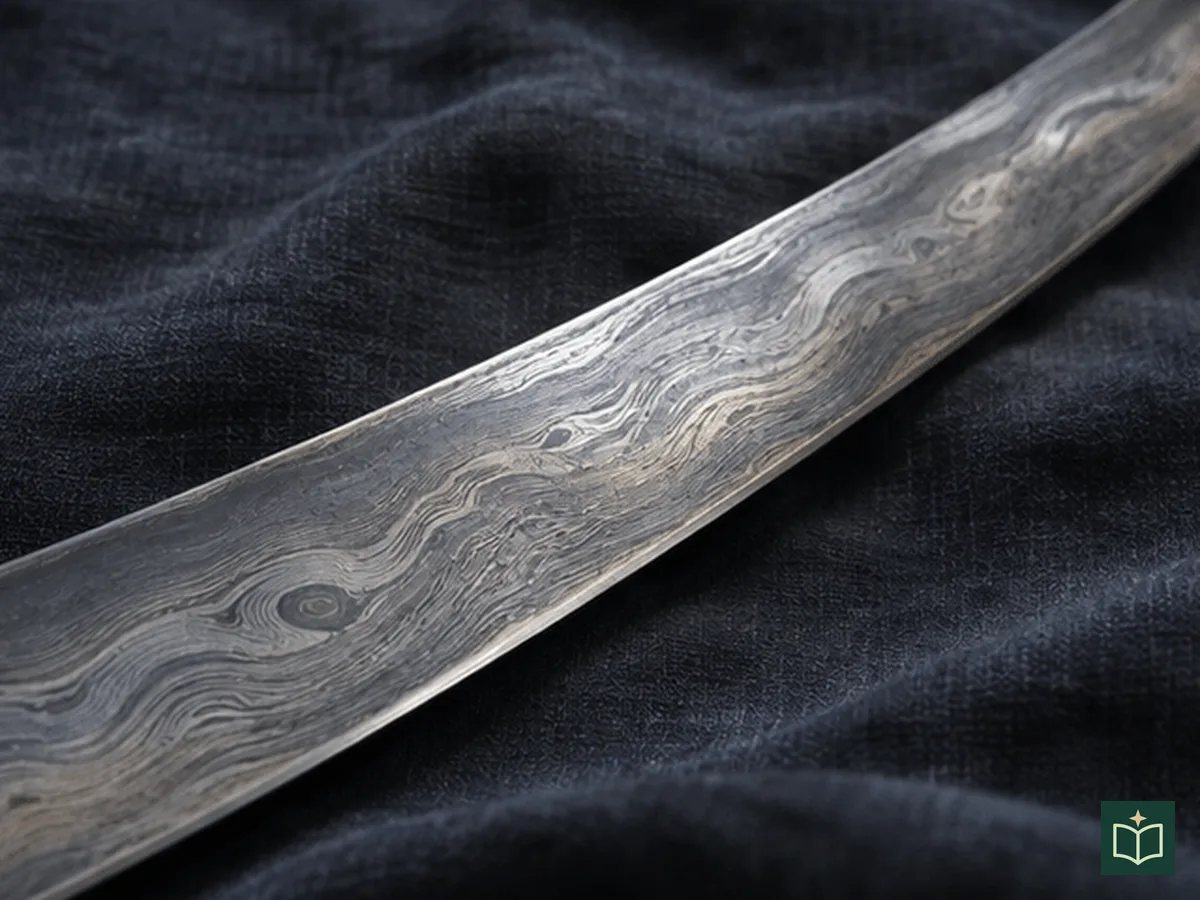
In Persia, Syria and elsewhere in the Islamic world, smiths turned these ingots into sabres and daggers famous for their strength, sharp edges and a flowing surface pattern resembling water or wood grain, known in Persian as jawhar. The name Damascus may come from the city as a centre of trade and craft, or from the patterned look itself; historians still debate it. Writers including the 9th-century scholar al-Kindi described different sword steels and their origins. European travellers and Crusaders spread stories of near-magical blades. Many legends, such as swords that sliced floating silk or cut through rifle barrels, are colourful but unverified.
Where the pattern comes from
The pattern is not decoration added by the smith but the steel's own structure. Wootz contained around 1.5% carbon, enough to form plenty of hard iron carbide, called cementite. Research by Iowa State metallurgists in the 1990s showed that tiny traces of elements such as vanadium in the ore helped carbide particles gather in parallel sheets as the ingot solidified and was reheated. Forging stretched these sheets into bands. After polishing and etching with acid, the bright carbide bands stood out against the darker steel between them. A German study in 2006 also reported nanoscale structures, including carbon nanotubes, in a 17th-century sabre.
Why the method was lost
The difficulty lay in forging. Wootz is brittle when hot, and heating it too much dissolves the carbides and erases the pattern, so smiths had to work it slowly at modest temperatures, a skill passed down by hand. By the late 18th and 19th centuries production of patterned blades had largely ceased. Likely reasons include the exhaustion of ore sources with the right trace impurities, disrupted trade routes and competition from cheaper industrial steel. European scientists, including Michael Faraday, tried to reproduce wootz. In Russia, Pavel Anosov produced a similar patterned steel, called bulat, in the 1830s. Modern researchers have since made convincing replicas.
What modern 'Damascus' is
Most knives sold today as Damascus are pattern-welded steel, a different technique with its own long history in Europe and Asia. Smiths stack sheets of two steels with different compositions, forge-weld them together, then fold, twist or cut the billet to multiply the layers. Starting with 10 layers and folding six times, each fold doubling the stack, gives 10 × 2 × 2 × 2 × 2 × 2 × 2, or 640 layers. Acid etching darkens one steel more than the other, revealing the pattern. Good pattern-welded blades can perform very well, but the pattern alone says nothing about quality, and some cheap knives simply have a pattern printed or etched on the surface.
Why the legend endures
Damascus steel remains a powerful story because it joins craft, trade and science. Indian and Sri Lankan furnace workers, Persian and Syrian smiths and the merchants who linked them created a material whose behaviour scientists could explain only with electron microscopes. Its history also shows how fragile skills can be: when supply chains and workshops broke down, knowledge built over centuries disappeared within a few generations. Museum collections preserve many original blades, and their surfaces still show the watered pattern. For buyers today the practical lesson is simple: ask whether a blade is crucible wootz or pattern-welded, and judge it by its steel and heat treatment, not by the name.
Sources & further reading
Figures are rounded and widely published; check the linked organisations for the latest editions. These organisations do not endorse this website.