A hard place for metal
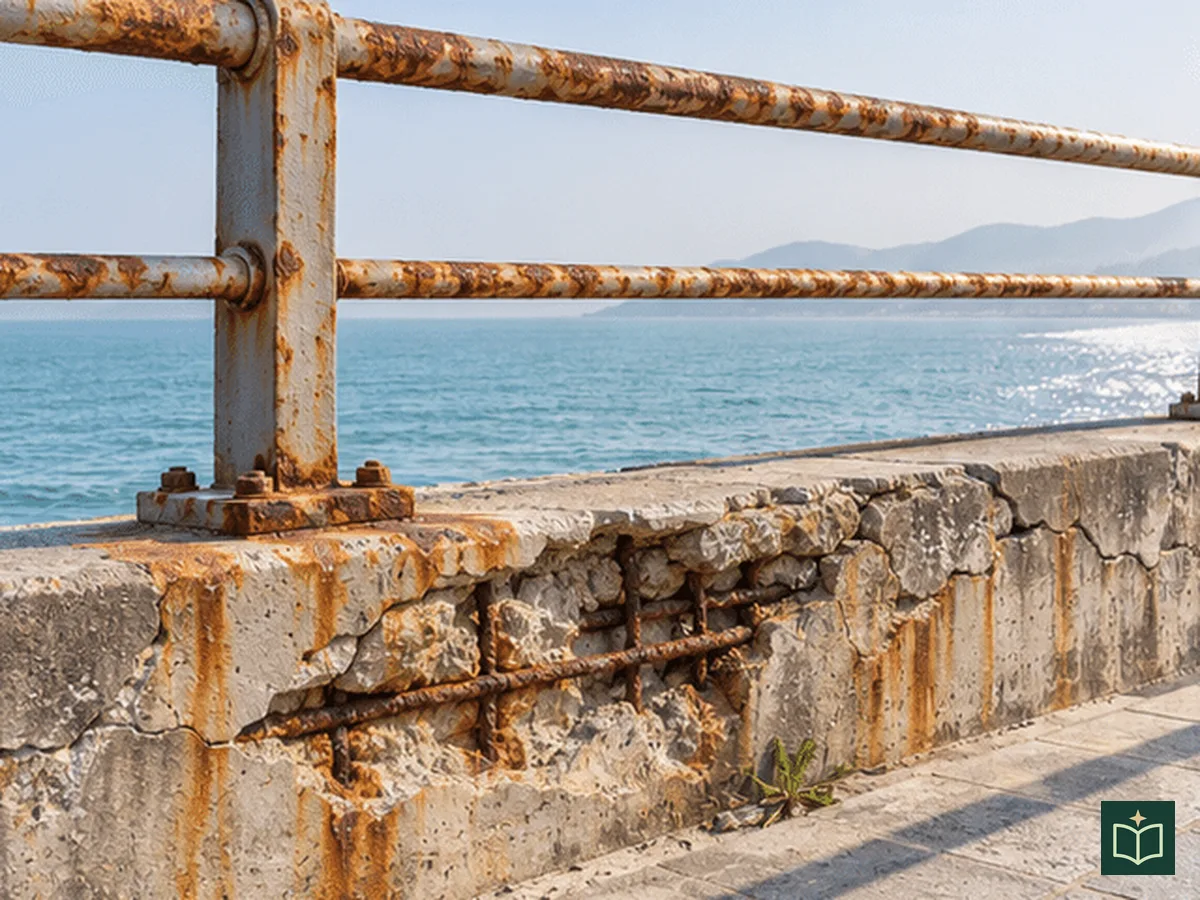
Visitors to Gulf cities often notice rust streaks on railings, flaking paint on street furniture and cracked concrete near the shore, sometimes on buildings only a few decades old. The cause is not heavy rain, which is rare, but a combination of conditions that suits corrosion almost perfectly. Steel rusts when it is wet and when oxygen and dissolved salts carry an electric current between tiny anode and cathode areas on its surface. The Gulf supplies salt from the sea and from sabkha salt flats, frequent moisture from humid air and dew, and high temperatures that speed chemical reactions whenever surfaces are damp.
Salt in the air
The Gulf is a shallow, salty sea, and onshore breezes lift fine droplets that dry into salt particles and settle on anything nearby. Chloride ions are especially damaging: they break down the thin protective oxide film on steel and make the moisture on its surface far more conductive. Coastal sabkha flats add salt-laden dust, and the shamal winds carry dust inland. The amount of salt deposited falls sharply with distance from the shore, so a building on the waterfront may face several times the corrosion rate of one a few kilometres inland. The international standard ISO 9223 classifies such sites up to its extreme category, CX.
The night-time wet
What makes the region distinctive is the time surfaces spend wet. In humid coastal months, temperatures fall overnight below the dew point, and water condenses on cooled metal and concrete, especially on surfaces facing the open sky. Salt already on the surface dissolves into this film, forming a concentrated electrolyte. The sun then dries it during the day, leaving the salt behind to work again the next night. In summer, high humidity combined with heat keeps reaction rates high. Air-conditioned buildings add a local twist: cold pipes and ducts sweat continuously, and corrosion under insulation on chilled-water lines is a common maintenance headache.
Rust inside concrete
Reinforced concrete normally protects its steel bars well, because the concrete is highly alkaline and keeps the steel passive. Chlorides change that. Salt from the air, from contaminated sand or water used in the mix, or from salty groundwater in sabkha soils slowly diffuses inward. When enough reaches the bars, the passive film breaks down and the steel rusts. Rust occupies several times the volume of the steel it replaces, so it pushes outward, cracking and spalling the cover concrete and exposing the bars to further attack. Repairing such damage is costly and disruptive, which is why prevention matters so much in coastal construction.
How builders fight back
The first defence is thicker, denser concrete. Under simple diffusion, the time for chlorides to reach steel grows with the square of the cover, so doubling cover from 40 to 80 millimetres roughly quadruples the time, all else equal. Engineers also use low water-to-cement ratios and add materials such as slag, fly ash or microsilica that make concrete less permeable. Further measures include coated, galvanised or stainless steel reinforcement, corrosion-inhibiting admixtures, waterproof membranes against groundwater and impressed-current cathodic protection, which uses a small electric current to keep steel from corroding. Gulf building codes typically set strict requirements for concrete cover and quality in exposed locations.
Protecting desalination plants
Desalination plants face perhaps the toughest conditions of all, handling hot, concentrated brine around the clock. Designers choose materials accordingly. Thermal plants use tubes of copper-nickel alloys or titanium in their heat exchangers, while reverse-osmosis plants rely on high-alloy duplex and super-duplex stainless steels for pumps and high-pressure pipework, together with fibreglass-reinforced plastic pipes that cannot rust. Intake structures and pipelines are coated and protected with sacrificial anodes or impressed currents. Regular inspection is essential, since a small leak or a corroded pump can take a unit offline. In a region that depends on desalinated water, corrosion engineering quietly protects much of the drinking water supply.
Sources & further reading
- ISO · ISO 9223 Corrosion of metals and alloys — Corrosivity of atmospheres ↗
- Britannica · Corrosion ↗
- AMPP · Association for Materials Protection and Performance ↗
Figures are rounded and widely published; check the linked organisations for the latest editions. These organisations do not endorse this website.