Discovery of radioactivity
In 1896, the French physicist Henri Becquerel found that uranium salts darkened photographic plates even in the dark, revealing a new kind of invisible emission. Marie and Pierre Curie soon identified other radioactive elements, including polonium and radium, and Marie Curie coined the term radioactivity. Ernest Rutherford later showed that radioactive atoms transform into different elements and identified distinct types of radiation, named alpha, beta and gamma. These discoveries overturned the old idea that atoms were unchangeable. They also laid the groundwork for nuclear medicine, nuclear power and modern dating methods, while revealing hazards that early researchers, including Marie Curie herself, did not fully appreciate.
Why some nuclei decay
An atom’s nucleus contains protons and neutrons held together by the strong nuclear force. Some combinations are stable and can last indefinitely. Others carry an imbalance and will eventually change to a more stable arrangement by emitting radiation. In alpha decay, the nucleus releases a cluster of two protons and two neutrons. In beta decay, a neutron turns into a proton, or the reverse, emitting an electron or its antimatter counterpart. Gamma rays, high-energy light, often accompany these changes. Each decay can turn one element into another: uranium-238, for instance, passes through a long chain of decays before ending as stable lead.
What half-life means
The timing of any individual decay is truly random. There is no way to predict when a particular nucleus will change. But each kind of unstable nucleus has a fixed probability of decaying in a given period, and with vast numbers of atoms, that probability produces remarkably regular behaviour. The half-life is the time it takes for half of a sample to decay. After one half-life, half remains; after two, a quarter; after three, an eighth. Half-lives vary enormously, from fractions of a second to billions of years. Iodine-131 has a half-life of about eight days, while uranium-238’s is about 4.5 billion years, close to Earth’s age.
Clocks in rocks and bones
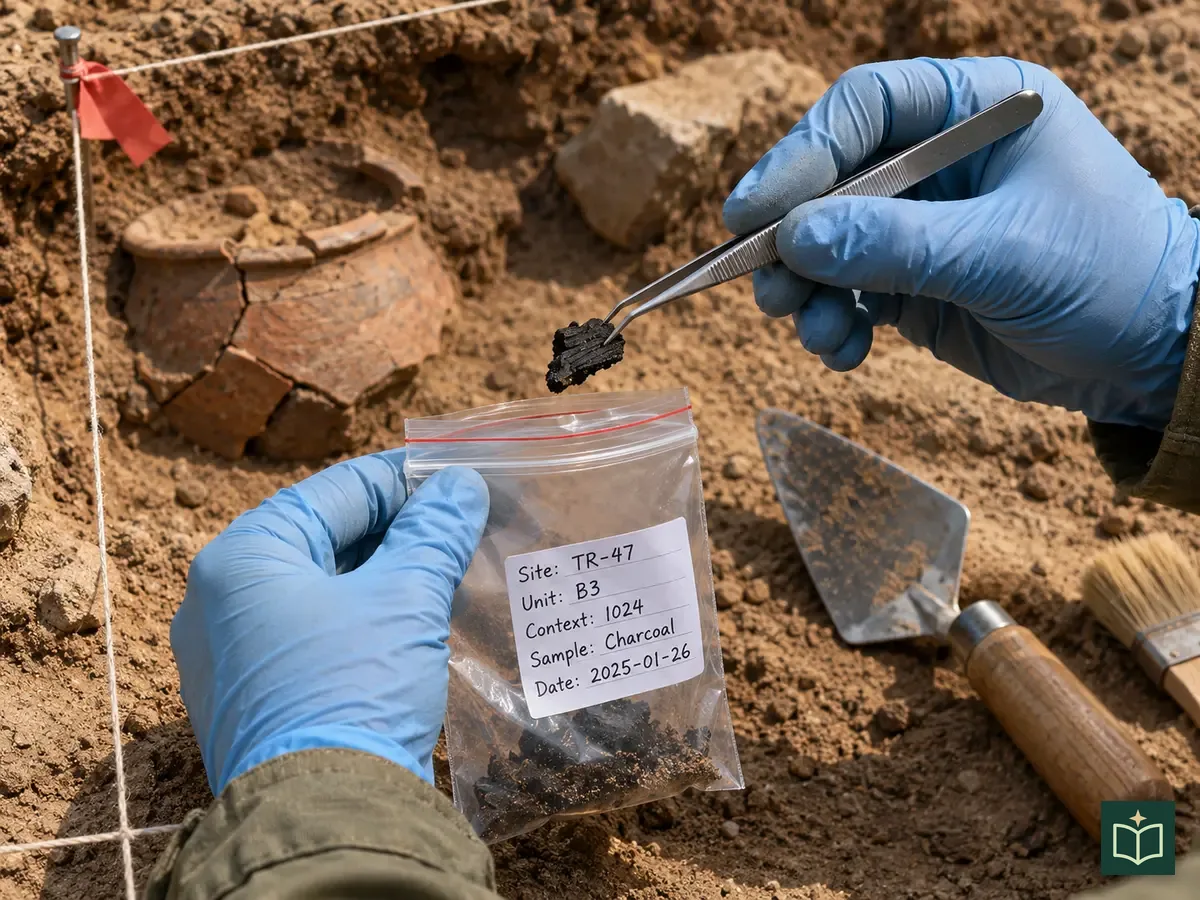
Because decay is so regular, radioactive isotopes work as natural clocks. Living things absorb carbon, including a small fraction of radioactive carbon-14, while they are alive. After death, no new carbon enters, and the carbon-14 steadily decays with a half-life of about 5,730 years. Measuring how much remains reveals how long ago the organism died, a method developed by Willard Libby in the late 1940s. It is widely used in archaeology, including dating ancient settlements and burials in the Arabian Peninsula. For much older materials, geologists use isotopes with longer half-lives, such as uranium and potassium, to date rocks across billions of years.
Common misconceptions
Half-life is often misunderstood. It does not mean a substance becomes completely safe after one half-life; half of it remains, and decay products may themselves be radioactive. Nor does a long half-life automatically mean greater danger. A material with a very long half-life decays slowly, so it emits radiation at a low rate, while short-lived isotopes can be intensely radioactive for a brief time. Another misconception is that all radiation makes things radioactive. Most medical X-rays and food irradiation do not leave the body or food radioactive. Radiation is also part of everyday life: rocks, soil, building materials, food and cosmic rays all expose people to low natural levels.
Why it matters
Half-life shapes decisions about health, energy and the environment. In hospitals, short-lived isotopes such as technetium-99m, with a half-life of about six hours, are used for imaging because they fade quickly after the scan. Radioactive iodine treats some thyroid conditions. Nuclear power plants, including the Barakah plant in the UAE, must manage spent fuel containing isotopes with very different half-lives, which is why storage plans are designed over many decades and beyond. After nuclear accidents, authorities track short-lived isotopes such as iodine-131 in the first weeks and longer-lived caesium-137 for years. The International Atomic Energy Agency sets safety standards for these practices worldwide.
Sources & further reading
Figures are rounded and widely published; check the linked organisations for the latest editions. These organisations do not endorse this website.