Gold you cannot see
Picture a gold mine and you may imagine nuggets, but most mined gold today is invisible. In typical ore it occurs as grains a few thousandths of a millimetre across, scattered through rock at a few grams per tonne or less. Panning and gravity methods, which rely on gold's weight, miss such tiny particles. The answer since the late 19th century has been chemistry. A dilute solution of sodium cyanide, in water kept alkaline and supplied with oxygen, dissolves gold by forming a stable gold-cyanide complex. Once the gold is in solution, it can be collected from huge volumes of rock that would otherwise be worthless.
The chemistry in brief
Gold resists almost all chemicals, but cyanide is an exception because it binds gold atoms very strongly. With oxygen from the air acting as the oxidising agent, metallic gold at the surface of each grain becomes a soluble gold-cyanide ion. The solution is weak, typically a few hundred milligrams of cyanide per litre. Operators add lime to keep the pH above about 10, because in acidic conditions cyanide turns into poisonous hydrogen cyanide gas. Silver dissolves the same way and is recovered alongside gold. The process was patented in 1887 by three Glasgow chemists, John MacArthur and the brothers Robert and William Forrest.
Tanks and activated carbon
In a conventional plant, ore is crushed and ground to a fine slurry and pumped through a series of large agitated tanks, where it is leached for a day or more. Granules of activated carbon, often made from coconut shells, are added to the tanks or to a following circuit. Their enormous internal surface adsorbs the gold-cyanide complex, loading the carbon with gold. Screens separate the loaded carbon from the slurry. A hot caustic solution then strips the gold back off, and electrolysis plates it onto steel wool. The result is smelted into doré bars of gold and silver for refining, and the carbon is reheated and reused.
Heap leaching low-grade rock
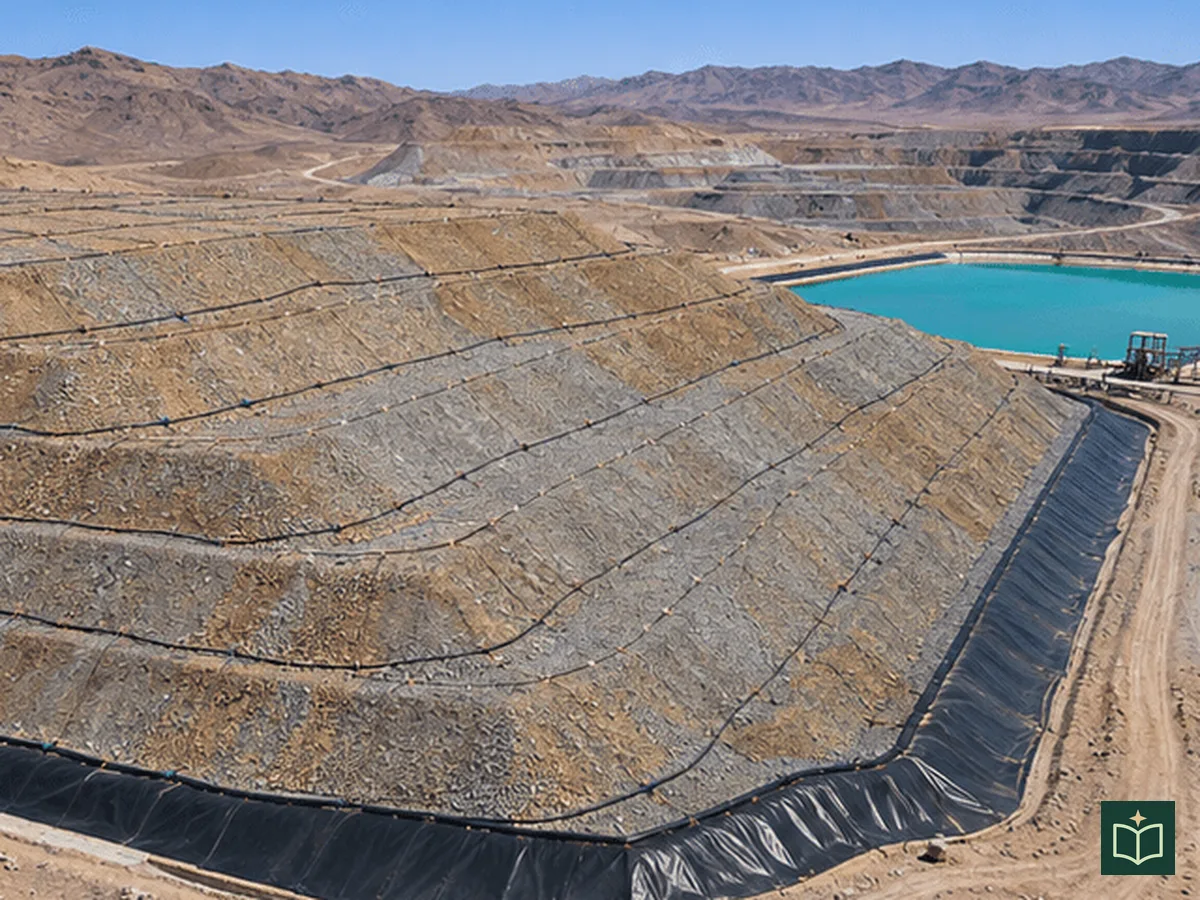
For lower-grade ore, mines skip the mill. In heap leaching, crushed or even blasted rock is stacked into terraced heaps tens of metres high on pads lined with thick plastic. Drip lines or sprinklers trickle cyanide solution over the top for weeks or months, and the gold-bearing solution that seeps out is collected and passed through carbon columns. Recovery is lower than in tanks, but costs are much lower too, so rock holding well under a gram of gold per tonne can be profitable. The method, developed in the United States in the 1960s and 1970s, opened up vast low-grade deposits in Nevada and elsewhere.
A worked example
Consider a 10-gram, 22-karat bangle. At 22 parts in 24 it contains about 9.2 grams of pure gold. From ore grading 1 gram per tonne with 90% recovery in a tank plant, that gold would need about 10 tonnes of rock. From heap-leach ore at 0.5 grams per tonne with 70% recovery, it would need around 26 tonnes. Mines therefore move staggering volumes of material, and every percentage point of recovery matters. These figures are illustrative, since grades and recoveries vary greatly by deposit, and some ores lock gold inside sulphide minerals that must first be roasted or oxidised before cyanide can reach it.
Handling a dangerous reagent
Cyanide is acutely toxic, so its use is tightly controlled. Modern mines keep solutions alkaline, monitor air and water, and treat tailings to break cyanide down into less harmful compounds before storage. Failures have caused serious harm: in 2000 a tailings dam at Baia Mare in Romania overflowed, sending cyanide-laden water into rivers flowing to the Danube and killing large numbers of fish. Such events led to the International Cyanide Management Code, a voluntary industry programme for transport, storage and disposal. Alternatives such as thiosulphate leaching exist but suit only some ores, so cyanide remains central to gold mining around the world.
Sources & further reading
- USGS · Gold statistics and information ↗
- International Cyanide Management Code ↗
- Britannica · Gold processing ↗
Figures are rounded and widely published; check the linked organisations for the latest editions. These organisations do not endorse this website.