Defined by temperature
Permafrost is ground, whether soil, sediment or rock, that remains at or below 0°C for at least two consecutive years. The definition is about temperature, not ice: some permafrost is dry, while other areas contain huge amounts of ice in lenses, wedges and buried masses. Above it lies the active layer, which thaws each summer and refreezes in winter, ranging from a few tens of centimetres to several metres thick. Permafrost underlies roughly a quarter of the exposed land in the Northern Hemisphere, across Siberia, northern Canada, Alaska, Greenland and the Tibetan Plateau, as well as high mountain ranges and ice-free parts of Antarctica.
How deep and how old
In the coldest regions, permafrost can be extremely thick. Parts of Siberia hold frozen ground extending more than a kilometre below the surface, built up over many glacial cycles. Further south, it becomes discontinuous and patchy, surviving only on shaded slopes, beneath peat or on north-facing ground. Much of today’s permafrost formed during cold periods of the ice ages, when frigid air reached land that was not buried under thick ice sheets. Some has persisted for hundreds of thousands of years. Frozen sediments preserve woolly mammoths, ancient plant material and microbes, making permafrost an archive for scientists studying past climates and ecosystems.
Patterns in the landscape
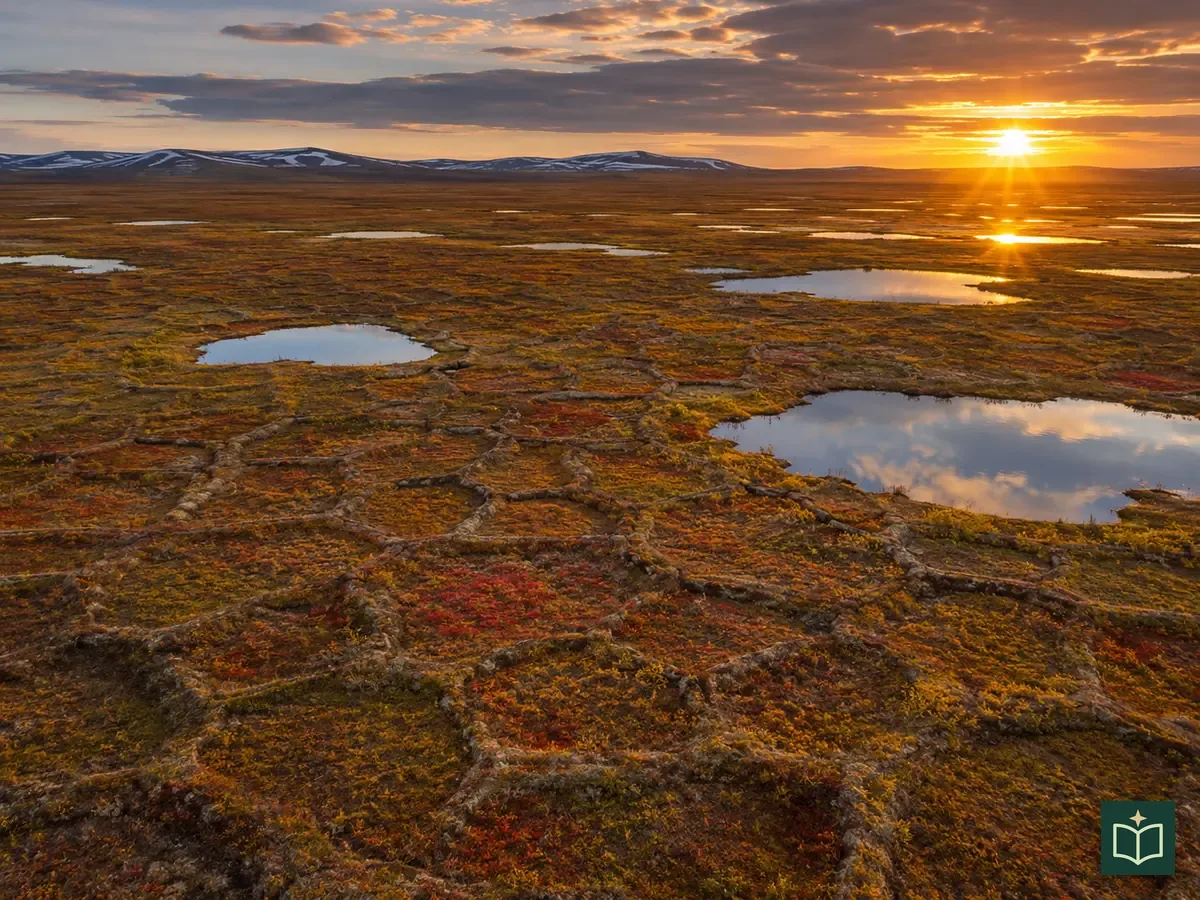
Freezing and thawing shape distinctive landforms. As the ground contracts in extreme cold, it cracks into polygons, and meltwater seeping into the cracks freezes into vertical ice wedges, creating patterned ground that is striking from the air. Pingos, dome-shaped hills with cores of ice, can rise tens of metres above flat tundra; Canada’s Tuktoyaktuk Peninsula has many. Where ice-rich permafrost thaws, the ground slumps unevenly, forming hummocky terrain called thermokarst, with sinking hollows and new ponds. Coastlines made of frozen sediment erode quickly when sea ice retreats and waves strike them, and some Arctic shores now lose several metres a year.
Building on frozen ground
For the several million people who live in permafrost regions, frozen ground is the foundation of homes, roads and pipelines. Buildings in cities such as Yakutsk in Siberia stand on piles driven deep into permafrost, with an air gap beneath so that heat from the building does not thaw the soil. The Trans-Alaska Pipeline uses supports fitted with heat pipes that draw warmth out of the ground in winter, keeping it frozen. When permafrost thaws, foundations tilt, roads buckle and pipes crack. Studies in Russia, Canada and Alaska report rising maintenance costs, and some communities have had to plan relocation as ground and coastlines become unstable.
The carbon question
Permafrost soils hold an enormous store of organic carbon, the remains of plants and animals that froze before they could decompose. Scientists estimate that northern permafrost regions contain roughly twice as much carbon as the atmosphere currently holds. When the ground thaws, microbes begin breaking down this material, releasing carbon dioxide and, in waterlogged conditions, methane, a more powerful greenhouse gas over shorter periods. This creates a feedback in which warming causes emissions that cause further warming. The release is expected to be gradual, over decades to centuries rather than sudden, but it is large enough to be included in estimates of global carbon budgets.
Watching the thaw
The Arctic is warming considerably faster than the global average, and monitoring networks have recorded rising permafrost temperatures in many boreholes over recent decades. The active layer is deepening in many places, and thaw is reaching ground that had been frozen for thousands of years. Researchers combine borehole measurements, satellite radar that detects ground subsidence and field surveys to track the changes. Thaw also reshapes rivers and lakes, which can expand or drain suddenly. For people far from the Arctic, including in the Gulf, permafrost matters because its carbon affects the global climate, and its loss shows how quickly cold landscapes can change.
Sources & further reading
Figures are rounded and widely published; check the linked organisations for the latest editions. These organisations do not endorse this website.