Driving out the Portuguese
In the early sixteenth century the Portuguese seized key ports around the Indian Ocean, including Muscat and other Omani coastal towns, to control trade. In the seventeenth century Oman's Ya'ariba dynasty unified the country and built a navy. In 1650 Omani forces took Muscat from the Portuguese. They then carried the fight to East Africa, where Swahili towns sought help against Portuguese rule. After a siege of nearly three years, Omani forces captured Fort Jesus in Mombasa in 1698. This victory established Oman as a power on the Swahili coast, with influence in towns such as Mombasa, Pemba, Kilwa and Zanzibar, alongside local Swahili rulers.
The Al Busaid dynasty
After civil war in the early eighteenth century, Ahmad bin Said became ruler around 1744, founding the Al Busaid dynasty that still rules Oman. His successors relied on commerce and sea power. Omani ships carried goods between the Gulf, India, Persia and Africa, timed by the monsoon: the north-east winds of winter carried ships south-west to Africa, and the south-west winds of summer brought them back. Muscat became a major entrepôt. Oman also held territory on the coast of Persia and Baluchistan; the port of Gwadar, in today's Pakistan, remained Omani until it was sold to Pakistan in 1958. Indian merchant communities played a central role in finance and trade.
Sayyid Said and Zanzibar
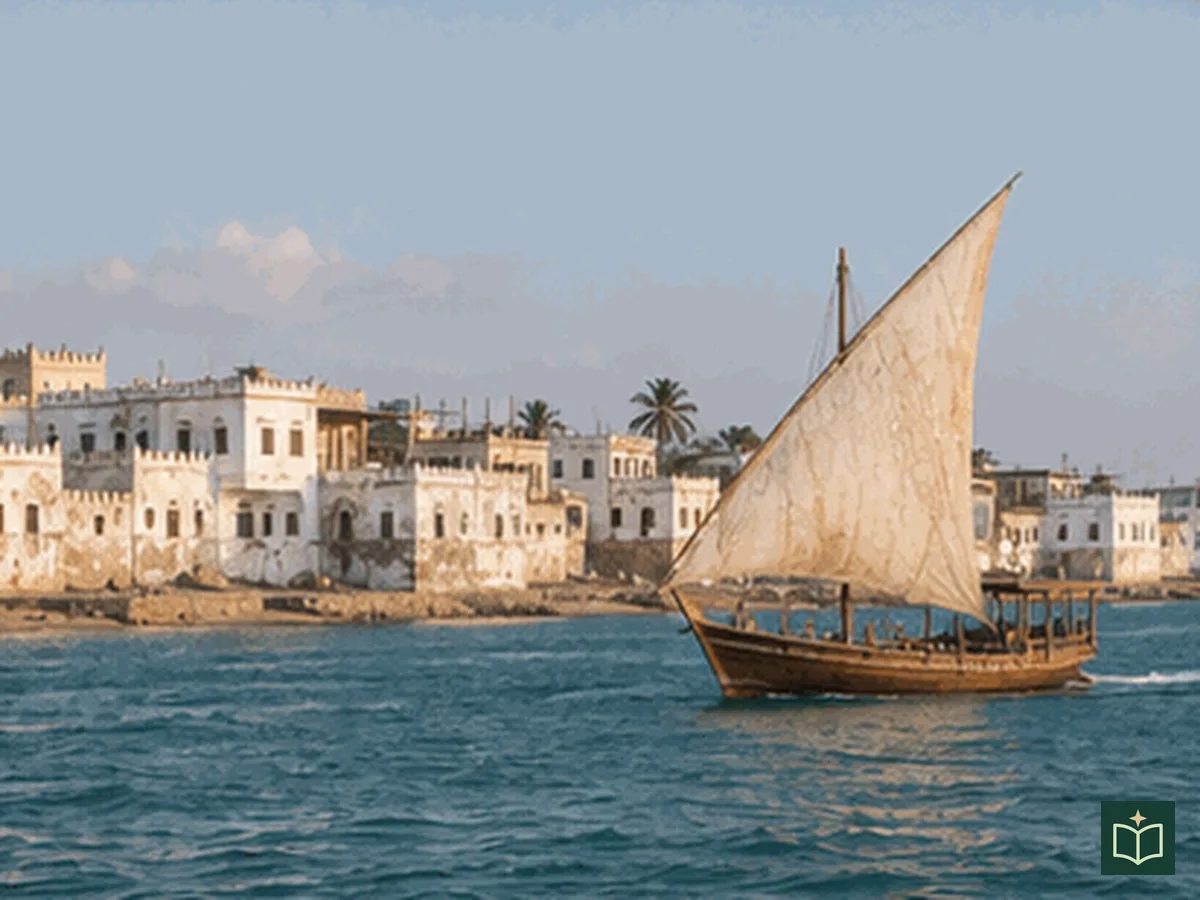
Sayyid Said bin Sultan ruled from 1806 to 1856, one of the longest reigns in Omani history. He saw the commercial potential of East Africa and spent increasing time there, making Zanzibar his main residence from about 1840. The island had a fine harbour, fertile soil and access to mainland trade routes. Said encouraged the planting of cloves, and Zanzibar and neighbouring Pemba became the world's leading producers. Caravans from the coast reached deep into the interior, as far as the great lakes, trading cloth and beads for ivory. Said signed commercial treaties with the United States, Britain and France, and consulates opened in Zanzibar town.
Trade and slavery
The prosperity of Zanzibar had a dark side. Clove plantations were worked largely by enslaved Africans, and Zanzibar became a major market of the East African slave trade, sending people to plantations on the islands and to Arabia, Persia and beyond. Britain, which had abolished slavery in its own empire, pressed the sultans to restrict the trade. A series of treaties narrowed it step by step, and in 1873 Sultan Barghash closed Zanzibar's slave market under strong British pressure. Slavery itself was abolished on the islands only in 1897. Any account of the Omani empire must include this suffering alongside its achievements in trade, architecture and culture.
The split of 1861
When Sayyid Said died in 1856, his sons disputed the succession. Thuwaini held Muscat, while Majid ruled in Zanzibar. To avoid war between them, Britain's Viceroy of India, Lord Canning, arbitrated. His decision of 1861, the Canning Award, divided the realm into two independent sultanates: Muscat and Oman, and Zanzibar. Because Zanzibar was the richer half, it was to pay Muscat an annual subsidy. The division weakened Oman's economy, which lost much of its African income just as steamships began to reduce the importance of Muscat's trade. Zanzibar became a British protectorate in 1890, and its sultanate ended in the revolution of 1964.
What remains
The connections between Oman and East Africa did not end in 1861. Many Omani families have roots in Zanzibar and the Swahili coast, and Swahili is still spoken in parts of Oman. Thousands returned to Oman after the 1964 revolution in Zanzibar and again after 1970, when Sultan Qaboos invited them to help build the modern state. In Zanzibar's Stone Town, a UNESCO World Heritage Site, Omani-style carved doors, palaces and forts stand beside Swahili, Indian and European buildings. Fort Jesus in Mombasa is also World Heritage. These places record a time when the Indian Ocean was less a barrier than a highway linking Arabia and Africa.
Sources & further reading
Figures are rounded and widely published; check the linked organisations for the latest editions. These organisations do not endorse this website.