Why New Guinea holds every place
Oceania usually means Australia, New Zealand and the islands of the Pacific, including the whole of New Guinea, whose western half belongs to Indonesia. On that definition, the ten highest mountains are all on New Guinea. Australia’s highest point on the mainland, Mount Kosciuszko, reaches only 2,228 metres, and New Zealand’s Aoraki is 3,724 metres. Hawaiʻi’s Mauna Kea, at 4,207 metres, is the highest outside New Guinea, but it is too low for this table. New Guinea’s central ranges run almost the length of the island, and dozens of their peaks rise above 4,000 metres, many of them still rarely visited.
How the ranges rose
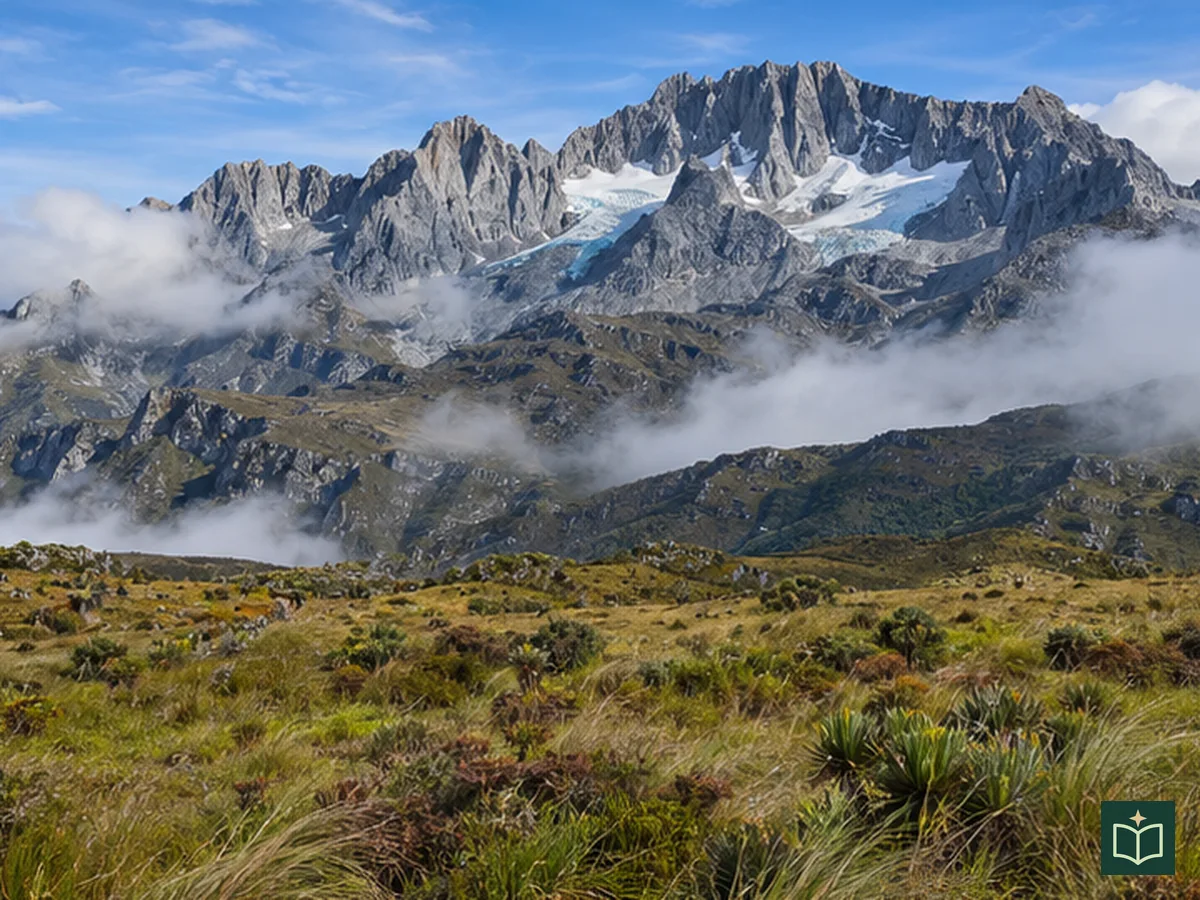
New Guinea sits at the northern edge of the Australian plate, which moves north by several centimetres a year and presses into the plates of the Pacific. Over the past few million years, that collision folded and lifted thick layers of limestone that had formed on a tropical sea floor. Fossils of marine creatures are found high on the summits as a result. The Indonesian ranges, the Sudirman and Jayawijaya mountains, hold the highest peaks. In Papua New Guinea, the Bismarck Range rises to Mount Wilhelm, and Mount Giluwe, an old shield volcano at about 4,367 metres, is often described as the highest volcano in Oceania.
Puncak Jaya and its rivals
Puncak Jaya is a steep limestone ridge first climbed in 1962 by a team led by the Austrian mountaineer Heinrich Harrer. It is counted among the Seven Summits, the highest points of each continent, and its ascent is technically harder than several of the others. The 4,884-metre height comes from a 1973 survey; an older figure of 5,030 metres, based on less precise methods, still circulates. Two nearby summits, Sumantri at about 4,870 metres and Ngga Pulu at about 4,862 metres, are higher than second place but are not counted separately, because they rise too little above the ridge they share with Puncak Jaya.
Equatorial ice
New Guinea’s highest peaks lie only a few degrees south of the equator, yet they have carried ice for thousands of years. The glaciers around Puncak Jaya are among the last tropical ice in Asia and the Pacific. They have retreated quickly as temperatures have risen, and scientists expect them to vanish within decades. Other ice has already gone. Puncak Trikora lost its ice cap between the late 1930s and early 1960s, and Puncak Mandala’s disappeared in the 1990s. Cores drilled from the remaining ice have helped scientists reconstruct past climate in the western Pacific, a record that will be lost when the glaciers melt.
Mount Wilhelm
Mount Wilhelm, at 4,509 metres, is the highest mountain in Papua New Guinea and the only peak in this table outside Indonesia. It is the most visited of New Guinea’s high summits, with a route that climbs from villages in the highlands through montane forest and grassland to bare rock. On clear mornings climbers report views towards both the north and south coasts of the island. Unlike Puncak Jaya, it has no permanent ice, but frost and occasional snow are common near the summit, a sharp contrast to the humid lowlands below. Its upper slopes hold a chain of glacial lakes left by ice that melted thousands of years ago.
Remote and partly unmeasured
Many peaks in this table are hard to reach, and access to the area around Puncak Jaya is restricted because of security concerns and the nearby Grasberg mine, one of the largest gold and copper mines in the world. Some heights come from maps made decades ago or from satellite elevation data rather than from survey markers on the summit, which is why several values are rounded. Names also vary: many peaks carry Dutch colonial names alongside Indonesian and local ones. As surveys improve, the order of the closely matched peaks in the middle of the table could change, but Puncak Jaya’s lead is secure.
Sources & further reading
Figures are rounded and widely published; check the linked organisations for the latest editions. These organisations do not endorse this website.