Chambers, not caves
Cave records come in three kinds. Some caves are famous for length, others for depth, and a third group for the size of a single room. A chamber is an enclosed space within a cave, and it can be measured either by the area of its floor or by the volume of air it holds. The two measures give different winners. Guinness World Records lists the Sarawak Chamber in Malaysia as the largest by floor area, at about 154,500 square metres, while the Miao Room in southern China holds more space overall. This ranking uses volume, which better captures the scale of a room whose roof soars far above the floor.
How a giant room forms
Almost all of these chambers lie in thick limestone in warm, wet climates. Rainwater absorbs carbon dioxide from the air and soil, becoming a weak acid that slowly dissolves the rock along cracks and bedding planes. Underground rivers then carry the dissolved rock away and undercut the walls. As a space grows, slabs of its roof fall in. The collapse continues until the ceiling forms a stable arch, often with a huge pile of broken rock on the floor beneath it. Strong, massive limestone beds are essential, because weaker rock would keep crumbling and eventually open the chamber to the surface.
The Miao Room and Sarawak Chamber
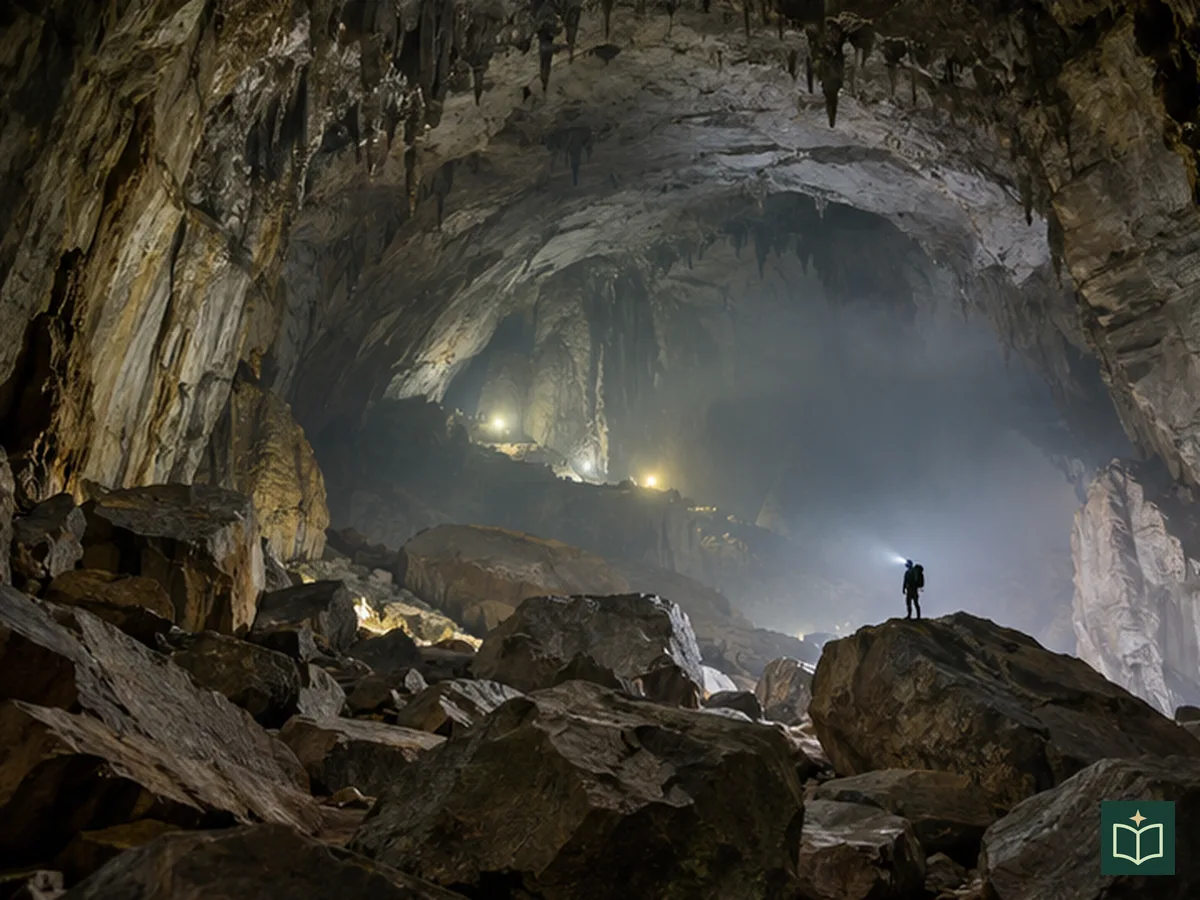
The Miao Room lies in Ziyun Getu He National Park in Guizhou, China. French cavers discovered it in 1989, and a British-led team measured it in 2013 with laser scanners that record millions of points on the walls. It is roughly 850 metres long, and an underground river runs through it. The Sarawak Chamber, found in 1980 inside Gunung Mulu National Park in Borneo, is about 700 metres long and on average about 300 metres wide. Cavers have described crossing its boulder-strewn floor by lamplight without being able to see the far wall. Mulu is a UNESCO World Heritage Site for its caves and karst.
Passages and Son Doong
Some of the biggest spaces underground are passages rather than rooms. Deer Cave, also in Mulu, has a main passage large enough to appear in chamber rankings, and millions of bats leave it at dusk. Vietnam’s Hang Sơn Đoòng is often called the world’s largest cave. Its main passage runs for several kilometres and in places exceeds 200 metres in height, with collapsed sections that let in sunlight and allow a forest to grow underground. Because it is a long corridor rather than one enclosed room, it does not appear in this table, even though its total volume is far larger than any chamber listed.
Arabia’s great chamber
The Arabian Peninsula has its own giant. Majlis al Jinn, on the Selma Plateau in Oman’s eastern Hajar Mountains, is a single chamber of about four million cubic metres with a floor area of around 60,000 square metres. Its only entrances are shafts in the roof, so visitors must descend more than a hundred metres on ropes. That places it just outside this top ten but among the largest chambers known anywhere, and the biggest known in Arabia. The cave formed in limestone laid down in ancient seas, the same rock that builds much of the Hajar range shared by Oman and the UAE.
Measuring in the dark
Older surveys relied on tape measures, compasses and estimates of ceiling height by eye or by balloon, which made large rooms hard to measure accurately. Several entries near the bottom of this table, in Papua New Guinea and Iran, are still rounded estimates from such surveys. Laser scanning has changed the picture since the 2010s, producing detailed three-dimensional models and revising some long-accepted figures. The rankings are likely to keep shifting, because large areas of tropical limestone, especially in southern China and New Guinea, remain little explored. The next record-breaking room may already be known to local people and simply never have been measured.
Sources & further reading
- Guinness World Records · Largest single cave chamber (surface area) ↗
- UNESCO World Heritage Centre · Gunung Mulu National Park ↗
Figures are rounded and widely published; check the linked organisations for the latest editions. These organisations do not endorse this website.