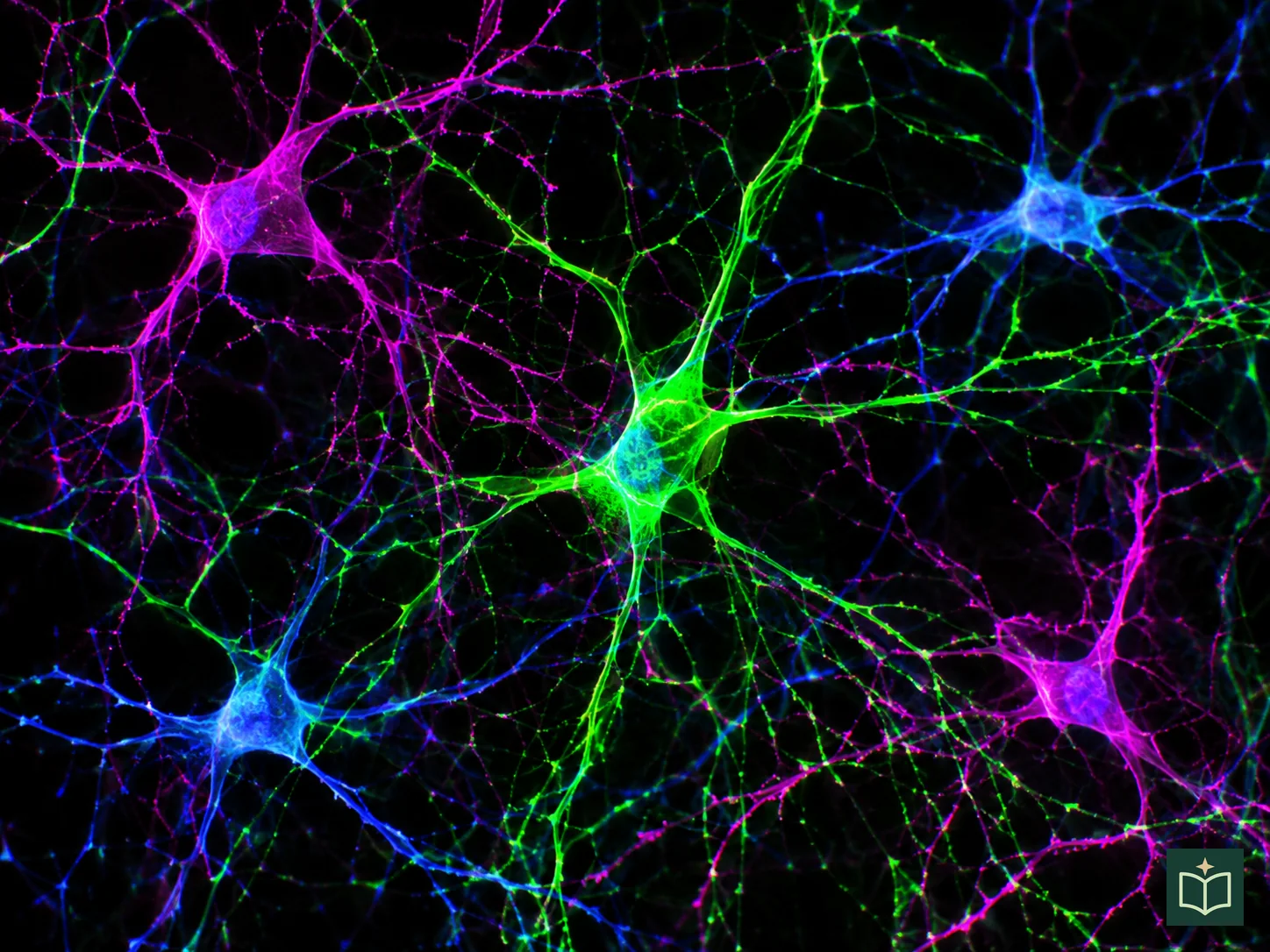
The parts of a neuron
A typical neuron has branching dendrites that receive signals, a cell body that integrates them, and a long axon that carries the outgoing message. Many axons are wrapped in myelin, a fatty insulation produced by supporting cells. The human brain contains roughly 86 billion neurons, along with a similar number of other cells that support and protect them.
How the pulse moves
At rest, a neuron keeps a small voltage across its membrane, about −70 millivolts inside. When incoming signals push this past a threshold, channels open and sodium ions rush in, briefly reversing the voltage. This action potential then triggers the next section of the membrane, sweeping along the axon. Myelin lets the signal jump between gaps, reaching speeds of over 100 metres per second in some nerves.
Crossing the synapse
Neurons do not usually touch. At the end of an axon, the electrical pulse triggers the release of neurotransmitters—such as glutamate, GABA, dopamine or serotonin—into a narrow gap. These molecules bind to receptors on the next cell, making it more or less likely to fire. Many medicines and drugs work by altering this chemical step.
Learning rewires the network
Connections between neurons strengthen or weaken with use, a property called synaptic plasticity. Repeating a skill or recalling a memory reinforces particular pathways. This is a major reason practice improves performance, and it also explains why the brain can partly reorganise after some injuries, with other regions taking on lost functions.
Sources & further reading
Figures are rounded and widely published; check the linked organisations for the latest editions. These organisations do not endorse this website.