Stellar nurseries
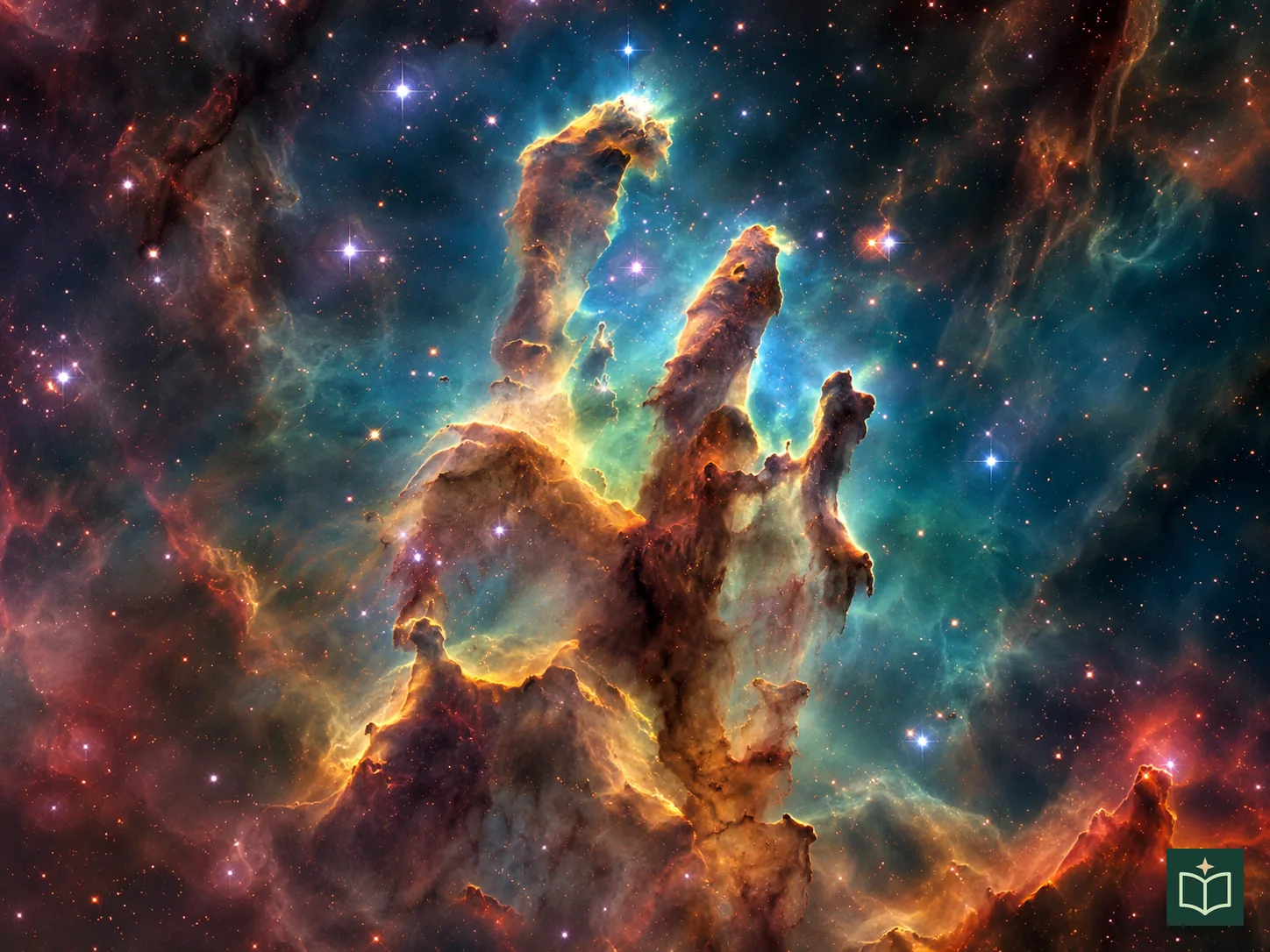
Stars form inside cold clouds of gas and dust called nebulae. When a dense region collapses under its own gravity, it heats up. Once the core reaches about 10 million degrees Celsius, hydrogen nuclei begin fusing into helium, releasing enormous energy. A new star is born, often surrounded by a disc of material that can form planets.
The main sequence
For most of its life, a star fuses hydrogen in its core, with the outward pressure of that energy balancing the inward pull of gravity. Astronomers call this stage the main sequence. The Sun, about 4.6 billion years old, is roughly halfway through. Massive stars burn far hotter and faster: a star tens of times the Sun’s mass may last only a few million years.
A gentle ending
When a Sun-like star runs low on core hydrogen, it swells into a red giant, fusing helium and puffing off its outer layers as a glowing planetary nebula. What remains is a white dwarf—an Earth-sized ember made largely of carbon and oxygen—that slowly cools over billions of years.
A spectacular ending
Stars more than about eight times the Sun’s mass fuse heavier elements up to iron. Iron fusion does not release energy, so the core collapses, triggering a supernova that can briefly outshine a galaxy. The remnant becomes a neutron star or, for the most massive, a black hole. Supernovae scatter heavy elements into space, seeding future stars and planets—including the atoms in us.
Sources & further reading
Figures are rounded and widely published; check the linked organisations for the latest editions. These organisations do not endorse this website.