Our stellar neighbourhood
A light-year is the distance light travels in a year, about 9.5 trillion kilometres. Within roughly ten light-years of the Sun, astronomers know of only about a dozen star systems, counting brown dwarfs. The table ranks them by distance, treating multiple stars that orbit one another as a single system. Most are red dwarfs, small, cool stars that shine faintly in visible light. They are the most common type of star in the Milky Way, making up around three-quarters of all stars, but not one of them is bright enough to see with the naked eye from Earth. Our neighbourhood, in other words, is dominated by stars that are easy to overlook.
Alpha Centauri
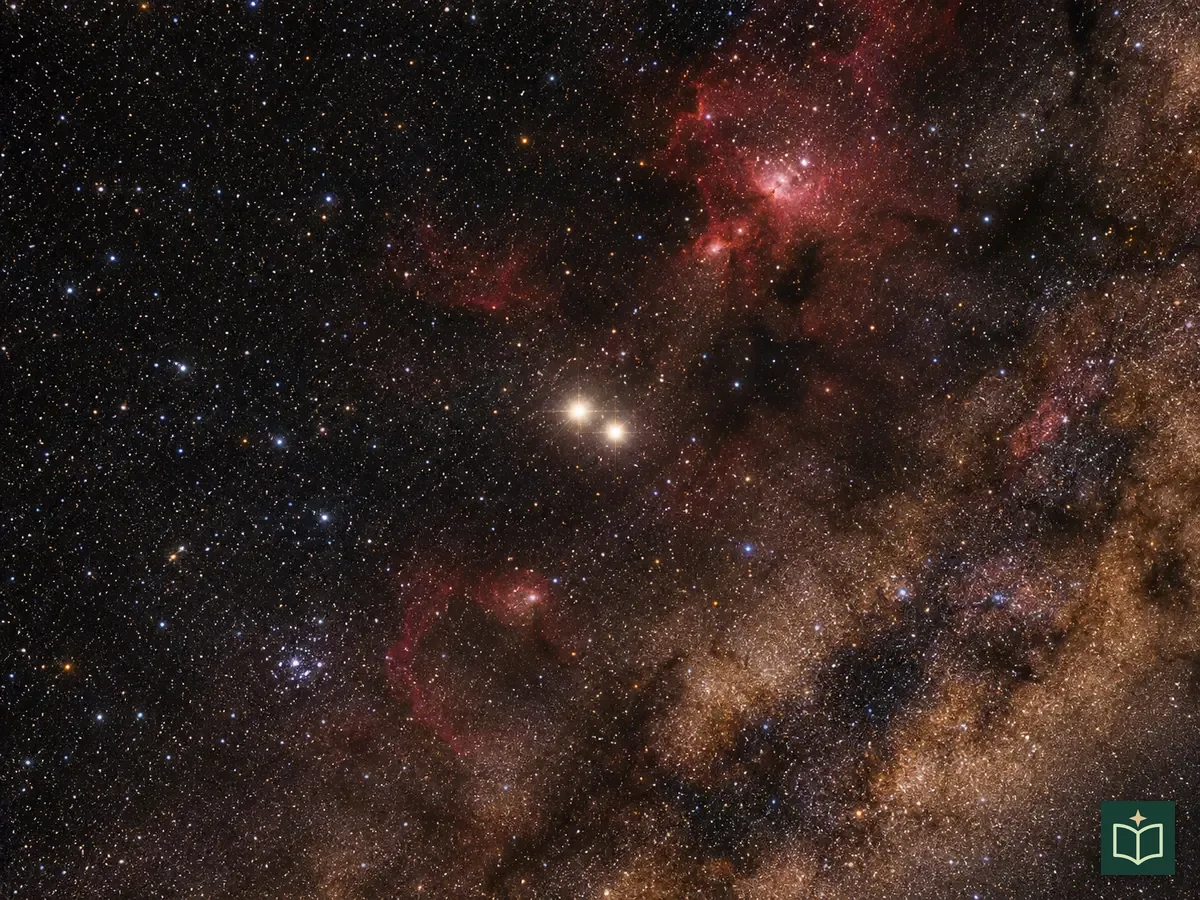
The nearest system is Alpha Centauri, made of three stars. Alpha Centauri A and B, two Sun-like stars orbiting each other, lie about 4.4 light-years away and together form one of the brightest points in the southern sky. The third member, Proxima Centauri, is a small red dwarf slightly closer at about 4.25 light-years, making it the nearest individual star to the Sun. In 2016 astronomers confirmed a planet, Proxima b, orbiting it in the zone where liquid water could exist on the surface, though frequent stellar flares may make conditions harsh. It is the closest known planet outside our solar system and a key target for future telescopes.
Red dwarfs
Barnard’s Star, second, is a red dwarf named after the American astronomer E. E. Barnard, who in 1916 measured that it moves across the sky faster than any other star. In 2024 and 2025 astronomers reported several small planets orbiting it. Wolf 359, Lalande 21185, Gliese 65, Ross 154 and Ross 248 are also red dwarfs. Many are flare stars that brighten suddenly as magnetic energy is released. Gliese 65 is a pair of dwarfs that includes UV Ceti, the prototype of this class of flaring star. Because red dwarfs burn their fuel slowly, they can shine for hundreds of billions or even trillions of years, far longer than the Sun.
Brown dwarfs
Two entries are not true stars. Luhman 16, a pair of brown dwarfs found in 2013, and WISE 0855−0714, a single brown dwarf found in 2014, were both discovered with data from NASA’s WISE infrared space telescope. Brown dwarfs are too small to sustain the hydrogen fusion that powers stars, so they glow mainly from leftover heat and slowly cool over time. WISE 0855−0714 is one of the coldest such objects known, with temperatures comparable to those of a freezer on Earth. Their late discovery shows that the census of our neighbourhood is still incomplete: faint, cold objects can remain hidden even at small distances.
How distances are measured
Distances to nearby stars are measured using parallax. As Earth moves around the Sun, a nearby star appears to shift slightly against much more distant background stars. Measuring that tiny angle six months apart allows astronomers to calculate the distance with simple geometry. The shifts are minute; even for Proxima Centauri the angle is less than one arcsecond, far smaller than the width of a human hair seen from across a room. Space telescopes such as the European Space Agency’s Hipparcos and Gaia, which has charted more than a billion stars, have made these measurements extremely precise. Sirius, seventh here, is the only one of these neighbours that is easy to spot.
How far is near?
Close in astronomical terms is still almost unimaginably far. Voyager 1, the most distant spacecraft, travels at about 17 kilometres a second; at that speed it would take roughly 75,000 years to cover the distance to Proxima Centauri. Proposals to send tiny laser-propelled probes to Alpha Centauri remain theoretical. For now, nearby stars are studied with telescopes, and their planets are prime targets in the search for atmospheres that might reveal signs of life. The list may still change. New brown dwarfs could be discovered nearby, and over tens of thousands of years the relative motions of stars will reshuffle the ranking entirely.
Sources & further reading
Figures are rounded and widely published; check the linked organisations for the latest editions. These organisations do not endorse this website.